
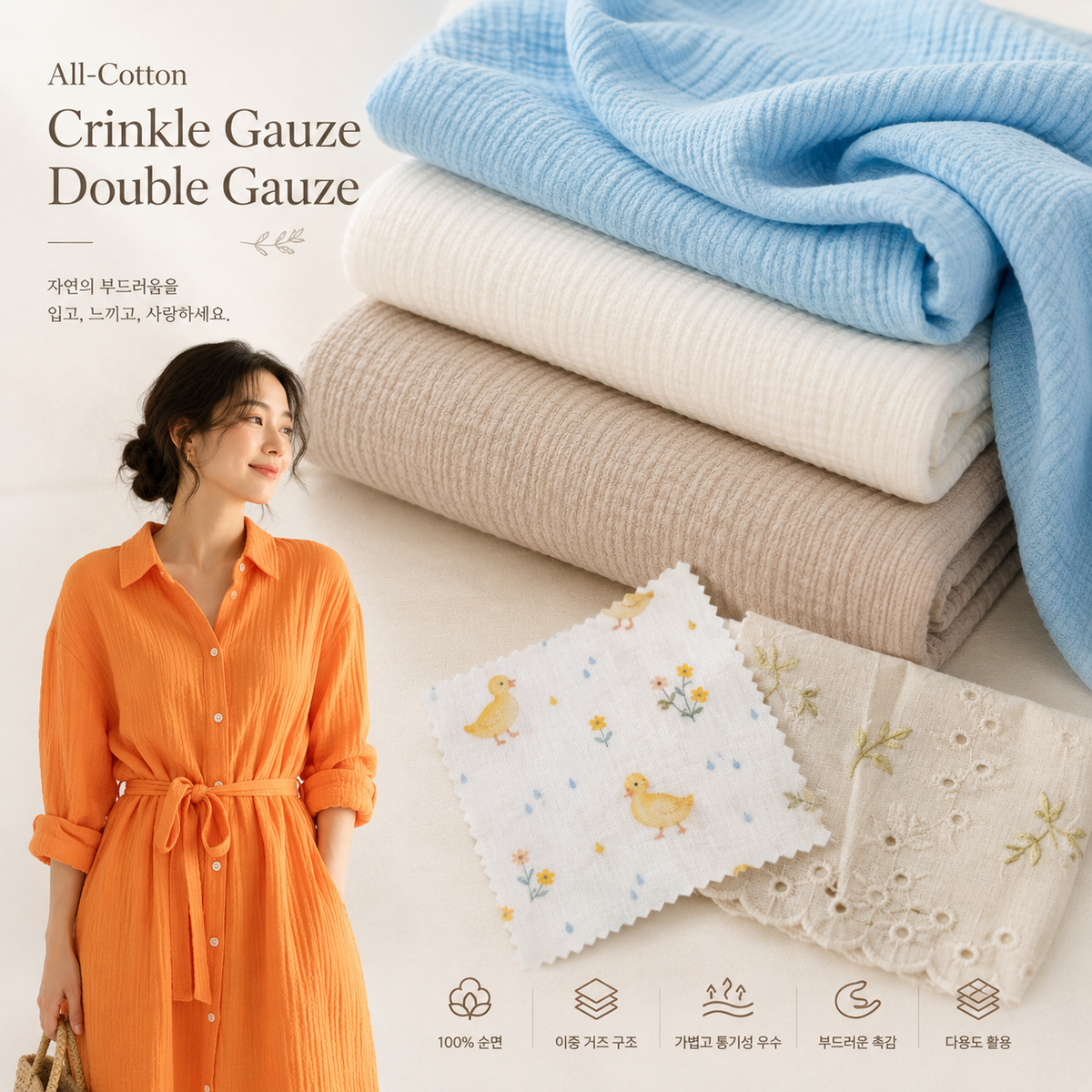
Direct Answer
Choose a supplier that can prove its double gauze experience, explain where each production stage occurs, provide finished and washed samples, define measurable tolerances, arrange relevant testing and inspect multiple bulk rolls. Also verify MOQ, lead time, price scope, batch traceability, repeat-order controls and written responsibility for quality problems.
Top Answers Pack
1. What should buyers define before contacting suppliers?
Define the intended garment, fiber composition, finished GSM, usable width, color or print, softness, crinkle, shrinkage, colorfastness, testing, quantity and delivery date. A supplier cannot provide a comparable quotation when the product requirement remains vague.
2. Must the supplier own every production process?
Not necessarily. A capable supplier may coordinate weaving, dyeing, printing, finishing and embroidery through specialized facilities. The key is transparency, technical control, traceability and accountability—not simply claiming that every process is completed under one roof.
3. How can buyers verify double gauze experience?
Ask for relevant quality cards, finished and washed samples, similar bulk-production records, test reports and explanations of common risks such as shrinkage, layer separation, uneven crinkle, opacity and seam slippage. Product-specific answers are more useful than general factory claims.
4. What sample should be approved?
Approve a sample made from the exact intended base fabric after dyeing or printing, washing and finishing. It should represent composition, GSM, usable width, color, hand feel, natural crinkle, opacity and shrinkage—not merely an unfinished greige cutting.
5. Which quality-control records matter most?
Useful records include yarn and greige lot identification, lab-dip or strike-off approval, finished GSM and width, shrinkage results, colorfastness data, first-bulk comparison, multi-roll inspection and packing lists that identify color and production batches.
6. What tests may be needed for babywear?
Depending on the market and product, buyers may require fiber composition, pH, formaldehyde, restricted substances, washing, rubbing, perspiration or saliva colorfastness, seam performance and flammability-related checks. Requirements should be confirmed before production.
7. How should buyers compare prices?
Compare quotations based on the same composition, finished GSM, usable width, finishing, shrinkage tolerance, testing, packing and Incoterm. The lowest price per meter may produce a higher garment cost if width is narrower, shrinkage is greater or defects are less controlled.
8. How can buyers check production reliability?
Request a stage-by-stage production plan, realistic lead time, approval deadlines, inspection points and progress records. For important orders, use a video assessment, factory audit or third-party inspection and verify that the address and production scope match the supplier’s explanation.
9. What shows that a supplier can manage repeat orders?
The supplier should retain the base-fabric code, approved sample, color reference, artwork, weaving and finishing parameters, GSM, width, shrinkage, testing and packing records. It should disclose when original yarn or greige lots are no longer available.
10. What are common warning signs?
Warning signs include refusing to identify the production location, quoting without complete specifications, avoiding washed samples, promising zero shrinkage, providing unrelated certificates, giving unrealistic lead times or refusing to define tolerances, inspection standards and responsibility for failed goods.
Supplier Evaluation Scorecard
| Evaluation area | Evidence to request | Warning sign |
|---|---|---|
| Company identity | Registration details, address and bank beneficiary | Names or addresses do not match |
| Double gauze experience | Relevant samples, quality cards and bulk records | Only general cotton knowledge |
| Production transparency | Process map and production locations | Unclear answers about subcontracting |
| Technical specification | Written composition, GSM, width and tolerance | Quotation contains only a product name |
| Sampling | Finished and washed sample | Only a small unfinished swatch |
| Testing | Method, results and relevant reports | Generic certificates unrelated to the order |
| Quality control | First-bulk and multi-roll inspection records | Inspection based on one cutting |
| Delivery control | Stage plan and realistic approval dates | Lead time promised without checking greige |
| Traceability | Lot, batch and roll identification | Different batches mixed without labels |
| After-sales | Written claim and corrective-action process | No responsibility after shipment |
1. Define the Product Before Evaluating the Supplier
Supplier selection should begin with a clear product requirement. Otherwise, buyers may receive several prices for technically different fabrics and mistakenly treat them as comparable.
The inquiry should specify:
-
Target garment or end use
-
Exact fiber composition
-
Genuine two-layer construction
-
Finished GSM and tolerance
-
Finished full width and usable width
-
Solid color, print or embroidery requirement
-
Desired softness and crinkle appearance
-
Opacity and breathability expectations
-
Lengthwise and widthwise shrinkage limits
-
Colorfastness and chemical requirements
-
Quantity per color or design
-
Required delivery date
-
Roll length and packaging
-
Destination and preferred Incoterm
For many cotton double gauze programs, Shaoxing Yilin Textile commonly develops approximately 125–145 GSM and 135–140 cm finished width. These ranges are references; the final specification should match the intended product.
2. Verify the Legal Company and Payment Identity
Before paying a deposit, buyers should confirm that the supplier’s legal identity, quotation, contract, invoice and bank beneficiary are consistent.
Useful checks include:
-
Registered company name
-
Business address
-
Main contact information
-
Bank-account beneficiary
-
Export documentation capability
-
Website and company-domain email where available
-
Factory or office location
-
Contract-signing entity
A sudden change in bank details should be independently verified through a previously confirmed communication channel.
Legal registration alone does not prove product quality, but inconsistent identities increase commercial and payment risk.
3. Understand Whether the Supplier Is a Factory, Converter or Trading Company
In textile supply chains, weaving, dyeing, printing, finishing and embroidery may be handled by different specialized facilities. A supplier can still be reliable without owning every machine.
Buyers should ask:
-
Which processes are completed internally?
-
Which processes use partner factories?
-
Who purchases the yarn and greige fabric?
-
Who approves dyeing or printing recipes?
-
Who performs final inspection?
-
Who is responsible if subcontracted processing fails?
-
Can production and batch records be traced?
The important distinction is not simply “factory versus trader.” It is whether the supplier understands the product, controls the process and accepts responsibility for the final shipment.
4. Check Product-Specific Double Gauze Experience
A supplier experienced in standard cotton poplin may not automatically understand double gauze. The two-layer, relatively open structure creates specific risks:
-
Layer separation
-
Broken or missing binding yarns
-
Uneven crinkle
-
Excessive shrinkage
-
Width loss after washing
-
Shade differences caused by surface texture
-
Print white marks around raised yarns
-
Fraying and seam slippage
-
Distortion during cutting
-
Packing pressure flattening the texture
Ask the supplier to explain how these risks are controlled. Detailed answers that connect construction, finishing and testing are stronger evidence than broad statements such as “stable quality.”
5. Review a Complete Product Specification Sheet
A reliable supplier should be able to provide a written specification that includes:
-
Quality code
-
Fiber composition
-
Yarn or construction details when relevant
-
Finished GSM
-
GSM tolerance
-
Full and usable width
-
Width tolerance
-
Color or print method
-
Finishing route
-
Shrinkage test conditions and results
-
Colorfastness requirements
-
Roll length and packing
-
Intended application
The sheet should state whether GSM and width refer to greige or fully finished fabric. Buyers should avoid approving orders based only on a commercial name such as “double muslin” or “soft double gauze.”
6. Request Both Unwashed and Washed Samples
Double gauze often becomes softer, fuller and more crinkled after washing. It may also lose length and width. An unwashed cutting does not show the complete performance.
The buyer should review:
-
Surface softness before and after washing
-
Natural crinkle development
-
Lengthwise and widthwise shrinkage
-
Finished GSM and width
-
Color change
-
Opacity
-
Layer stability
-
Pilling or surface damage when relevant
-
Hand feel after repeated laundering when required
The washing and drying method should match the intended care label. The final approved sample should be sealed and labeled for bulk comparison.
7. Approve Lab Dips and Printed Strike-Offs Correctly
For solid-dyed fabric, the supplier should develop lab dips on the selected double gauze base. Color should be evaluated under agreed lighting, with a written reference and acceptable tolerance.
For prints, the strike-off should use the actual intended base because the crinkled texture affects:
-
Pattern clarity
-
Fine-line visibility
-
Color penetration
-
White marks around raised yarns
-
Apparent repeat size
-
Hand feel after printing
-
Appearance after washing
A print sampled on smooth poplin cannot accurately define the final appearance on double gauze.
8. Evaluate Softness Without Relying on Marketing Words
Terms such as “super soft” or “baby soft” are subjective. The buyer and supplier need a physical reference.
The approved sample should define:
-
Surface touch
-
Fluffiness and compression
-
Flexibility
-
Drape
-
Dry or smooth hand
-
Fine natural crinkle
-
Absence of oily or heavily coated feel
Excessive softener may create temporary slipperiness, reduce absorbency, affect breathability or hide an unsuitable base fabric. A reliable supplier should explain the role of yarn, weaving, washing and finishing in the final hand feel.
9. Verify Shrinkage Control
Suppliers should test both lengthwise and widthwise shrinkage under an agreed laundering method.
The report should state:
-
Original marked dimensions
-
Washing temperature and cycle
-
Detergent when relevant
-
Drying method
-
Number of washes
-
Conditioning and resting time
-
Lengthwise result
-
Widthwise result
The buyer should receive the data before pattern grading and bulk cutting. Be cautious of claims such as “no shrinkage” without a method and test result.
10. Check Colorfastness and Babywear-Related Requirements
Testing should be selected according to the destination market and end product. Possible checks include:
-
Fiber composition
-
pH
-
Formaldehyde
-
Restricted substances
-
Colorfastness to washing
-
Dry and wet rubbing fastness
-
Perspiration fastness
-
Saliva fastness when required
-
Seam strength and slippage
-
Tearing strength
-
Flammability-related requirements
Certification logos do not replace a test report covering the relevant fabric, color, print or production lot. Buyers should verify the report scope, date, laboratory and tested item.
11. Review the Supplier’s Quality-Control Process
Quality control should cover the whole production chain rather than only final packing.
A useful control plan includes:
-
Yarn and greige specification confirmation.
-
Greige inspection before dyeing or printing.
-
Lab-dip or strike-off approval.
-
First-bulk comparison with the approved sample.
-
Washing and shrinkage testing.
-
Finished GSM and usable-width checks.
-
Shade and texture inspection across the width.
-
Inspection of multiple rolls and production stages.
-
Separation of different dye or print batches.
-
Roll-length and packing verification.
Ask who performs each check, how results are recorded and what happens when a lot fails.
12. Check Bulk Inspection Coverage
One small cutting does not represent a full order. Inspection should include different positions and rolls.
Recommended coverage includes:
-
Beginning, middle and end of the finishing batch
-
Left, center and right across the width
-
Multiple dye or print lots
-
Different rolls
-
Production restarts and joins
Inspect for:
-
GSM and width variation
-
Shade differences
-
Uneven softness
-
Flat or excessively coarse crinkle
-
Broken binding yarns
-
Layer separation
-
Holes and oil marks
-
Skewing and bowing
-
Print defects
-
Roll-length shortages
Off-shade or different-texture rolls should be labeled and separated rather than mixed without explanation.
13. Confirm MOQ and Quantity Tolerance
MOQ depends on greige availability, composition, color, printing method, finishing, testing and packaging.
Buyers should confirm:
-
MOQ per color
-
MOQ per print design
-
MOQ per colorway
-
Total-order minimum
-
Minimum for a custom construction
-
Allowed over-delivery and under-delivery
-
Minimum roll length
-
Short-roll allowance
A low MOQ may be practical when the base fabric is available, but it does not automatically guarantee the same cost or production efficiency as a standard bulk order.
14. Evaluate Sampling and Bulk Lead Time
A reliable lead time should be divided into stages rather than presented as one optimistic number.
Ask for timing for:
-
Base-fabric confirmation
-
Lab dip or strike-off
-
Buyer approval
-
Greige preparation
-
Dyeing or printing
-
Washing and finishing
-
Testing
-
Final inspection
-
Packing
-
Shipment booking
The supplier should clearly state when the lead-time clock begins: after deposit, greige availability, lab-dip approval or strike-off approval.
Very short promises are not useful if they exclude approvals, testing or correction time.
15. Compare Prices on the Same Basis
A reliable sourcing decision should not be based on the lowest quoted price per meter.
Compare:
-
Exact composition
-
Finished GSM
-
Finished usable width
-
Shrinkage
-
Dyeing, printing and finishing
-
Quality tolerances
-
Testing included
-
Roll length and packing
-
Quantity basis
-
Payment terms
-
Incoterm and named port or place
-
Quotation validity
A slightly higher price may create a lower garment cost when usable width is better, shrinkage is controlled, defects are lower and lining is unnecessary.
16. Verify Customization Capability
If the order requires solid colors, prints or embroidery, ask for process-specific evidence.
Solid Colors
Check lab-dip control, shade-banding method, colorfastness and repeat-color records.
Digital or Rotary Printing
Check artwork handling, repeat size, color separation, strike-off procedure, registration, penetration, hand feel and wash performance.
Embroidery
Check stitch density, thread, needle, backing, usable-width loss, puckering, yarn damage and washed appearance.
The supplier should approve the complete customized fabric, not only the undecorated base.
17. Assess Communication and Change Control
Good communication means more than fast replies. The supplier should confirm technical information accurately and document changes.
Check whether the team can:
-
Restate the specification correctly
-
Identify missing information
-
Explain technical tradeoffs
-
Record approvals
-
Warn about production risks
-
Notify the buyer before substitutions
-
Provide progress updates tied to production stages
-
Keep artwork and customer information confidential when required
Unapproved changes in yarn, greige, color, finishing or packing are a serious risk even when communication appears friendly.
18. Inspect Packaging and Export Preparation
Double gauze should be protected from moisture, dirt and excessive compression.
Confirm:
-
Roll length
-
Paper-tube specification
-
Rolling tension
-
Face-in or face-out rolling
-
Inner plastic protection
-
Outer woven bag or carton
-
Color and batch labels
-
Roll numbers
-
Meters or yards
-
Customized shipping marks
-
Packing-list details
Packing pressure can temporarily flatten the crinkle. The supplier should balance loading efficiency with the fabric’s appearance and softness.
19. Review Payment, Inspection and Claims Terms
Before paying a deposit, put the following in writing:
-
Currency and unit-price basis
-
Deposit and balance timing
-
Sample, testing and inspection costs
-
Quantity tolerance
-
Quality tolerances
-
Inspection standard
-
Third-party inspection rights
-
Procedure for failed goods
-
Claim period and required evidence
-
Reprocessing, replacement or compensation process
-
Incoterm and named destination
A reliable supplier should be willing to define how quality disagreements will be evaluated instead of promising that problems will never occur.
20. Check Repeat-Order Capability
Repeat-order stability matters to wholesalers, garment factories and brands that need replenishment.
The supplier should retain:
-
Base-fabric quality code
-
Yarn and greige specification
-
Approved finished and washed sample
-
Lab dip or strike-off
-
Artwork and color references
-
Weaving and finishing parameters
-
Finished GSM and width
-
Shrinkage and colorfastness results
-
Inspection and packing records
If the original yarn, greige or dye lot is unavailable, the supplier should disclose the change and submit a new approval sample.
Factory Audit and Third-Party Inspection
For strategic or high-value orders, buyers may use:
-
Live video production review
-
On-site factory or supplier visit
-
Document review
-
Social or quality-system audit
-
Pre-production meeting
-
During-production inspection
-
Pre-shipment inspection
-
Container-loading supervision
The audit scope should match the risk. A factory audit can confirm capability and systems, while an order-specific inspection checks the actual shipment. One does not replace the other.
Common Red Flags
Be cautious when a supplier:
-
Quotes without asking about composition, GSM or width.
-
Refuses to provide a washed sample.
-
Claims every double gauze quality has zero shrinkage.
-
Provides only unrelated certificates.
-
Cannot explain where dyeing, printing or finishing occurs.
-
Changes the payment beneficiary without clear verification.
-
Promises an unrealistic lead time before checking greige.
-
Avoids written tolerances.
-
Uses a sample from a different base fabric.
-
Refuses third-party inspection without a practical reason.
-
Cannot separate dye or print batches.
-
Has no written process for claims or corrective action.
One warning sign may have an explanation, but several together indicate higher sourcing risk.
Recommended Supplier-Approval Process
-
Define the product and test requirements.
-
Shortlist suppliers with relevant double gauze experience.
-
Verify legal identity and production scope.
-
Compare specification-based quotations.
-
Review base-fabric samples.
-
Approve a lab dip or strike-off.
-
Test the finished and washed sample.
-
Complete a sewing or garment trial.
-
Confirm MOQ, lead time and commercial terms.
-
Place a controlled trial order when appropriate.
-
Inspect first bulk and multiple rolls.
-
Review performance before scaling repeat orders.
Questions Buyers Should Ask
-
What double gauze constructions do you produce regularly?
-
Which processes are completed internally or by partner facilities?
-
What are the finished GSM and usable width?
-
How are the two layers connected and inspected?
-
Can you provide an unwashed and washed sample?
-
What are the lengthwise and widthwise shrinkage results?
-
How do you control crinkle and softness consistency?
-
What colorfastness and babywear-related tests can be arranged?
-
Will the strike-off use the actual double gauze base?
-
How are first bulk and multiple rolls inspected?
-
How are different production batches identified?
-
What is the MOQ per color or design?
-
What does the quoted lead time include?
-
Which charges are excluded from the price?
-
What records are retained for repeat orders?
-
How are nonconforming goods investigated and resolved?
Frequently Asked Questions
Is a manufacturer always better than a trading company?
No. A manufacturer may control weaving directly, while a capable supplier or converter may coordinate several specialized processes effectively. The better choice is the company that provides transparent production, technical control, traceability and clear responsibility.
Are certificates enough to prove a supplier is reliable?
No. Certificates may support a supplier assessment, but buyers should verify their scope and validity. Product samples, order-specific tests, process records and bulk inspection remain necessary.
Should buyers begin with a sample order?
When practical, a development or controlled trial order helps evaluate communication, sampling, quality, delivery and documentation before scaling. The trial should use the intended production route.
Can supplier samples be trusted without testing?
Samples are useful references but do not prove bulk consistency. Buyers should wash, measure and test the relevant sample and then require first-bulk and multi-roll comparison.
How can buyers protect custom artwork?
Use written confidentiality terms, identify artwork ownership, restrict unauthorized use and confirm how digital files, screens and samples will be stored or disposed of.
What is the most important bulk inspection point?
No single point is enough. Compare different rolls and positions against the approved finished and washed sample for shade, texture, GSM, width, shrinkage and structural defects.
How should a supplier handle a failed test?
The supplier should identify affected lots, investigate the cause, propose a controlled corrective action, retest the material and obtain buyer approval before shipment or further processing.
What makes a supplier suitable for long-term replenishment?
Reliable repeat orders require retained samples, stable quality codes, lot traceability, disclosed material changes, recorded process parameters, consistent packing and proactive resampling when the original inputs change.
Conclusion
Choosing a reliable Double Gauze Fabric Manufacturer & Supplier in China requires evidence, not only a low price or attractive sample. Buyers should verify the company identity, production chain, double gauze experience, technical specifications, washed-sample performance, testing, bulk inspection, delivery planning, packaging and after-sales responsibility.
The safest approach is to convert subjective expectations—such as softness, natural crinkle and stable quality—into approved physical samples, measurable tolerances and written procedures. A controlled trial order and multi-roll inspection can further reduce risk before larger or repeat purchases.
Shaoxing Yilin Textile supports solid-dyed and printed cotton double gauze development for babywear, children’s clothing, summer garments, sleepwear and loungewear. Buyers can provide the target garment, composition, GSM, color or artwork, testing requirements and order quantity to develop an appropriate sampling and bulk-production plan.



Leave a comment
This site is protected by hCaptcha and the hCaptcha Privacy Policy and Terms of Service apply.