
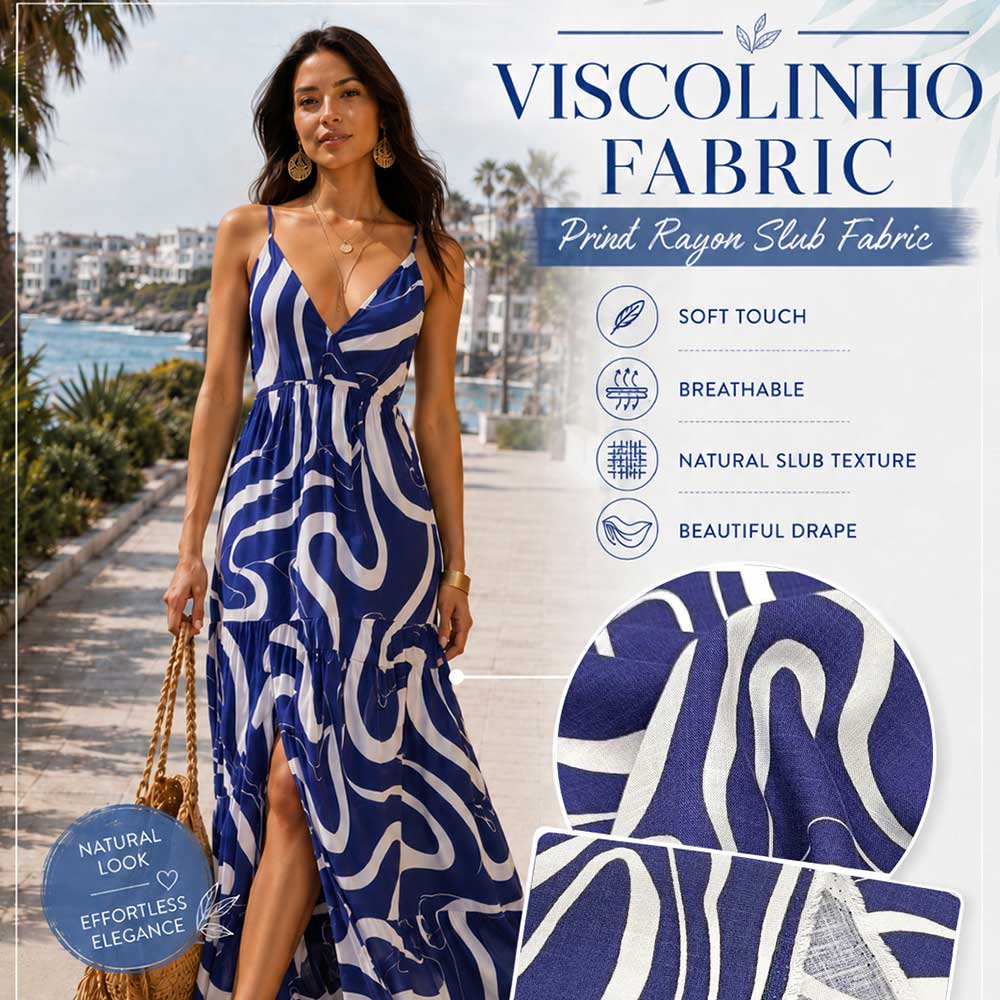
Why Is Working with a Viscose Slub Fabric Manufacturer & Supplier in China Suitable for Summer Fashion Collections?
Direct Answer
Working with a Viscose Slub Fabric Manufacturer & Supplier in China is suitable for summer collections because the fabric combines soft drape, moisture absorption, lightweight comfort and a fine natural slub texture. China suppliers can usually support both dyed and printed programs, custom colors, digital-print trials, rotary-print bulk production, multiple weight options and export packing. When specifications and tolerances are agreed, buyers can develop coordinated summer styles while controlling MOQ, sampling time, shrinkage, colorfastness, usable width and bulk consistency.
Top Answers Pack
1. Why is viscose slub suitable for summer clothing?
Viscose slub normally feels soft, fluid and comfortable against the skin. Its fine woven construction can support airflow, while the slub yarn creates visual texture without the heavy appearance of coarse linen. The final comfort still depends on GSM, weave density, garment fit and finishing.
2. What summer garments can be made from viscose slub?
Common applications include maxi dresses, wrap dresses, blouses, skirts, loose trousers, shorts, shirt sets, resortwear, beach cover-ups and lightweight jumpsuits. The preferred GSM and opacity should be matched to the garment.
3. Can China suppliers provide solid colors and prints?
Yes. A capable supplier may support solid dyeing, rotary printing and digital printing. Buyers can develop coordinated solid colors and printed designs on the same or related viscose slub bases.
4. What is a common viscose slub specification?
One common women’s apparel range is approximately 120–150 gsm and 145–150 cm finished width. A 30S slub quality at approximately 130–140 gsm and around 150 cm is one practical reference for dresses, blouses and relaxed trousers.
5. Is viscose slub breathable?
Lightweight woven viscose slub can feel breathable because the construction allows air movement and the viscose fiber absorbs moisture. However, breathability should not be judged by fiber name alone. Finished GSM, weave density and chemical finishing also affect comfort.
6. Can buyers start with a low print quantity?
Digital-print programs may begin from approximately 300 meters per design, subject to greige availability and artwork conditions. This can help buyers test summer patterns before committing to larger rotary-print quantities.
7. How long does custom development take?
A typical solid-color lab dip may require approximately 3–5 days, while a printed strike-off may require approximately 5–7 days. Bulk production can take approximately 10–15 days for some confirmed programs or 20–25 days for more customized orders.
8. How is summer fabric shrinkage controlled?
The supplier controls yarn, greige construction, pretreatment, washing, drying tension and finishing, then tests lengthwise and widthwise dimensional change. Better-controlled apparel programs may target shrinkage within approximately 5% under the agreed care method.
9. How should buyers evaluate a China supplier?
Buyers should review the exact base fabric, washed sample, development speed, production chain, testing, roll inspection, repeat-order records, packing options and claims process—not only the price per meter.
10. What is the main commercial advantage for summer collections?
The main advantage is the ability to develop one summer fabric category across several colors, prints, garments and order sizes. This can reduce development fragmentation and create a more coordinated seasonal collection.
Why Viscose Slub Works for Summer Fashion
Summer clothing must balance comfort, movement, coverage, appearance and cost. A fabric can feel light in the hand but become transparent, unstable or difficult to sew. Another fabric may provide good coverage but feel too stiff or warm.
Viscose slub is often selected because it offers a useful middle position:
- Softer than many structured cotton fabrics
- More textured than smooth plain viscose
- More fluid than many linen blends
- Suitable for both solid dyeing and printing
- Available in lightweight and medium-weight options
- Compatible with relaxed summer silhouettes
- Visually interesting without a heavy surface
The result depends on construction and finishing. Buyers should approve the actual finished and washed sample rather than relying only on the name “viscose slub.”
1. Soft Drape Supports Summer Silhouettes
Many summer garments depend on movement. Maxi dresses, wrap skirts, loose blouses and wide-leg trousers need fabric that falls naturally rather than standing away from the body.
Viscose slub can create:
- Soft rounded folds
- Flowing skirt movement
- Natural gathering
- Relaxed sleeves
- Comfortable loose trousers
- Lightweight layered effects
This makes it suitable for South American resortwear, European summer dresses, Southeast Asian warm-weather clothing and other markets where soft movement is important.
The buyer should test a larger cutting or garment sample. A small folded swatch cannot show how the fabric moves across a full dress panel.
2. Fine Slub Texture Adds Value to Solid Colors
Plain smooth fabric can look flat when used in a simple solid-colored dress. Viscose slub creates subtle yarn variation that adds visual depth without requiring an additional print or surface treatment.
A suitable slub effect normally appears:
- Fine rather than coarse
- Elongated rather than knotted
- Naturally irregular
- Distributed across the fabric
- Matte or softly lustrous
- Integrated into the woven structure
The surface should not automatically resemble rough linen, burlap, heavy stripes or embossed texture. For lightweight women’s fashion, a fine slub is generally easier to use across multiple garments.
3. Moisture Absorption Supports Warm-Weather Comfort
Viscose absorbs moisture, which can make the fabric feel comfortable in warm conditions. This is useful for dresses, blouses and relaxed sets worn close to the skin.
However, buyers should understand the difference between absorbency and rapid drying. Viscose may retain moisture longer than certain synthetic performance fabrics. The correct choice depends on:
- Climate
- Garment looseness
- Fabric GSM
- Weave density
- Number of garment layers
- Expected washing and drying method
The supplier should avoid describing viscose slub as technical quick-dry fabric unless specific testing supports that claim.
4. Multiple GSM Options Support Different Garments
One fabric name can cover different weights and constructions. Buyers can select a lighter quality for blouses or cover-ups and a fuller quality for dresses or trousers.
| Approximate finished GSM | Possible summer applications | Main point to check |
|---|---|---|
| 100–120 gsm | Blouses, cover-ups and lightweight layers | Transparency and seam stability |
| 120–140 gsm | Dresses, skirts, shirts and sets | Balance of drape and coverage |
| 140–160 gsm | Fuller dresses and relaxed trousers | Heat, drying time and garment weight |
These are sourcing references rather than fixed standards. Yarn, density, width and finishing can make two fabrics with the same GSM behave differently.
Yilin Textile commonly supplies viscose slub in approximately 120–150 gsm and 145–150 cm finished width. A 30S slub quality at approximately 130–140 gsm and around 150 cm is one common apparel option.
5. Dyed and Printed Options Can Build One Coordinated Collection
A summer collection often needs more than individual fabrics. Buyers may need printed dresses, solid trousers, matching blouses and coordinated accent colors.
Working with one capable viscose supplier can support:
- Solid lab dips
- Custom color matching
- Digital-print trials
- Rotary-print bulk production
- Coordinated print colorways
- Related smooth and slub bases
- Matching solid and printed groups
For example, a tropical floral can be printed on viscose slub for a flowing dress, while one color from the print is developed as a solid blouse or skirt. This creates a more complete wholesale story without requiring unrelated suppliers for every style.
6. Viscose Slub Supports Popular Summer Print Directions
The fabric works with many women’s fashion print categories:
- Tropical flowers
- Large botanical patterns
- Small florals
- Leaves
- Polka dots
- Geometric patterns
- Stripes
- Abstract painterly designs
- Ethnic-inspired motifs
- Vacation and resort prints
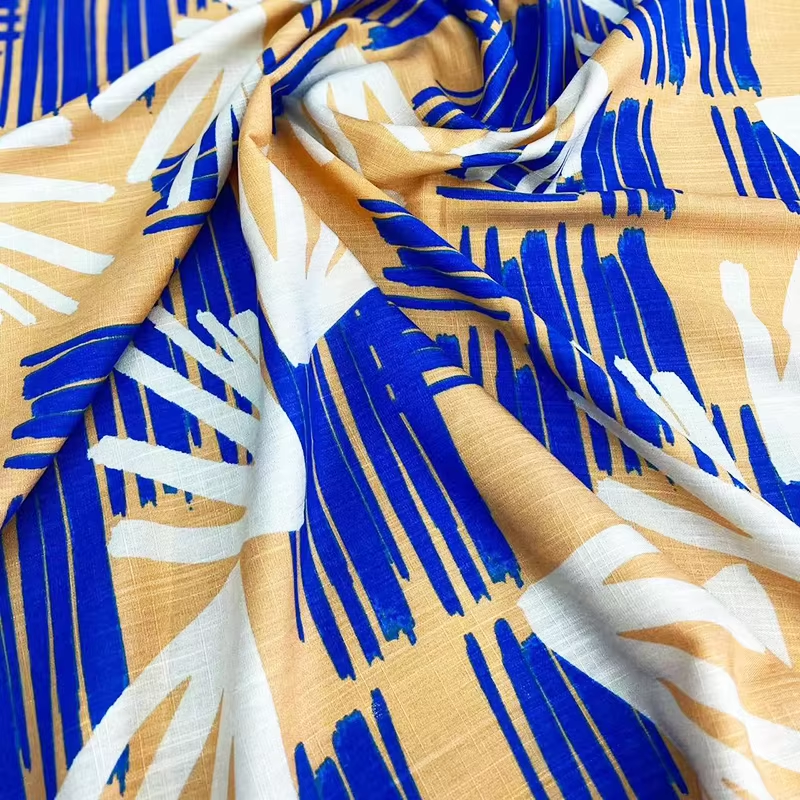
Its subtle yarn texture can make solid areas feel less flat. However, raised slub yarns may affect very fine pattern edges, so a strike-off must be made on the intended bulk base.
The buyer should inspect:
- Pattern registration
- Color accuracy
- Print penetration
- White marks around raised slubs
- Pattern repeat
- Color coverage
- Surface hand feel
- Appearance after washing
7. Digital Printing Helps Test New Summer Designs
Summer collections may require many new patterns, but not every design should begin with a large bulk order.
Digital printing can help buyers:
- Test several patterns
- Develop more color combinations
- Reduce initial quantity per design
- Respond to shorter fashion cycles
- Evaluate new regional preferences
- Create samples for buyer meetings
A digital-print MOQ may begin from approximately 300 meters per design, depending on base-fabric availability and production conditions.
Lower MOQ does not remove the need for quality approval. Buyers should still confirm artwork scale, color, penetration, hand feel, shrinkage and colorfastness before production.
8. Rotary Printing Supports Larger Commercial Programs
When a design has passed market testing, rotary printing may be more suitable for larger repeat quantities.
One Yilin Textile rotary-print program uses:
- Approximately 6,000 meters per design
- One design in three colorways
- Approximately 2,000 meters per colorway
- Strike-off development in approximately 5–7 days
- Custom bulk production in approximately 20–25 days after approvals
These figures are program references rather than universal rules. Actual MOQ and lead time depend on greige availability, artwork, color count, screen or cylinder requirements, finishing and factory schedule.
9. Custom Color Matching Helps Build Seasonal Color Groups
Summer collections often need coordinated colors rather than isolated fabric shades.
A supplier can develop colors based on:
- Pantone references
- Buyer swatches
- Printed artwork
- Existing garment colors
- Seasonal color cards
- Market-specific color groups
For solid-dyed fabric, the lab dip should be confirmed before bulk production. A typical development may require approximately 3–5 days.
Color approval should define:
- Light source
- Color standard
- Acceptable tolerance
- Finished condition
- Whether the comparison is made before or after washing
Different screens and cameras display color differently, so digital photographs should support—not replace—physical lab-dip approval.
10. China’s Production Network Supports Several Processes
A capable China supplier may coordinate weaving, pretreatment, dyeing, printing, finishing, testing, inspection and packing within one managed production network.
For buyers, this can reduce the need to coordinate separate suppliers for:
- Greige fabric
- Solid dyeing
- Digital printing
- Rotary printing
- Soft finishing
- Shrinkage control
- Fabric inspection
- Export packing
The supplier does not need to perform every process in one building to provide reliable control. What matters is clear responsibility, stable production partners, documented standards and final inspection.
Buyers should ask who controls each process and who accepts responsibility when bulk fabric does not match the approved sample.
11. Wider Fabric Can Improve Garment-Cutting Yield
Viscose slub is commonly available around 145–150 cm finished width. A wider usable width can support efficient marker planning for dresses, skirts and trousers.
The buyer should confirm:
- Full finished width
- Minimum usable width
- Unprinted edge width
- Selvedge condition
- Width tolerance
- Width after washing
Price per meter should not be compared without usable width. A lower-priced narrow fabric may create a higher garment cost if cutting yield is reduced.
12. Supplier Testing Can Reduce Garment-Production Problems
Viscose slub can change during washing and garment production. The supplier should test the finished quality rather than relying on greige specifications.
Important tests may include:
- Fiber composition
- Finished GSM
- Full and usable width
- Lengthwise shrinkage
- Widthwise shrinkage
- Colorfastness to washing
- Dry and wet rubbing fastness
- Perspiration fastness
- Skewing or bowing
- Tearing strength
- Seam slippage
- Restricted substances when required
The test method and acceptance limit should be written into the purchase order.
13. Shrinkage Control Is Essential for Summer Dresses
Flowing garments often contain long panels, gathered seams or tiered sections. Uneven shrinkage can change garment length, twist side seams or distort the drape.
The washing test should record:
- Original marked dimensions
- Washing temperature
- Washing cycle
- Detergent conditions
- Drying method
- Number of washes
- Lengthwise result
- Widthwise result
- Skewing or twisting
- Hand feel after washing
Commercial viscose qualities may show approximately 5–8% dimensional change depending on construction and finishing. Better-controlled apparel programs may require shrinkage within approximately 5% under the agreed care method.
The garment factory should receive the final result before pattern adjustment and bulk cutting.
14. Colorfastness Protects Bright Summer Colors
Summer collections often use saturated tropical shades, dark grounds and strong color contrasts. These colors require careful fastness control.
Depending on the garment, buyers may request:
- Washing fastness
- Dry rubbing fastness
- Wet rubbing fastness
- Perspiration fastness
- Water fastness
- Light fastness
- Staining on adjacent fabrics
Grade 3–4 may be used for selected commercial tests, while stronger programs may request grade 4–5. The buyer should specify the exact method and grade rather than requesting “good colorfastness.”
Dark printed grounds and saturated colors normally require closer attention to wet rubbing.
15. Washed Samples Show the Real Summer Fabric Performance
Unwashed fabric may not represent the final garment appearance. Washing can change:
- Dimensions
- Softness
- Surface hairiness
- Slub visibility
- Color
- Opacity
- Drape
- Wrinkle appearance
Buyers should approve both an unwashed sample and a washed cutting. A garment-washing trial may be necessary when the finished garment will use a special wash or tumble-drying process.
16. Roll Inspection Supports Bulk Consistency
One top cutting cannot represent an entire summer collection order. Inspection should cover multiple rolls, batches and positions.
Inspectors should check:
- Beginning, middle and end of production
- Different dyeing or printing batches
- Left, center and right sides
- Beginning, middle and end of selected rolls
- Long and short rolls
Common risks include:
- Shade variation
- Uneven slub texture
- Width or GSM differences
- Weaving lines
- Holes
- Oil marks
- Print misregistration
- Poor penetration
- Skewing
- Short roll lengths
Different shade or texture groups should be labeled and separated rather than mixed silently.
17. Customized Roll Packing Supports Wholesale Distribution
Summer fabric buyers may need packing that fits local warehouse and resale practices.
Possible options include:
- 30-meter fixed rolls
- 50-meter fixed rolls
- 75-meter rolls for selected Brazilian programs
- 100–150-meter natural rolls
- 30-yard fixed rolls
- Transparent inner protection
- Customized labels or logos
- Circular roll labels
- Palletization
- Moisture-resistant packing
Fixed-length rolls may improve wholesale resale and inventory management, but they can affect packing cost and production loss. Roll length, short-roll allowance and joins should be agreed before quotation.
18. Viscose Slub Supports Several Summer Price Levels
A buyer can use different weights, print methods and finishes to create several price positions.
| Collection level | Possible development approach |
|---|---|
| Entry commercial range | Proven prints, standard finish and planned rotary quantity |
| Mid-market fashion | Custom colorways and coordinated solid styles |
| Trial collection | Digital print with lower starting quantity |
| Premium capsule | Finer yarn, controlled finish and exclusive artwork |
| Resort collection | Flowing dresses with coordinated solid sets |
The lowest fabric price does not always create the best margin. Buyers should also calculate usable width, shrinkage, defect rate, garment consumption, freight and resale positioning.
19. Summer Collection Development Can Be More Efficient
Working with one supplier for base fabric, colors, prints and quality control can reduce communication fragmentation.
A structured development process may include:
- Buyer provides target garment and market.
- Supplier recommends GSM, width and base quality.
- Buyer approves the base-fabric hanger.
- Lab dips or strike-offs are developed.
- Washed and sewn samples are evaluated.
- Test requirements are confirmed.
- First bulk is compared with the approved reference.
- Rolls are inspected and packed by batch.
This process is especially useful when one collection contains many colors and prints but must remain visually coordinated.
20. Repeat-Order Records Support Replenishment
Summer bestsellers may need repeat production. The supplier should retain:
- Yarn and greige quality code
- Approved base-fabric sample
- Lab dip or strike-off
- Artwork version
- Color references
- Finished GSM and width
- Shrinkage results
- Finishing instructions
- Inspection records
- Packing requirements
The same dye or print recipe does not guarantee an identical result if yarn, greige fabric or processing conditions change. A repeat-order sample may still be required.
Viscose Slub Compared with Other Summer Fabrics
| Fabric | Main advantage | Main limitation | Suitable summer use |
|---|---|---|---|
| Viscose slub | Soft drape and fine natural texture | Shrinkage and distortion need control | Dresses, blouses, skirts and sets |
| Plain viscose | Smooth surface and strong print clarity | Solid colors may look flatter | Printed dresses and blouses |
| Rayon linen | Natural dry touch and more body | More visible wrinkles and often higher cost | Shirt dresses, trousers and resort sets |
| Cotton poplin | Stable, crisp and easy to cut | Less fluid drape | Shirts and structured dresses |
| Polyester crepe | Quick drying and dimensional stability | Different moisture and hand-feel profile | Easy-care dresses and travel wear |
No fabric is automatically better. The garment structure, target customer, care method and price position should determine the selection.
Best Summer Garment Applications
Viscose slub is commonly considered for:
- Flowing maxi dresses
- Wrap dresses
- Halter dresses
- Off-shoulder dresses
- Blouses
- Tiered skirts
- Wide-leg trousers
- Loose shorts
- Jumpsuits
- Matching shirt-and-short sets
- Beach cover-ups
- Sleepwear and loungewear
Light colors and lower-GSM qualities should be checked for transparency. Trousers and fitted skirts may require a fuller construction or lining.
How Buyers Should Choose the Right Supplier
A reliable supplier should provide evidence rather than general promises.
Buyers should check:
- Experience with viscose and rayon fabrics
- Access to stable greige fabric
- Solid dyeing and print-development capability
- Physical base-fabric samples
- Washed samples
- Lab-dip and strike-off process
- Testing methods and reports
- First-bulk approval procedure
- Multi-roll inspection
- Batch identification
- Repeat-order records
- Packing customization
- Claims and corrective-action process
Factory ownership alone does not guarantee quality. Buyers should understand who controls weaving, dyeing, printing, finishing, testing and final inspection.
Recommended Buyer Checklist
Before placing a summer viscose slub order, confirm:
- Exact fiber composition.
- Yarn count and slub character.
- Finished GSM and tolerance.
- Full and usable width.
- Hand feel and drape.
- Opacity.
- Solid or printing method.
- Lab dip or strike-off.
- Pattern scale and colorways.
- Print penetration.
- Lengthwise and widthwise shrinkage.
- Required colorfastness grades.
- Skewing or bowing tolerance.
- MOQ per color or design.
- Sampling and bulk lead time.
- Inspection standard.
- Roll length and packing.
- Quantity tolerance.
- Payment and Incoterm.
- Repeat-order reference retention.
Frequently Asked Questions
Is viscose slub too warm for summer?
Lightweight and medium-weight viscose slub is commonly used for summer garments. Heavier or densely woven qualities may feel warmer, so buyers should select the GSM and construction according to the climate and garment design.
Is viscose slub suitable for humid climates?
It can be suitable because viscose absorbs moisture and the fabric can be made with a lightweight woven construction. Cotton-like absorbency does not guarantee quick drying, so buyers should evaluate the intended use and care conditions.
Does viscose slub need lining?
Not always. Dark or fuller qualities may provide sufficient coverage, while pale colors and lightweight constructions may require lining. Opacity should be checked in a garment sample and under daylight.
Can viscose slub be used for trousers?
Yes, especially for loose wide-leg or relaxed trousers. Buyers should select sufficient GSM and opacity and test seam slippage, shrinkage and garment movement.
Can one summer print be developed in several colors?
Yes. A rotary-print program may use one design in three coordinated colorways, while digital printing can support more flexible color testing. Each colorway should be approved before bulk production.
What is the difference between a lab dip and a strike-off?
A lab dip is a small solid-color dyeing sample used for shade approval. A strike-off is a printed sample used to approve artwork scale, color, registration and print appearance on the actual fabric base.
How can buyers reduce sample-to-bulk differences?
Approve a sealed finished and washed sample, define GSM, width, shrinkage and color tolerances, approve the first bulk output and inspect multiple rolls before packing.
Is digital printing better for a new summer collection?
Digital printing is useful for lower quantities, design testing and multiple colors. Rotary printing may be more cost-effective for larger repeat programs. The best option depends on quantity, design, price and reorder plan.
What shrinkage should buyers accept?
The limit depends on construction, finishing and care method. Commercial viscose may show approximately 5–8%, while stronger apparel programs may require shrinkage within approximately 5%. The method and limit should be written into the order.
Why should buyers work with a supplier experienced in viscose?
Viscose requires careful control of wet processing, finishing tension, shrinkage, skewing, hand feel and print penetration. An experienced supplier is more likely to identify these risks during development rather than after garment production.
Conclusion
Working with a Viscose Slub Fabric Manufacturer & Supplier in China can be highly suitable for summer fashion collections because buyers gain access to a soft, fluid and naturally textured fabric together with coordinated dyeing, printing, testing, inspection and export packing.
The fabric can support dresses, blouses, skirts, trousers, jumpsuits and matching sets across commercial and premium price levels. Digital printing can help test new patterns from lower quantities, while rotary printing can support larger repeat programs.
The strongest results come from choosing the correct GSM and usable width, approving the actual washed base, controlling shrinkage and colorfastness, and converting visual expectations into measurable bulk standards.
Shaoxing Yilin Textile supplies dyed and printed viscose slub fabric in approximately 120–150 gsm and 145–150 cm finished width for South American, European and other women’s fashion markets. Buyers can provide the target garment, reference sample, color or artwork, testing standard, roll length and order quantity to develop a coordinated summer sampling and bulk-production plan.


Leave a comment
This site is protected by hCaptcha and the hCaptcha Privacy Policy and Terms of Service apply.