
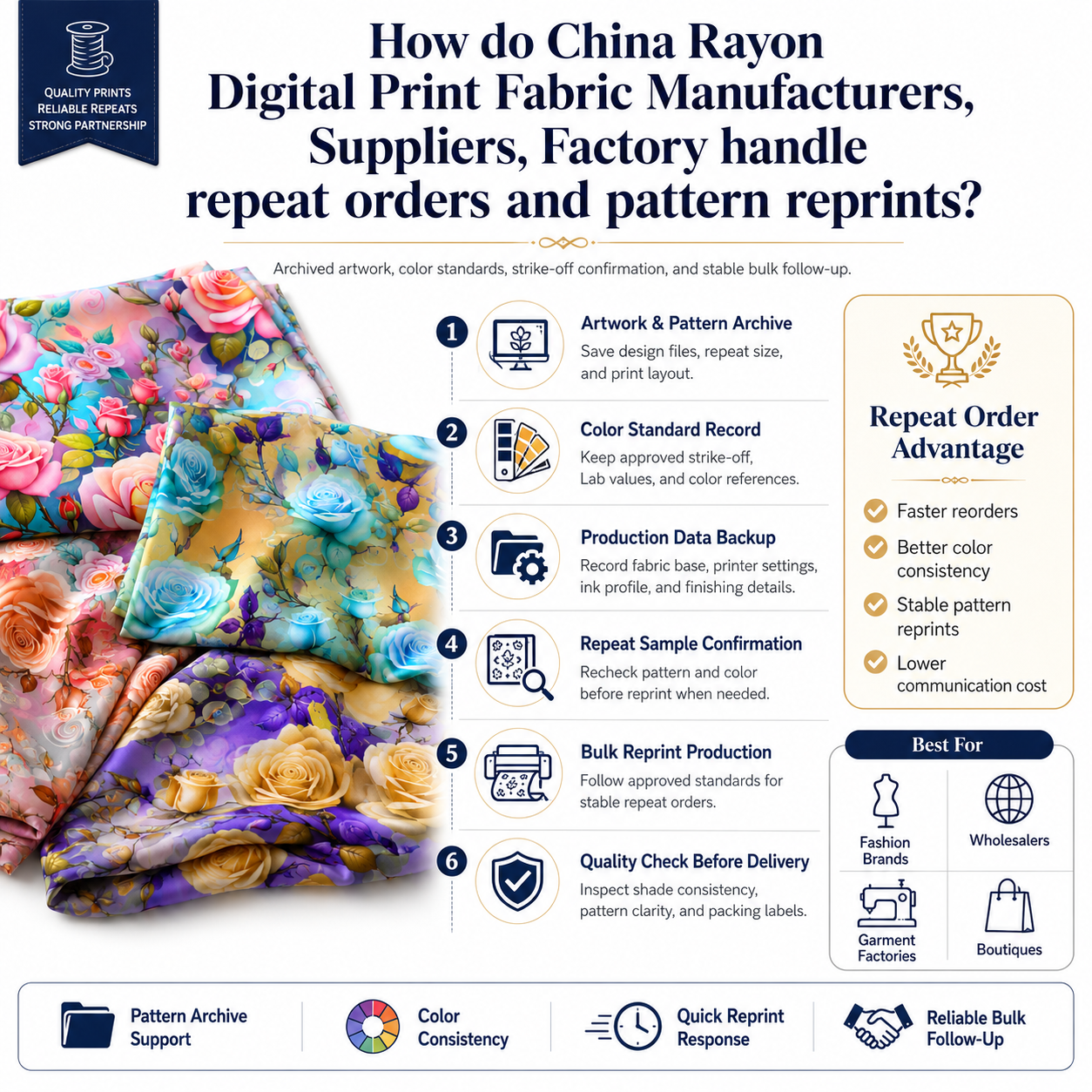
How Do China Rayon Digital Print Fabric Manufacturers, Suppliers, and Factories Handle Repeat Orders and Pattern Reprints?
Repeat orders are an important part of rayon digital print fabric sourcing. Once a fashion brand, garment factory, or fabric wholesaler finds a successful pattern, it may need the same design again for replenishment, a new production season, or a larger garment order.
A reliable supplier does not treat a repeat order as a completely new print. The factory normally retrieves the original pattern file, approved color reference, rayon base-fabric specification, strike-off record, and previous bulk-production information. It then checks whether the same materials and production conditions are still available.
However, a repeat order does not automatically guarantee an identical result. Rayon base whiteness, GSM, weave, pre-treatment, machine calibration, ink or dye batches, steaming, washing, and finishing can all influence the final appearance. For this reason, professional suppliers manage pattern reprints through documented standards and pre-production checks rather than relying only on the pattern name.
Quick Answers
China rayon digital print suppliers usually save approved artwork, colorways, fabric specifications, and production references for future repeat orders.
The buyer should provide the previous order number, pattern code, colorway, base-fabric specification, and required quantity when requesting a reprint.
A repeat pattern should preferably be printed on the same rayon base because changes in weight, weave, whiteness, or finishing may affect color and drape.
The original digital artwork can normally be reused, but the supplier should still verify its scale, repeat size, orientation, and color version before production.
An approved strike-off, bulk cutting, or digital color record can serve as the reference standard for a repeat order.
A new strike-off may be required if the base fabric, color standard, printing machine, dye system, or finishing process has changed.
Digital printing makes pattern reprints more flexible because the design is stored as a digital file rather than requiring a new physical printing screen.
Repeat-order MOQ depends on the supplier, fabric availability, print quantity, and whether the original base fabric is still running.
The repeat-order price may change when raw materials, processing costs, quantities, specifications, or delivery requirements differ from the original order.
The safest repeat order is based on a clearly identified reference sample and an updated written specification.
Why Digital Printing Supports Pattern Reprints
Digital printing is well suited to repeat orders because the pattern is stored as an electronic design file. Chinese supplier listings commonly advertise custom patterns, custom colors, and customized rayon digital printing, showing that pattern data can be reused and adjusted for different commercial orders.
Unlike conventional printing methods that may require physical screens for each color, digital printing sends processed pattern information directly to the printing system. This makes it more practical to retrieve a previous design, confirm the colorway, and prepare another production run.
However, retaining the artwork alone is not enough. The supplier also needs to retain or reconstruct the production conditions that helped create the approved result.
What Information Is Usually Stored After the First Order?
A professional supplier should create a record for each approved print program. Depending on the factory’s management system, that record may contain:
Pattern code
Original artwork file
Approved colorway
Repeat size
Pattern direction
Fabric composition
Yarn construction
Finished GSM
Finished width
Printing method
Pre-treatment route
Steaming and washing settings
Finishing requirements
Strike-off approval
Bulk shade reference
Packing instructions
Buyer order number
Digital color-control systems can store standards for the multiple colors appearing in a printed pattern and compare later batches with those standards. Datacolor’s textile-print evaluation documentation specifically describes storing multiple color standards from a floral pattern in a folder for later batch evaluation.
This type of record makes future replenishment more reliable. Instead of asking production teams to recreate a pattern from memory, the supplier can retrieve a defined standard.
How Buyers Should Identify the Previous Pattern
When requesting a repeat order, buyers should avoid sending only a photograph with a message such as “Please make this pattern again.” A photo taken under different lighting or compressed through messaging software is not a reliable production reference.
The repeat-order request should ideally include:
Previous purchase order number
Supplier pattern or article number
Buyer’s internal design code
Approved colorway
Original artwork file, when available
Previous bulk cutting or strike-off
Required meterage
Requested delivery date
Any changes to scale, color, or fabric base
The pattern code is especially important for suppliers with large design libraries. Public Chinese supplier listings may advertise hundreds or thousands of customizable products and designs, making clear identification necessary for accurate retrieval.
Confirming the Digital Artwork
Before reprinting, the supplier should verify that the retrieved file is the final approved version rather than an earlier development file. Fashion print programs often include several revisions with small differences in color, scale, background, or layout.
The following points should be checked:
File name and revision
Pattern scale
Horizontal and vertical repeat
Design direction
Colorway number
Background color
Print width
Placement or all-over layout
Any requested color replacement
A small difference in repeat scale can noticeably change the appearance of a finished dress. For example, a floral design reduced from a large resort scale to a smaller repeat may technically contain the same artwork but create a completely different garment effect.
Keeping the same approved file protects both the buyer and supplier from avoidable interpretation errors.
Confirming the Same Rayon Base Fabric
The fabric base is one of the most important factors in repeat-order consistency. Public supplier pages show that rayon digital print fabrics can vary considerably in construction, including different yarn constructions, weights, widths, twill textures, and challis qualities. Examples include customized 108 GSM rayon at 55/56 inches and a 160 GSM twill-textured digital print article.
The same pattern may look different when printed on:
A lighter or heavier GSM
A different yarn count
A tighter or looser weave
A brighter or warmer white base
A plain weave instead of twill
A different pre-treatment
A sand-washed or standard finish
For this reason, the supplier should check whether the original rayon base is still available. If the original greige fabric has been discontinued, the supplier should disclose the change and submit the closest alternative for approval.
A repeat order based on a different substrate should be treated as a modified development, not an automatic reproduction.
Using the Previous Strike-Off or Bulk Cutting
An approved strike-off is usually one of the most useful references for a repeat order. It represents the buyer-approved combination of pattern, color, and actual fabric base.
A finished bulk cutting from the previous shipment may be even more useful because it reflects the full production and finishing route. When available, suppliers can compare the new strike-off or first bulk meters with the retained reference.
The reference should be:
Clearly labeled
Protected from direct sunlight
Stored in a clean and dry location
Linked to the correct pattern and colorway
Replaced when it becomes faded or damaged
Digital color records can support this process, but physical fabric approval remains commercially useful because buyers judge the complete print effect, not only isolated color measurements.
Rechecking Color Before Production
Even when the same pattern file is reused, color should be checked before bulk printing. Raw material and production conditions may have changed since the previous order.
Professional suppliers may compare the new output with the retained standard through:
Controlled-light visual assessment
Spectrophotometer measurement
Individual color-point evaluation
Delta E or agreed tolerance checks
Side-by-side fabric comparison
Early-production inspection
X-Rite describes spectrophotometers as tools for consistent and accurate color measurement, while Datacolor documentation supports storing and evaluating several colors within printed patterns.
The acceptance tolerance should be agreed between buyer and supplier. A single numerical tolerance is not universally suitable for every printed rayon design because pattern complexity, background color, fabric texture, and commercial expectations vary.
When Is a New Strike-Off Needed?
A repeat order may not always require a completely new development cycle. However, a confirmation strike-off is advisable when:
The original order was produced a long time ago
The previous physical standard has faded
The rayon base fabric has changed
The finished GSM or width has changed
The printing machine or ink system has changed
The colorway has been adjusted
The pattern scale has changed
The finishing route has changed
The buyer requires tighter color control
The destination market or quality requirements have changed
Even when no major variable has changed, some buyers still request a short confirmation sample before a large repeat order. This adds a little time, but it can prevent a much larger commercial claim.
How Suppliers Control Pattern Scale and Repeat Alignment
A pattern reprint must reproduce not only the color but also the design geometry. The supplier should verify repeat size, design orientation, print width, and any alignment requirements before releasing the file.
For all-over rayon dress prints, common checks include:
Correct pattern dimensions
No visible repeat break
No missing artwork elements
Correct fabric direction
No unintended mirroring
Consistent motif spacing
Correct border or edge treatment
No file-resolution problems
Pattern alignment is particularly important for geometric, stripe, border, or directional floral designs. A loose abstract print may tolerate small visual variation, while a geometric pattern will reveal even minor registration or repeat errors.
Managing Repeat Orders When the Original Fabric Is Unavailable
Sometimes the pattern file is available but the original rayon base is no longer being produced. In this situation, a responsible supplier should not quietly substitute another quality.
The supplier should provide:
The closest available replacement
A comparison of composition, GSM, width, and construction
A new printed sample
Updated shrinkage and handfeel information
A revised quotation
An updated production lead time
The buyer can then decide whether the replacement is acceptable.
This is particularly important for fashion brands because even a technically similar rayon fabric may change garment drape, opacity, cutting consumption, or perceived quality.
Repeat-Order MOQ and Quantity Planning
Repeat orders do not always carry the same MOQ as the original production. The commercial minimum may depend on current base-fabric availability, printing capacity, colorway quantity, and whether the supplier still has suitable greige or stock-supported material.
Public listings show a wide range of commercial approaches: some rayon digital print offers support very small trial quantities, while regular customized woven programs may require hundreds or thousands of meters.
Buyers should ask:
Is the MOQ per pattern?
Is the MOQ per colorway?
Can multiple colorways share the total quantity?
Is the original rayon base in stock?
Is there a sample or pilot-run option?
Does the repeat price change by volume?
A previous low MOQ should not be assumed to remain permanently available, especially if the base fabric or production arrangement has changed.
Why the Repeat-Order Price May Change
A repeat pattern does not always mean the price will remain identical. Reusing the digital artwork can reduce design-development work, but the final fabric price is still influenced by current production conditions.
Common price variables include:
Rayon yarn or greige cost
Fabric GSM and width
Order quantity
Dye and chemical cost
Printing and finishing cost
Energy and labor cost
Packing requirements
Delivery urgency
Exchange-rate or freight changes
Replacement of the original fabric base
The supplier should explain whether the revised quotation reflects a specification change, cost change, or quantity difference. Buyers should compare the repeat-order specification with the original order before judging the new price.
Checking Early Bulk Production
After the repeat sample is approved, the supplier should inspect the first production output before printing the entire order.
The early-bulk check can confirm:
Pattern identity
Correct colorway
Print scale
Fabric direction
Color match
Print sharpness
Fabric handfeel
Finished width
GSM
Visible defects
Color-quality systems are designed to manage standards and monitor performance during production rather than relying only on end-stage inspection. X-Rite’s ColorCert quality-assurance tools, for example, are built around managing color standards and improving repeatability.
Catching an error in the first meters is much less expensive than discovering it after the whole order has been printed and finished.
Final Inspection Before Shipment
Before shipment, the repeat order should be checked against the approved reference and purchase specification.
Final inspection normally focuses on:
Pattern and colorway
Roll-to-roll shade
Print defects
Missing or blurred motifs
White spots or ink marks
Finished GSM
Usable width
Fabric length
Packing and roll labels
Order identification
The buyer may also request retained samples from the new bulk lot. These samples become the reference for future complaints, garment production, or another repeat order.
How Intellectual Property and Pattern Confidentiality Should Be Handled
Custom fashion prints may be commercially sensitive. Buyers should clarify who owns the artwork and whether the supplier is permitted to show, resell, or reproduce the pattern for other customers.
For exclusive patterns, the buyer may request:
A nondisclosure agreement
Restricted internal file access
A unique pattern code
No catalog display
No resale to other buyers
Secure file storage
Written ownership confirmation
The repeat-order process is easier when artwork ownership and permitted usage were defined at the beginning of the relationship.
What Buyers Should Ask Before Confirming a Pattern Reprint
Before approving a repeat order, ask the supplier the following questions:
Do you still have the final approved artwork and colorway?
Is the original rayon base fabric still available?
Will the finished GSM, width, and weave remain unchanged?
Do you have the approved strike-off or previous bulk cutting?
Has the printing or finishing process changed?
Is a new strike-off recommended?
What is the current MOQ per design and colorway?
What is the updated price and lead time?
How will early bulk be checked against the previous standard?
Will you retain a sample from the new shipment?
These questions help turn a casual reorder request into a controlled reproduction process.
Repeat Order and Pattern Reprint Process
Stage
| Supplier Action | Buyer Check |
Order identification
| retrieve previous PO, pattern code, and colorway | provide accurate old-order details |
File verification
| confirm final artwork, scale, and repeat | approve the correct revision |
Fabric-base check
| confirm composition, GSM, width, and construction | accept the same base or approve a replacement |
Reference retrieval
| locate strike-off, bulk cutting, and color data | confirm the valid approval standard |
Sample decision
| determine whether a new strike-off is needed | approve or waive confirmation sampling |
Color check
| compare visually and instrumentally | confirm agreed tolerance |
Bulk start
| inspect first production meters | review early bulk when required |
Production QC
| monitor pattern, color, and defects | receive progress or QC records |
Final inspection
| check finished rolls against order standard | approve shipment documents |
Record retention
| save new bulk sample and production data | keep matching garment and fabric records |
Conclusion
China rayon digital print fabric manufacturers, suppliers, and factories usually handle repeat orders by retrieving the approved pattern file, colorway, fabric specification, strike-off reference, and previous production data. They then confirm whether the same rayon base, printing method, and finishing process are still available before starting the reprint.
Digital printing makes pattern reproduction more flexible because artwork can be stored and reused electronically. However, true repeatability still depends on substrate consistency, color control, correct file management, early bulk checks, and final inspection.
For buyers, the safest approach is to identify the previous order clearly, provide an approved reference, and treat any change in fabric base or processing route as a new approval point. A pattern file can be repeated easily. Repeating the complete fabric result requires disciplined production control.
FAQ
Q: Can a China rayon digital print supplier reproduce an old pattern?
A: Usually yes, provided the supplier still has the final approved artwork or the buyer can supply the correct file. The original colorway, repeat size, fabric specification, and approval reference should also be confirmed.
Q: What information should buyers provide for a repeat order?
A: Buyers should provide the previous order number, pattern code, colorway, fabric specification, required quantity, and preferred delivery date. An approved bulk cutting or strike-off is also helpful.
Q: Is the digital artwork enough for an exact reprint?
A: No. The artwork controls the design, but the final result also depends on the rayon base, pre-treatment, printing conditions, steaming, washing, and finishing.
Q: Does a repeat order always require a new strike-off?
A: Not always. A new strike-off is most important when the fabric base, colorway, scale, machine, process, or finishing route has changed, or when the previous order was produced a long time ago.
Q: Why must the same rayon base be used?
A: Changes in GSM, weave, whiteness, absorbency, or finishing can alter color, print sharpness, drape, and handfeel even when the same design file is used.
Q: Can a supplier change the pattern scale for a repeat order?
A: Yes, but the revised scale should be confirmed before printing. Changing scale affects motif size, repeat dimensions, and the overall appearance of the finished garment.
Q: Will a repeat order have the same MOQ as the first order?
A: Not necessarily. MOQ depends on current fabric availability, print quantity, colorways, and the supplier’s production arrangement at the time of reorder.
Q: Why can the price change on a repeat order?
A: The price may change because of raw-material costs, order quantity, fabric availability, processing costs, delivery urgency, or changes in the original specification.
Q: How is repeat-order color consistency checked?
A: Suppliers may use retained strike-offs, previous bulk cuttings, controlled lighting, spectrophotometer measurements, agreed color tolerances, and early-bulk comparisons.
Q: How can buyers protect exclusive patterns?
A: Buyers can use an NDA, define artwork ownership, request restricted file access, prohibit resale, and assign a unique pattern code to the design.
Last updated: July 14, 2026
Author: Chief Product Engineer
Reviewers: Compliance Lead; QA Lead


Leave a comment
This site is protected by hCaptcha and the hCaptcha Privacy Policy and Terms of Service apply.