
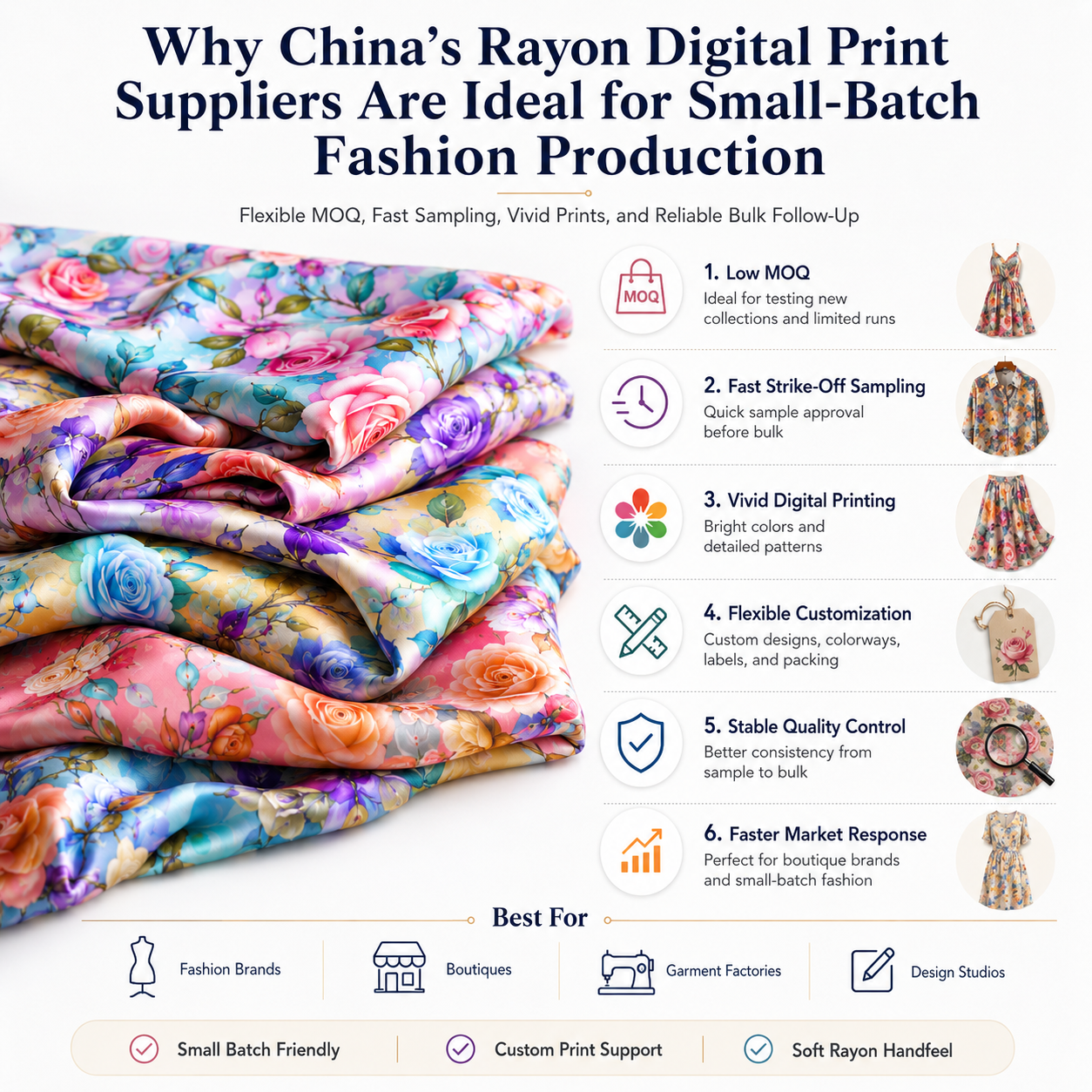
Working with a rayon digital print fabric manufacturer and supplier in China is often suitable for small-batch fashion collections because many visible suppliers combine custom print capability with relatively flexible MOQs, lightweight dress-fabric bases, and make-to-order service models. Public supplier listings show custom digital printed rayon dress fabric with MOQ as low as 120 yards in one case, 150 meters in another, and 200-meter or 300-meter-per-design style offers in other market listings, while still supporting custom designs and dress-oriented rayon bases.
For emerging brands, capsule drops, test collections, and trend-led seasonal programs, this matters because small-batch sourcing is usually limited by three things: print flexibility, minimum order size, and speed. China-based rayon digital print suppliers visible in the market often position themselves around exactly these points, offering custom floral or fashion prints, reactive printing on rayon challis or woven rayon bases, and lead times such as 7–14 workdays or similar small-run development models.
Quick Answers
China rayon digital print suppliers are often suitable for small-batch fashion because visible MOQs can be much lower than traditional bulk woven-print programs, including examples such as 120 yards and 150 meters.
Public supplier listings show that many China suppliers accept custom designs for rayon digital print fabric, which is important for limited collections and brand-exclusive styles.
Rayon challis and similar lightweight woven rayon bases are widely positioned for dresses and women’s fashion, making them suitable for boutique and seasonal fashion drops.
Digital printing is especially suitable for small-batch fashion because it allows customized pattern development without requiring the same setup model as large conventional print programs. This is an inference based on visible low-MOQ digital print listings compared with higher woven-print MOQs in other public offers.
Visible supplier examples show fast delivery or sample-ready positioning such as 7–14 workdays in one listing, which helps small brands move faster.
Low MOQ reduces inventory risk, which is especially important for brands testing new prints, silhouettes, or market response. This is an inference based on the visible MOQ ranges in supplier listings.
China suppliers also appear suitable because the market shows multiple specification options in rayon print fabric, including different weights, widths, and print styles for dresses.
Some visible suppliers support free samples or quick OEM sample development, which helps buyers validate color, handfeel, and print effect before bulk.
Small-batch fashion collections often need custom packaging, custom labels, or brand-level differentiation, and supplier pages commonly emphasize OEM or custom support.
The strongest commercial advantage is that small-batch brands can start with lower order quantities, validate demand, and then scale with the same supplier if the design performs well. This is an inference based on the make-to-order and low-MOQ supplier models visible in the market.
Lower MOQ Makes Testing New Collections More Practical
One of the biggest reasons China rayon digital print suppliers are suitable for small-batch fashion collections is MOQ flexibility. Public supplier listings show examples such as MOQ 120 yards for custom digital printed rayon dress fabric, 150 meters for custom digital print viscose challis, and 200-meter or 300-meter-style small-MOQ digital print offers in market listings. By contrast, other public rayon printed listings also show 1000-meter and 2000-meter programs, which makes it clear that digital-print-oriented sourcing can open more flexible entry points for smaller buyers.
For a small fashion label, lower MOQ is not just a purchasing detail. It is a risk-control tool. If the first collection does not sell as expected, the buyer avoids overcommitting to one print or one color story. That conclusion is an inference based on the visible differences between smaller digital-print MOQs and higher conventional listing MOQs.
Custom Prints Support Brand Identity
Small-batch fashion collections often need exclusivity more than scale. Public supplier pages show custom design acceptance, custom patterns, custom colors, and graphic customization for rayon digital print fabrics. One Made-in-China product page explicitly lists accepted custom designs for 100% rayon digital printed dress fabric, while Alibaba rayon listings also show customized print programs.
This makes rayon digital print sourcing suitable for brands that want their own floral, resort, abstract, or seasonal print stories instead of buying generic stock patterns. In small-batch fashion, uniqueness is often more valuable than raw volume. The second sentence is an inference based on the custom-design support clearly shown in public supplier listings.
Fast Sampling and Faster Market Response
Public supplier pages show delivery examples such as 7–14 workdays for custom digital printed rayon dress fabric, and other supplier pages emphasize free stock samples within 2 working days or OEM samples within 7 working days. These timelines are especially useful for brands that need to validate a style, show a sample line to buyers, or prepare a quick capsule launch.
For small-batch fashion, speed is often the difference between following a trend and missing it. A supplier that can move from design file to sample and then to production within a shorter window is commercially more suitable than one built only for large seasonal orders. The second sentence is an inference based on the sample and delivery positioning in the cited supplier pages.
Rayon Is Well Suited to Dress-Led Collections
The base fabric itself also matters. Public supplier listings position digital printed rayon challis and woven rayon fabrics for dresses, women’s clothing, and fashion garments. Rayon challis in particular is frequently sold as a soft, breathable, drape-friendly printed dress fabric.
That is important because small-batch collections often focus on dresses, blouses, resortwear, and similar categories where print and drape matter more than rigid structure. If the base fabric already fits those silhouettes, the brand can move from design concept to sellable product more efficiently. The second sentence is an inference based on the dress-oriented rayon listings cited above.
China Suppliers Often Offer Multiple Specification Options
Another reason China suppliers fit small-batch programs is the breadth of visible options. Public listings show rayon digital print fabrics around 105 GSM, 110 GSM, 125 GSM, and 145 cm or 57/58 inch widths, as well as different floral and woven dress-fabric constructions. This range gives small buyers more freedom to match print style with garment type instead of forcing every design onto one generic base.
For independent brands, that flexibility matters because one collection may need a soft challis for summer dresses, another may need a slightly different woven base for shirts or matching sets. The second sentence is an inference based on the visible spread of rayon digital print offerings in public listings.
Better Fit for Trend Testing and Market Validation
Small-batch fashion collections are usually built around testing. Brands want to see which print, silhouette, or price point performs before committing to scale. Suppliers offering lower-MOQ rayon digital printing make that process more practical because they reduce the size of the first commercial decision. Visible listings with 120-yard, 150-meter, or 200-meter style offers are much easier to use for validation than traditional 2000-meter print programs.
That is why this sourcing model is especially suitable for fashion startups, boutique brands, private-label test runs, and social-media-driven launches. It helps convert uncertainty into manageable trial production. The second sentence is an inference based on the MOQs and custom print support in public supplier listings.
Easier Path from Sampling to Scale
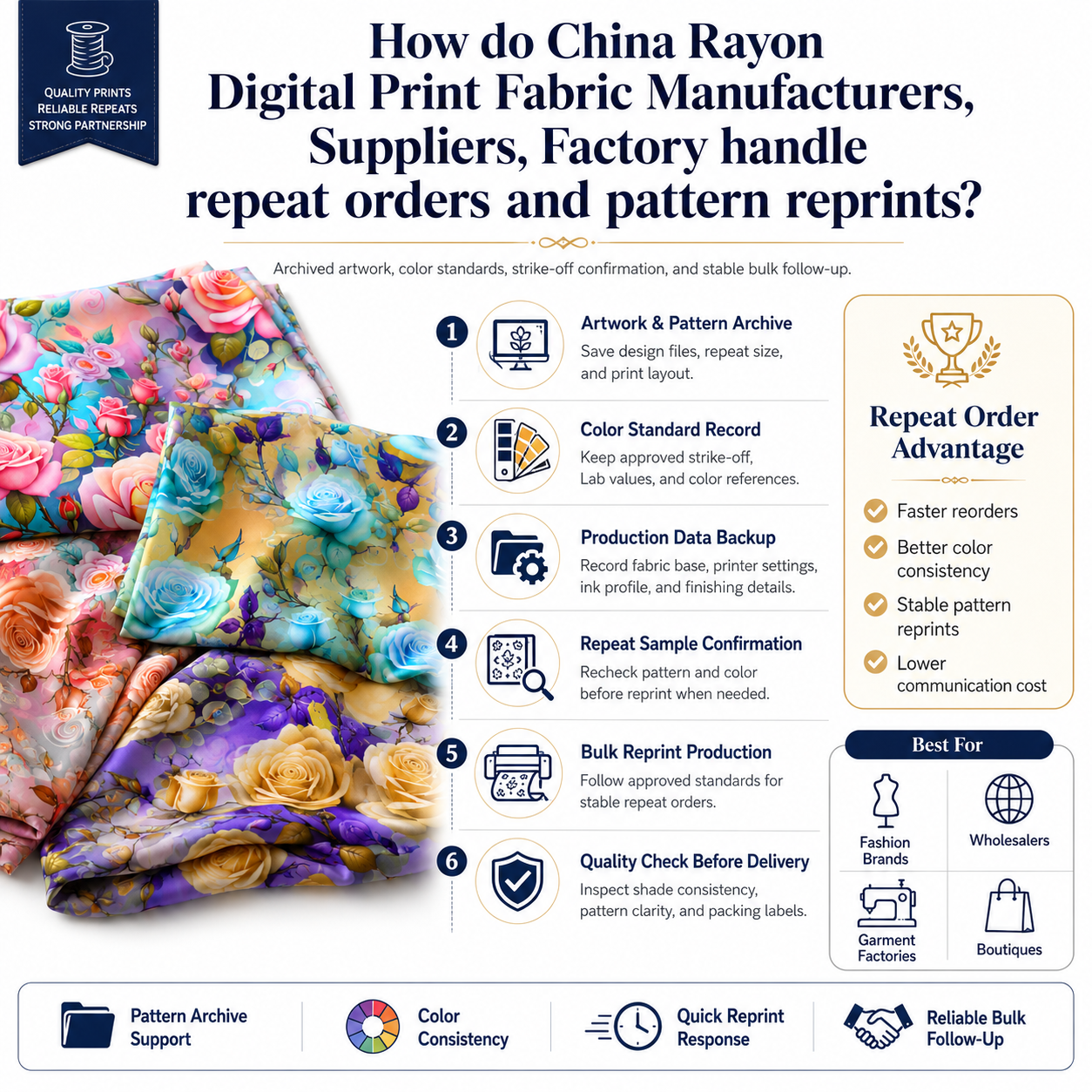
One practical advantage of working with a manufacturer rather than only a trading reseller is continuity. Public supplier listings show make-to-order models, OEM service, custom packaging service, and ongoing bulk-order support around rayon fabrics. This suggests that at least some China suppliers are structured not only to sample fabric, but also to continue into production if the collection succeeds.
For small-batch fashion, this is very useful. A brand can start small, validate demand, then move into repeat production with a supplier who already knows the base fabric, print file, and quality expectation. That conclusion is an inference based on the OEM and make-to-order models shown in the cited listings.
What Buyers Should Still Check Before Ordering
Being suitable for small-batch fashion does not mean every supplier is equally suitable. Buyers should still confirm the actual MOQ, whether it is per design or per color, whether the rayon base used for sampling is the same as bulk, whether the supplier accepts true custom prints, and how fast sampling and production can really move. These checks are directly grounded in the product parameters shown in public listings.
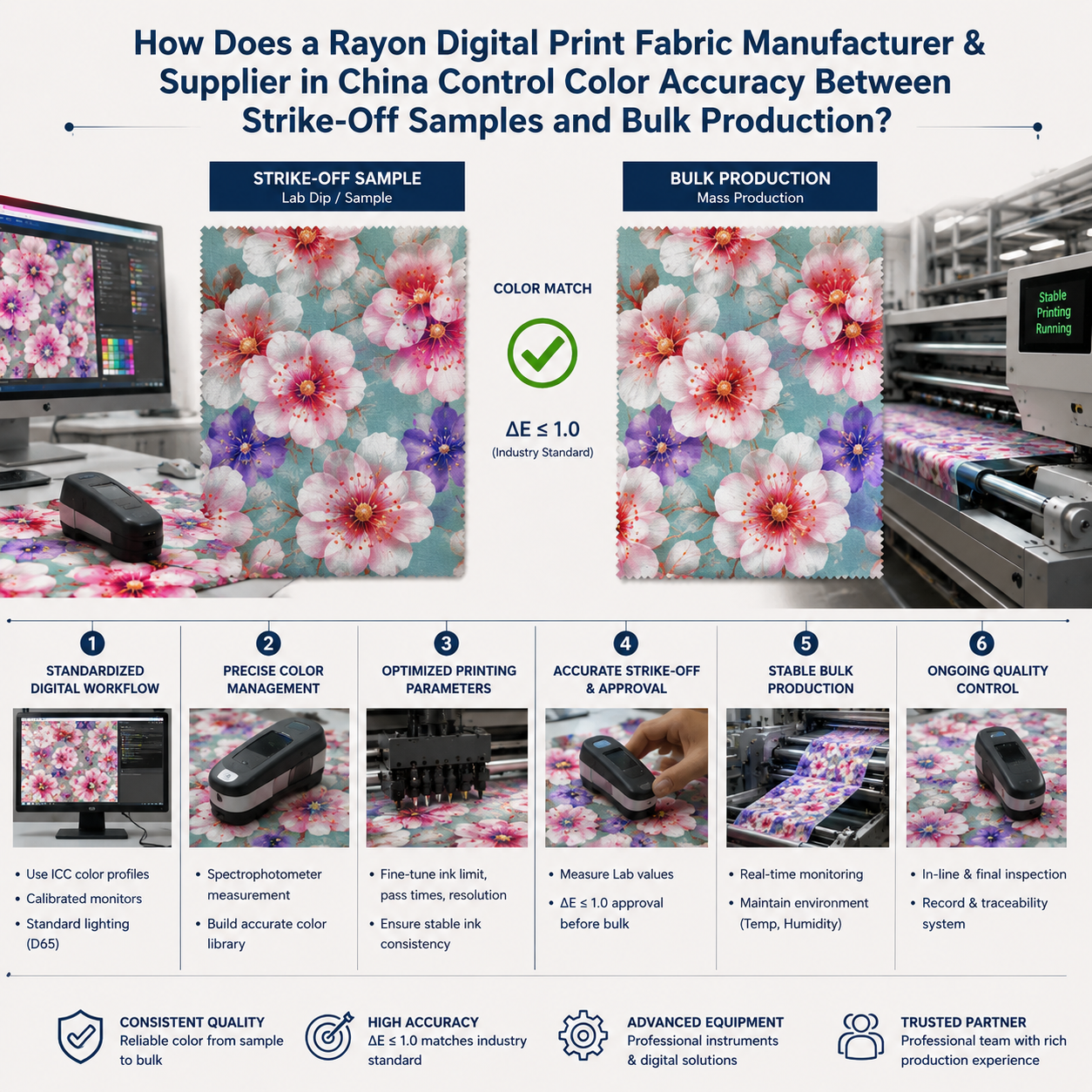
A supplier may advertise low MOQ, but the real commercial value depends on whether the print quality, handfeel, strike-off approval, and repeatability also meet the brand’s standard. The second sentence is an inference based on the general differences visible across supplier offers.
Rayon Digital Print Supplier Suitability Table
Factor
| Why It Suits Small-Batch Fashion | Public Market Signals |
Low MOQ
| reduces inventory risk and entry cost | visible offers at 120 yards, 150 meters, and small-MOQ digital print listings |
Custom designs
| supports exclusive prints and brand identity | suppliers explicitly accept custom designs and patterns |
Fast sampling
| helps brands launch or test faster | visible sample and delivery timelines such as 2 working days or 7–14 workdays |
Dress-friendly base
| rayon challis and woven rayon fit dresses and women’s fashion | listings position rayon digital print for dresses and apparel |
Specification flexibility
| allows different weights and widths for different collections | visible offers across multiple GSM and width formats |
Scalable production
| lets buyers start small and reorder if successful | make-to-order, OEM, and bulk-support models are visible in supplier pages |
Conclusion
Working with a rayon digital print fabric manufacturer and supplier in China is suitable for small-batch fashion collections because the visible market combines three things small brands need most: flexible minimums, custom print support, and faster development models. Public supplier listings show low-MOQ custom rayon digital print offers, custom design acceptance, dress-oriented rayon bases, and sample or delivery timing that fits test-oriented fashion programs better than traditional large-print sourcing alone.
For many boutique labels and emerging brands, this makes China a practical sourcing option for limited drops, pilot collections, and trend-led launches. The best supplier is usually the one that can combine low-risk entry with scalable follow-up production once the design proves itself in the market. That second sentence is an inference based on the supplier models and MOQ ranges cited above.
FAQ
Q: Why are China rayon digital print suppliers suitable for small-batch fashion collections?
A: Because public supplier listings show low-MOQ options, custom design support, and faster make-to-order models that fit smaller fashion programs.
Q: What low MOQ examples are visible in the market?
A: Public listings show examples such as 120 yards, 150 meters, and 200-meter style digital print offers, while some other listings remain at 1000 or 2000 meters.
Q: Do China suppliers accept custom rayon print designs?
A: Yes. Public listings explicitly mention accepted custom designs, custom colors, and customized print options.
Q: Is rayon digital print fabric suitable for dresses?
A: Yes. Public supplier pages position rayon challis and similar woven rayon digital print fabrics for dresses, women’s clothing, and fashion garments.
Q: Can small brands get samples quickly?
A: Some supplier pages show free stock samples within 2 working days and OEM samples within 7 working days, while one rayon digital print listing shows 7–14 workday delivery.
Q: Why is digital printing more suitable than conventional bulk print programs for small runs?
A: Public listings suggest digital print programs often support lower entry quantities than traditional larger MOQ print offers. This is an inference based on the visible MOQ differences across listings.
Q: Can a buyer scale up later with the same supplier?
A: In many cases yes, because supplier pages show make-to-order, OEM, and bulk-service models. This is an inference based on the cited supplier listings.
Q: What should buyers still confirm before ordering?
A: Buyers should confirm MOQ basis, actual rayon base fabric, print approval process, lead time, and repeatability before placing an order. This is an inference based on the product details shown in public supplier pages.
Q: Is China suitable only for large rayon print orders?
A: No. Public listings show both large-volume and smaller-batch rayon digital print offers, which suggests the market serves different business models.
Q: What is the biggest commercial advantage for small-batch brands?
A: The biggest advantage is usually being able to test custom printed styles with lower inventory risk and then scale if the market responds well. This is an inference based on the MOQ and make-to-order structures shown in public listings.

Leave a comment
This site is protected by hCaptcha and the hCaptcha Privacy Policy and Terms of Service apply.