
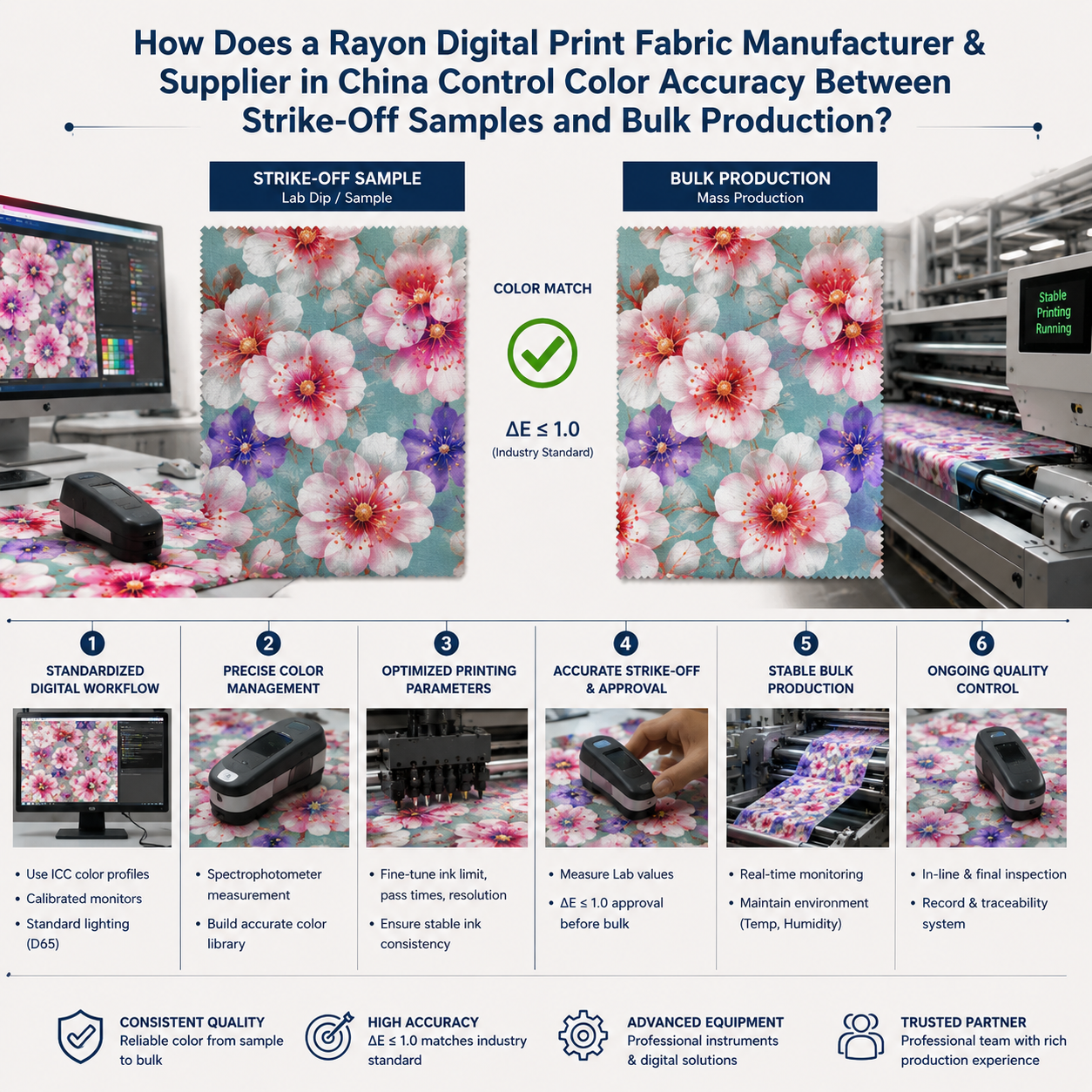
Color accuracy in rayon digital print fabric is usually controlled through a full process, not a single approval step. A reliable manufacturer or supplier in China typically starts with a defined fabric base, uses reactive digital printing for rayon, prepares strike-off samples under controlled conditions, measures shade with instruments such as spectrophotometers, sets an acceptable color-difference tolerance, and then checks bulk production against the approved strike-off before shipment. Public supplier listings for printed rayon already mention reactive printing, Pantone color customization, and strike-off style approval workflows, while color-management providers emphasize spectrophotometer-based control and Delta E tolerancing in textile production.
For buyers, the most important point is simple: if the supplier cannot explain how color is measured, approved, monitored, and corrected from strike-off to bulk, then the risk of shade mismatch remains high. Strong color control means the supplier is managing substrate consistency, print chemistry, digital color data, approval communication, and bulk inspection as one connected system. That conclusion is an inference based on the cited supplier and color-management sources.
Quick Answers
Reliable suppliers usually control color accuracy by matching bulk production against an approved strike-off sample, not by printing bulk directly from artwork alone. This is an inference based on standard color-management workflows and supplier strike-off references.
Reactive printing is commonly used for printed rayon fabric in public supplier listings, and that matters because dye class and process stability affect final color results.
Spectrophotometers are widely used in textile color management to measure shade objectively instead of relying only on visual judgment.
Delta E is a standard way to describe color difference, and Datacolor notes that a Delta E below 1 is usually imperceptible while a value above 1 is perceivable.
Some apparel brands using digital color-management systems report consistent bulk control targets such as Delta E below 1.5.
Color accuracy depends on using the same fabric base, because even correct color data can shift visually if the substrate changes. This is an inference supported by Datacolor’s case study on inconsistent standards and sample handling.
A supplier should control not only the print file, but also pre-treatment, steaming, washing, finishing, and final inspection, because these process steps can alter shade. This is an inference based on textile color-matching workflows and dye-process software references.
Digital color communication is more reliable when suppliers use shared color data rather than only physical swatches moving between teams.
Bulk approval should be based on measurable tolerance plus visual review in consistent lighting, not one of those alone. This is an inference based on color-management best practice from X-Rite and Datacolor sources.
The best suppliers reduce color risk by combining strike-off approval, instrument measurement, bulk monitoring, and pre-shipment shade inspection. This is an inference based on the cited color-control sources.
Why Color Accuracy Is Difficult in Rayon Digital Printing
Rayon digital print fabric can look excellent in a strike-off and still shift in bulk if the production controls are not stable. That is because color is influenced not only by the digital artwork, but also by the fabric base, absorbency, pre-treatment, dye chemistry, machine calibration, steaming, washing, and finishing. Public printed-rayon listings already show that suppliers customize pattern, color, and style while using reactive printing, which means the final output depends on more than one variable.
For buyers, this explains why “same design” does not always mean “same color result.” A strike-off is only meaningful if it is produced on the same or equivalent rayon construction that will be used in bulk, under a controlled process. This is an inference based on the supplier listing and color-management case studies.
Start with a Fixed Fabric Base
The first condition for color accuracy is substrate consistency. If the rayon base changes in GSM, yarn count, weave, whiteness, or finish, the same color recipe or digital profile may no longer produce the same result. Datacolor’s DK Company case study shows how inconsistent standards and poor sample discipline can create approval problems even when teams think they are following the right color codes.
For rayon digital printing, this means suppliers should lock the greige or finished base before strike-off approval. If the approved strike-off was printed on one rayon challis base and the bulk is printed on another, the color risk rises immediately. The second sentence is an inference based on the cited color-management case study.
Use Reactive Printing and Defined Process Parameters
Public supplier listings for printed rayon show reactive printing as the selected print route for custom rayon challis. That matters because dye class is part of color control. Datacolor textile-matching documentation also shows that dye class, dye process, and substrate are key variables in textile color matching.
In practice, a reliable supplier should be able to explain whether the strike-off and bulk are both produced with the same dye class, same machine family, same process profile, and same post-print route. If any of these change, the approved strike-off may stop being a valid reference. This is an inference based on the cited supplier and textile color-matching sources.
Approve a Real Strike-Off, Not Only Artwork
A digital design file is not the same as a fabric approval standard. Buyers should expect a supplier to prepare a strike-off on the actual rayon fabric base before bulk printing starts. Public supplier pages already mention sample customization and strike-off style workflows through custom pattern and color options.
The approved strike-off becomes the working standard for bulk comparison. Without that physical or instrument-linked reference, production teams have no reliable way to decide whether the bulk shade is acceptable. This is an inference based on color-management workflows described by Datacolor and X-Rite sources.
Measure Color with a Spectrophotometer
Strong color control depends on instrument measurement. X-Rite positions spectrophotometer-based color matching as a way to improve first-match rates and reduce corrections, while Datacolor’s textile case study shows how spectrophotometers were used to uncover inconsistencies in physical standards and supplier samples.
For buyers, that means a serious rayon digital print supplier should be able to measure strike-offs and bulk samples objectively rather than relying only on visual judgment. Human eyes still matter, but instrument data makes approval more repeatable across teams, mills, and production dates. The second sentence is an inference based on the cited color-management sources.
Set a Delta E Tolerance Before Bulk
Measuring color is not enough unless the supplier and buyer also agree on the acceptable difference. X-Rite explains that CMC tolerancing is commonly used in color control, while Datacolor explains that Delta E describes the distance between two colors and that a Delta E below 1 is usually imperceptible, while a value above 1 is perceivable. Datacolor’s DK Company case study also reports a working target of Delta E below 1.5 for consistent approvals.
This does not mean every rayon print order must use exactly the same tolerance. It means buyers should ask the supplier what tolerance is being used and whether that tolerance is checked between strike-off and bulk. A supplier who cannot answer that question is usually not running a strong color-control system. The second sentence is an inference based on the cited sources.
Use Shared Digital Color Data
One of the biggest causes of shade mismatch is inconsistent communication. Datacolor’s DK Company case study found that physical standards themselves had become inconsistent and that digital color communication improved control, reduced cost, and improved accountability.
For rayon digital print suppliers, this means the workflow is stronger when color standards, measurement data, and approval records are shared digitally instead of depending only on couriered swatches and subjective comments. This is especially important when design, merchandising, printing, and QC teams are in different locations. The final sentence is an inference based on the cited case study.
Control Bulk in Production, Not Only at the End
A supplier should not wait until all meters are printed before checking color. Datacolor’s production-oriented software documentation describes routine color matching in lab and production, queue management, data storage, and Delta E tracking, which supports the idea that color control should continue during production, not just after it.
In practice, good suppliers usually check early bulk output against the approved strike-off, correct if needed, and continue monitoring through production. If bulk control only happens at final packing, the cost of correction becomes much higher. The operational conclusion is an inference based on the cited production-color-management documentation.
Visually Review Under Controlled Lighting
Instrument control is essential, but visual review still matters because buyers ultimately see garments, not only numbers. Datacolor’s textile case study describes the use of light boxes for evaluating samples, even before the company improved its digital control system.
For rayon dress fabrics, suppliers should compare strike-off and bulk under consistent viewing conditions, especially where floral prints, skin-tone shades, or low-contrast colors are involved. A color can pass a tolerance value and still look commercially wrong if the visual appearance is not reviewed carefully. The second sentence is an inference based on the cited use of light-box evaluation plus standard textile practice.
Check Bulk Shade Before Shipment
Final roll inspection is still necessary. Even when strike-off approval and in-process color checks are well managed, buyers should expect the supplier to confirm that finished bulk remains within the approved shade tolerance and visual standard before shipment. This is an inference based on the combined color-management and production-control sources.
For practical sourcing, this is where many problems can still be prevented. If the supplier identifies drift before shipment, the buyer avoids a much more expensive garment-level problem later.
How Buyers Should Evaluate a Supplier’s Color Control
The simplest way to evaluate a supplier is to ask process questions instead of only asking for promises. Ask whether the supplier uses reactive printing for rayon, whether strike-offs are printed on the actual bulk base, whether color is measured by spectrophotometer, what Delta E or other tolerance is used, whether digital color data is shared, and how bulk shade is checked before shipment. Those questions directly reflect the control points described in supplier listings and color-management sources.
A good supplier does not just say “color is controlled.” A good supplier can describe the method.
Rayon Digital Print Color Control Comparison Table
Control Step
| What the Supplier Should Do | Why It Matters |
Fabric base
| lock the approved rayon base before strike-off and bulk | substrate changes can shift shade |
Printing method
| use the same reactive print route and process parameters | process changes can alter color result |
Strike-off approval
| print and approve a real strike-off on the target fabric | artwork alone is not a reliable color standard |
Instrument control
| measure samples with a spectrophotometer | objective color data improves repeatability |
Tolerance setting
| define Delta E or similar acceptance tolerance | approval needs a measurable pass/fail rule |
Color communication
| share digital color data and approval records | reduces errors from inconsistent physical standards |
In-process QC
| compare early bulk to the approved strike-off | catches drift before full production |
Visual review
| check color in controlled lighting | commercial appearance still matters |
Final inspection
| confirm bulk shade before shipment | reduces shipment and garment-level risk |
Conclusion
A rayon digital print fabric manufacturer or supplier in China usually controls color accuracy between strike-off samples and bulk production by combining fixed substrate control, reactive printing, strike-off approval, spectrophotometer measurement, Delta E tolerancing, digital color communication, in-process monitoring, and final shade inspection. Public printed-rayon listings and textile color-management sources support this workflow clearly.
For buyers, the most useful takeaway is this: color accuracy is not a promise, it is a system. The supplier who can explain that system clearly is usually the supplier most likely to deliver bulk that matches the approved strike-off.
FAQ
Q: How do China rayon digital print suppliers usually control color accuracy?
A: They usually control it through strike-off approval, reactive printing, spectrophotometer measurement, set tolerances, and bulk QC checks before shipment.
Q: Why is a strike-off sample important before bulk production?
A: A strike-off creates the actual approved fabric standard for bulk comparison. Artwork alone is not enough to control final shade on rayon fabric. This is an inference based on supplier and color-management workflows.
Q: What printing method is commonly used for printed rayon fabric?
A: Public supplier listings show reactive printing for custom printed rayon challis fabrics.
Q: Why do suppliers use spectrophotometers in textile color control?
A: Spectrophotometers provide objective color measurement and help improve repeatability compared with visual judgment alone.
Q: What is Delta E in color control?
A: Delta E is a way to describe the distance between two colors. Datacolor explains that below 1 is usually imperceptible and above 1 is perceivable.
Q: What Delta E target might a buyer see in practice?
A: Datacolor’s DK Company textile case study reports consistent control at Delta E below 1.5. That is a real example, not a universal rule for every supplier.
Q: Why does the fabric base matter for color accuracy?
A: If the rayon base changes, the same color data may print differently. This is an inference supported by color-management case studies about inconsistent standards and sample handling.
Q: Is visual review still necessary if the supplier measures color instrumentally?
A: Yes. Instrument control is essential, but visual review under controlled lighting is still important for commercial approval.
Q: Should color be checked only at final inspection?
A: No. Strong suppliers usually control color during production as well as before shipment. This is an inference based on production color-management documentation.
Q: What should buyers ask suppliers before placing an order?
A: Buyers should ask about strike-off method, fabric-base consistency, reactive print route, spectrophotometer use, color tolerance, digital approval records, and final bulk shade checks. This is an inference based on the cited sources.



Leave a comment
This site is protected by hCaptcha and the hCaptcha Privacy Policy and Terms of Service apply.