
Direct Answer
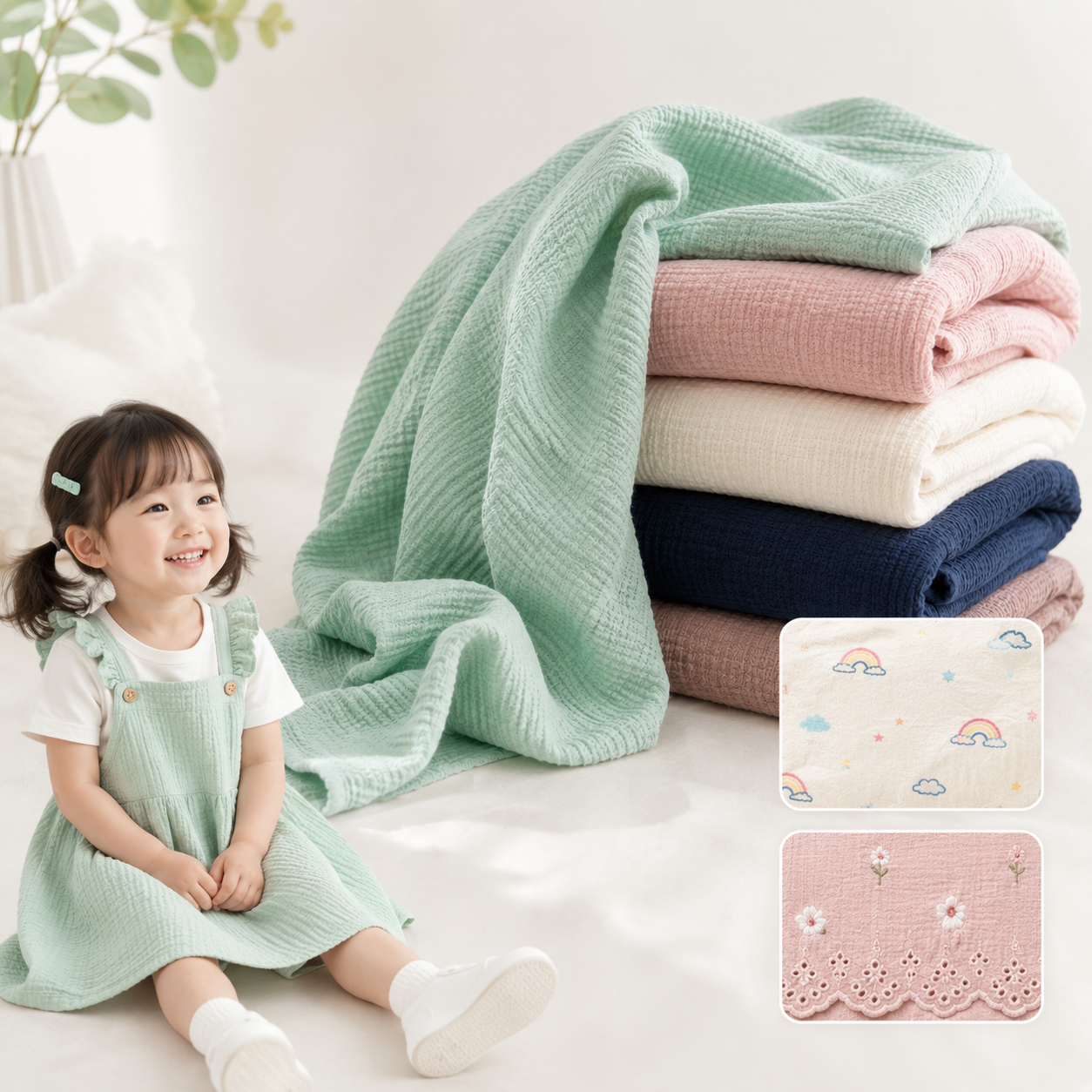
Yes. Double gauze fabric can be customized with solid dyeing, digital or rotary printing, and suitable embroidery. The process must preserve its soft hand, breathable two-layer structure and natural crinkle. Buyers should approve a lab dip, printed strike-off or embroidery sample on the actual base fabric before bulk production.
Top Answers Pack
1. Can double gauze fabric be custom printed?
Yes. Floral, geometric, cartoon, animal, tropical and brand-exclusive patterns can be printed on double gauze. The strike-off should use the actual textured base because the crinkled surface can change line sharpness, color coverage and the apparent size of small pattern details.
2. Which printing methods can be used?
Digital, rotary screen and other suitable textile-printing methods may be used, depending on fiber composition, design, quantity and required hand feel. Digital printing is often practical for varied designs, while rotary printing may be more economical for larger repeated orders.
3. Can buyers order custom solid colors?
Yes. Colors can be developed from a Pantone reference, color card or physical swatch. A lab dip should be approved under agreed lighting before bulk dyeing, and the purchase order should define the color standard, tolerance and required colorfastness.
4. Can double gauze fabric be embroidered?
Yes, but the embroidery design must suit the fabric’s soft, open construction. Light all-over motifs, borders, eyelet effects and selected placement embroidery can work well. Excessively dense stitching may add stiffness, distort the crinkle or damage the gauze layers.
5. Will printing change the softness?
It can. Heavy pigment coverage or excessive binder may create a firmer, coated hand. Printing recipes, fixation, washing and finishing should therefore be tested on the actual double gauze base, with the finished sample compared against an approved hand-feel reference.
6. Will embroidery reduce breathability?
Embroidery covers some open areas and adds thread weight, so dense designs can reduce local airflow. Breathability is usually better preserved by using lighter stitch density, smaller motifs, suitable spacing and limited backing in areas that contact the skin.
7. Can printed double gauze be used for babywear?
It can be suitable when the finished fabric meets the buyer’s requirements for composition, restricted substances, pH, formaldehyde, colorfastness, shrinkage and seam performance. A babywear application should never be approved solely because the fabric feels soft.
8. What should be approved before bulk production?
Approve the exact base fabric, finished GSM, usable width, washed texture, lab dip, printed strike-off or embroidery swatch, colorfastness, shrinkage and final hand feel. The approved sample should be sealed, labeled and retained as the bulk-production reference.
9. What affects customization MOQ?
MOQ depends on greige-fabric availability, number of colors, printing method, artwork repeat, embroidery coverage, thread colors, finishing, testing and packing. Buyers should confirm whether the MOQ applies per color, per pattern, per embroidery design or to the total order.
10. How is repeat-order consistency controlled?
The supplier should retain the base-fabric quality code, approved color reference, artwork, print screen or digital file, embroidery program, thread details, finishing instructions, test results and sealed sample. A new approval may still be needed when yarn, greige or dye lots change.
Customization Options at a Glance
| Customization | Suitable development reference | Main quality risk | Key approval point |
|---|---|---|---|
| Solid dyeing | Pantone, color card or fabric swatch | Shade variation and colorfastness | Lab dip on the selected base |
| Digital printing | High-resolution artwork and color target | Color deviation, penetration and hand feel | Strike-off on actual double gauze |
| Rotary printing | Repeat artwork and color separation | Registration, screen marks and MOQ | Approved strike-off and repeat size |
| Pigment printing | Artwork and surface-color target | Stiffness from excessive binder | Hand feel and rubbing fastness |
| All-over embroidery | Embroidery file, motif and thread chart | Distortion, stiffness and yarn damage | Embroidered panel after washing |
| Border embroidery | Border width and placement drawing | Crooked placement and usable-width loss | Full-width border sample |
| Placement embroidery | Garment pattern and placement map | Misalignment during cutting | Garment-panel trial |
How Can Double Gauze Be Customized with Prints?
Double gauze can carry many commercial pattern categories, including:
-
Small floral and large floral prints
-
Tropical and botanical designs
-
Polka dots and stripes
-
Geometric and abstract patterns
-
Animal and leopard-inspired prints
-
Cartoon and children’s patterns
-
Paisley and ethnic motifs
-
Fruit-and-flower combinations
-
Exclusive artwork for fashion brands
The pattern must be evaluated on the real double gauze surface. Its soft, irregular crinkle can slightly interrupt fine lines and change how small details appear. A design that looks sharp on paper or smooth poplin may look softer on double gauze.
Digital Printing
Digital printing is useful for designs with many colors, gradients, photographic effects or frequent pattern changes. It can reduce the need for physical screens and may support smaller development quantities than rotary printing.
Buyers should still confirm:
-
Printable fabric width
-
Artwork scale and repeat
-
Color profile and reference standard
-
Front-to-back penetration requirement
-
White marks around raised yarns
-
Hand feel after fixation and washing
-
Colorfastness and shrinkage
-
Bulk speed and approved lead time
Digital printing does not automatically guarantee exact screen-to-fabric color. A physical strike-off remains necessary.
Rotary Screen Printing
Rotary printing is often suitable for repeat designs and larger commercial volumes. It may provide an economical unit cost when the order quantity is sufficient, but screen preparation and color separation add development work.
Important controls include:
-
Repeat size and screen circumference
-
Number of print colors
-
Registration between colors
-
Screen marks and streaks
-
Print paste penetration
-
Shade consistency from beginning to end
-
Hand feel after washing and finishing
Pigment and Reactive Printing
The most suitable color system depends on fiber composition, required colorfastness, price, print effect and factory process. Pigment printing can be used on different fiber types, but excessive binder may stiffen the fabric. Reactive printing is commonly considered for cellulosic fibers when a softer hand and good wash performance are required, although it involves additional fixation and washing controls.
The buyer should define the required result rather than select a printing method only by price.
How Can Custom Solid Colors Be Developed?
For solid-dyed double gauze, the buyer may provide:
-
A Pantone reference
-
A supplier color-card number
-
A physical fabric swatch
-
A garment sample
-
A previously approved production cutting
The supplier then develops lab dips on the selected double gauze base. Buyers should review them under the agreed light source because color can appear different under daylight, store lighting and office lighting.
The approval should record:
-
Color standard and selected lab-dip option
-
Light source used for evaluation
-
Acceptable color tolerance
-
Finished hand feel and crinkle
-
Required washing and rubbing fastness
-
Shade-banding procedure for bulk rolls
Dark, bright and highly saturated shades may require additional attention to wet rubbing, washing and shade consistency.
How Can Double Gauze Be Customized with Embroidery?
Double gauze can be embroidered, but the design should respect the fabric’s lightweight, layered structure. Suitable options may include:
-
Small scattered motifs
-
Light all-over embroidery
-
Floral embroidery
-
Border embroidery
-
Eyelet or cutwork-inspired effects
-
Simple geometric patterns
-
Selected placement embroidery for garment panels
Control Stitch Density
Dense embroidery can pull the fabric inward, flatten the crinkle and create a stiff patch. Lighter stitch density and adequate spacing usually preserve more of the original softness and airflow.
Select Suitable Thread and Needle
Thread thickness, thread composition, needle size and machine tension must suit the base fabric. An unsuitable needle or excessive tension may cause holes, broken yarns, puckering or layer separation.
Use Backing Carefully
Backing may be needed to stabilize the fabric during embroidery, but heavy or non-removable backing can feel rough against the skin and reduce flexibility. For babywear and lightweight garments, the finished back should be evaluated for comfort as well as appearance.
Check Embroidery Placement
Border and placement embroidery can reduce the usable cutting width or create matching requirements during garment cutting. The purchase order should state motif direction, border width, distance from the selvedge and acceptable placement tolerance.
Test the Washed Appearance
The cotton base, embroidery thread and backing may shrink differently. A washed embroidery sample helps reveal puckering, twisting, thread bleeding, roughness and dimensional change before bulk production.
How Customization Affects Double Gauze Performance
Softness
Heavy print paste, pigment binder, dense embroidery or firm backing can reduce softness. The finished sample should be assessed after printing or embroidery, not only before decoration.
Breathability
Open printed areas normally retain more airflow than heavily covered areas. Dense embroidery reduces local air permeability, so motif scale and coverage should match the garment’s warm-weather positioning.
Natural Crinkle
High finishing tension may flatten the texture, while dense embroidery can hold some areas flatter than others. The crinkle should remain fine, soft and naturally irregular across undecorated areas.
Weight and Drape
Embroidery adds weight and may change how the fabric hangs. Larger motifs can be used intentionally for a fuller look, but the garment pattern should be tested with the finished embroidered fabric.
Shrinkage
Dyeing, printing, washing and embroidery all influence dimensional stability. Buyers should request both lengthwise and widthwise shrinkage results from the final customized fabric.
Suitable Applications
Customized double gauze can be developed for:
-
Baby rompers and loose baby clothing
-
Children’s dresses and shirts
-
Swaddles, bibs and burp cloths
-
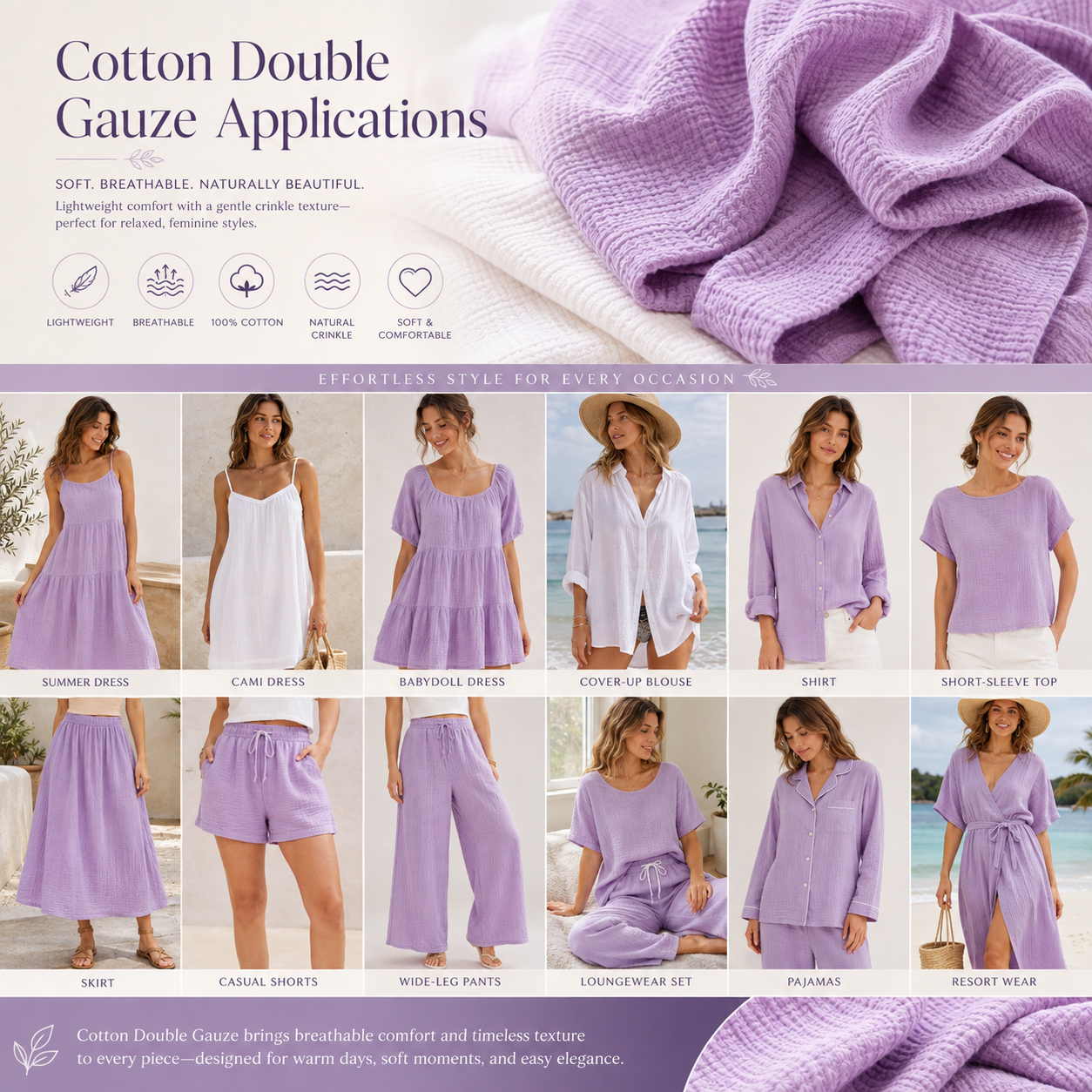
Summer dresses and blouses
-
Relaxed shirts and matching sets
-
Sleepwear and loungewear
-
Beach cover-ups
-
Lightweight scarves and accessories
For baby products, the final fabric and garment must meet the applicable safety and testing requirements of the destination market.
What Specifications Should Buyers Confirm?
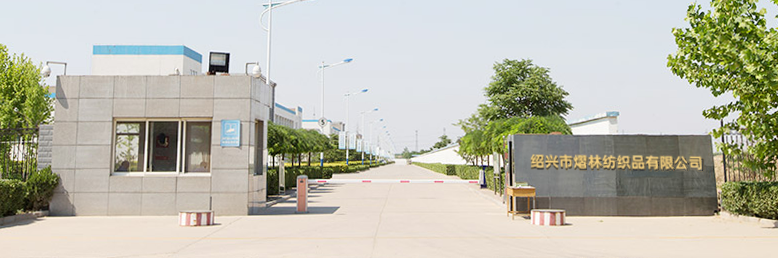
For many cotton double gauze programs, Shaoxing Yilin Textile commonly develops finished widths of approximately 135–140 cm and weights of approximately 125–145 GSM. Custom requirements should be confirmed against the intended garment and approved physical sample.
Before ordering, confirm:
-
Exact fiber composition.
-
Genuine two-layer construction.
-
Finished GSM and tolerance.
-
Full and usable width.
-
Base-fabric color or whiteness.
-
Print method or embroidery type.
-
Artwork scale, repeat and direction.
-
Color and thread references.
-
Finished softness and crinkle appearance.
-
Lengthwise and widthwise shrinkage.
-
Opacity and breathability requirements.
-
Colorfastness and babywear-related testing.
-
MOQ and quantity tolerance.
-
Sampling and bulk lead time.
-
Roll length, labeling and packing.
Recommended Sampling Process
A reliable customization process normally includes:
-
Approve the intended double gauze base fabric.
-
Confirm the finished GSM and usable width.
-
Submit Pantone references, artwork or embroidery files.
-
Approve a lab dip, strike-off or embroidery swatch.
-
Review the front, back, hand feel and crinkle.
-
Wash the customized sample under the intended care conditions.
-
Complete a sewing or garment trial when required.
-
Seal and label the approved sample.
-
Compare the first bulk lot with the approved standard.
-
Inspect multiple rolls before shipment.
Artwork development, color separation, screen engraving, embroidery programming, lab testing and corrections should be included in the production calendar. Actual lead time depends on design complexity, greige availability, order quantity and approval speed.
MOQ and Cost Factors
There is no single MOQ for every customized double gauze order. The practical quantity depends on:
-
Availability of the selected greige quality
-
Number of solid colors
-
Digital or rotary printing method
-
Number of print colors and screens
-
Artwork repeat and design count
-
Embroidery coverage and stitch count
-
Number of thread colors
-
Special washing or finishing
-
Testing and packaging requirements
Digital printing may be more suitable for smaller or design-intensive collections, while rotary printing can offer a better unit cost for larger repeated runs. Embroidery cost is strongly affected by stitch count, coverage, machine time and usable-width loss.
The quotation should separate any sampling, screen, programming, testing and bulk-production charges.
Quality-Control Tests
Depending on the application and destination market, buyers may request:
-
Fiber-composition verification
-
Finished GSM and usable width
-
Lengthwise and widthwise shrinkage
-
Washing colorfastness
-
Dry and wet rubbing fastness
-
Perspiration fastness
-
Saliva fastness when required
-
pH and formaldehyde
-
Restricted-substance testing
-
Seam strength and seam slippage
-
Tearing strength
-
Print registration and shade consistency
-
Embroidery attachment, puckering and yarn damage checks
The test method, washing conditions and acceptance standard should be agreed before bulk production.
Bulk Inspection Points
Inspect the beginning, middle and end of production and compare different rolls for:
-
Shade and print-color variation
-
Pattern registration and repeat accuracy
-
Missing print, streaks or white marks
-
Embroidery position and motif completeness
-
Loose or broken embroidery threads
-
Holes, needle damage and layer separation
-
Uneven softness or flattened texture
-
GSM, width, skewing and bowing
-
Wash appearance and shrinkage
Different dye, print or embroidery batches should be identified on roll labels so garment factories can avoid mixing visibly different lots in one cutting group.
Packaging Requirements
Customized double gauze should be protected from moisture, dirt, snagging and excessive compression. Confirm:
-
Roll length and short-roll tolerance
-
Face-in or face-out rolling
-
Paper tube and inner plastic protection
-
Outer packing material
-
Color, pattern and batch labels
-
Roll numbers and quantity units
-
Embroidery-face protection when required
-
Customized shipping marks
Excessive pressure can temporarily flatten the natural crinkle, while exposed embroidery may snag during handling.
Payment and Incoterms
The quotation should state the currency, deposit, balance-payment timing, sampling charges, screen or embroidery-program costs, testing charges, inspection responsibility, quantity tolerance and agreed Incoterm with a named port or place.
Buyers should also confirm whether development charges are refundable or deductible after the bulk order reaches an agreed quantity.
Repeat Orders and After-Sales Control
For repeat production, the supplier should retain:
-
Base-fabric quality code
-
Approved finished and washed sample
-
Lab-dip reference
-
Original artwork and color separation
-
Digital print file or rotary-screen information
-
Embroidery program and thread chart
-
Finishing instructions
-
GSM, width and shrinkage results
-
Inspection and packing records
If the original yarn, greige, dye or embroidery thread lot is unavailable, the supplier should advise the buyer and submit a new approval sample rather than assume an exact match.
Frequently Asked Questions
Can one double gauze quality be offered in several colors?
Yes. Multiple solid colors or colorways can be developed from one approved base quality. Each color should have its own lab-dip approval, colorfastness review and bulk shade record.
Can the same print be made in different colorways?
Yes. One pattern can be developed in several color combinations. Each colorway should receive a separate strike-off approval because color interaction and contrast can change the apparent design.
Can a buyer provide an original pattern?
Yes. Buyers can provide repeat-ready artwork or design references. File format, resolution, repeat dimensions, color channels, ownership and confidentiality requirements should be confirmed before sampling.
Is embroidered double gauze suitable for babywear?
It may be suitable when the embroidery is soft, secure and compliant with the intended market. Buyers should inspect the back for rough threads or backing and test wash durability, yarn damage, loose components and skin-contact comfort.
Can embroidery and printing be combined?
Yes, but the processing sequence must be planned carefully. Print placement, embroidery registration, shrinkage and hand feel should be verified through a combined sample before bulk production.
Will dark printed colors rub off?
Performance depends on the color system, fixation, washing and finishing. Dark shades require particular attention to wet and dry rubbing fastness. Buyers should specify the test method and acceptance level.
Can the natural crinkle remain after customization?
Yes, when printing, embroidery and finishing are properly controlled. Heavy coating, dense stitching or high finishing tension can flatten or stiffen the surface, so the final customized sample should define the approved texture.
Why must the sample use the actual double gauze base?
Yarn density, whiteness, absorbency and crinkle all influence color and pattern appearance. A sample made on smooth cotton or another gauze quality cannot reliably represent bulk production.
Conclusion
Double gauze fabric can be customized with solid colors, printed designs and carefully engineered embroidery. The best result preserves the fabric’s soft hand, breathable two-layer construction and fine natural crinkle while achieving the required visual effect.
For bulk sourcing, buyers should approve every treatment on the actual base fabric and evaluate the finished sample after washing. Color, pattern, embroidery density, GSM, usable width, shrinkage, colorfastness, softness and batch consistency should all become written production standards.
Shaoxing Yilin Textile supports solid-dyed, printed and embroidery development for cotton double gauze used in babywear, children’s clothing and summer collections. Buyers can send the intended garment, target GSM, color reference, artwork, embroidery file, testing requirements and order quantity to develop a suitable sampling and bulk-production plan.

Leave a comment
This site is protected by hCaptcha and the hCaptcha Privacy Policy and Terms of Service apply.