
How Does a Double Gauze Fabric Manufacturer & Supplier in China Control Softness, Breathability, and Crinkle Texture Consistency?
Direct Answer
A Double Gauze Fabric Manufacturer & Supplier in China controls softness, breathability and crinkle consistency by standardizing cotton yarn, double-layer construction, weave density, fabric tension, washing, drying and finishing.
Each bulk lot is compared with an approved sample for hand feel, GSM, usable width, air permeability, shrinkage and surface texture.
Top Answers Pack
1. How is double gauze softness controlled?
Softness is controlled through yarn quality, yarn twist, weaving tension, pretreatment, washing and finishing. The manufacturer should evaluate the fabric after finishing and washing because untreated greige fabric does not represent the final hand feel.
2. What determines double gauze breathability?
Breathability depends mainly on yarn thickness, weave density, finished GSM, fabric shrinkage and the amount of finishing chemicals applied. A soft fabric is not automatically breathable, so air permeability should be tested separately when required.
3. How is the crinkle texture created?
The natural crinkle develops from the two connected gauze layers, yarn tension and controlled relaxation during wet processing. Washing, drying, overfeed and finishing conditions all influence how fine, full or flat the final texture appears.
4. Should every crinkle look identical?
No. Double gauze should have a natural, finely irregular surface rather than identical mechanical wrinkles. The manufacturer should control the overall crinkle size, density, softness and distribution within an approved visual tolerance.
5. Why can bulk fabric feel different from the sample?
Differences may come from yarn lots, greige construction, fabric tension, washing time, drying temperature or softener dosage. A sealed finished sample and recorded production parameters help reduce these variations.
6. How should buyers check texture consistency?
Buyers should compare the beginning, middle and end of different rolls, as well as the left, center and right sides. The fabric should be evaluated both flat and naturally draped under consistent lighting.
7. Does washing affect breathability and texture?
Yes. Washing relaxes the yarns and develops the crinkled surface, but excessive shrinkage can make the structure denser. The manufacturer must balance softness and texture development with dimensional stability and airflow.
8. Can too much softener reduce performance?
Yes. Excessive finishing chemicals may create an artificial slippery hand, reduce absorbency, cover the natural texture or affect breathability. Babywear programs may also require stricter chemical and odor controls.
9. What specifications should buyers approve?
Buyers should approve composition, finished GSM, usable width, softness, crinkle appearance, opacity, shrinkage, colorfastness, air permeability when required, seam performance and packing instructions.
10. What is the best reference for bulk production?
A sealed, labeled and finished physical sample is the most practical reference. It should represent the approved softness, natural crinkle, GSM, width, color and washed appearance of the bulk fabric.
Quality-Control Overview
| Production stage | Main control point | Quality risk being reduced |
|---|---|---|
| Yarn selection | Fiber quality, yarn count and twist | Rough or unstable hand feel |
| Double-layer weaving | Density, tension and layer connection | Uneven structure or layer separation |
| Greige inspection | Width, defects and layer stability | Problems continuing into finishing |
| Pretreatment | Cleanliness and controlled fiber swelling | Roughness and uneven absorbency |
| Washing | Time, temperature and mechanical action | Insufficient or excessive crinkle |
| Drying | Temperature, tension and overfeed | Flat areas or harsh hand feel |
| Finishing | Softener dosage and mechanical relaxation | Artificial hand feel or reduced breathability |
| Final setting | GSM, width and dimensional stability | Batch-to-batch differences |
| Inspection | Hand feel, texture, shade and defects | Inconsistent rolls reaching the buyer |
| Testing | Shrinkage, colorfastness and air permeability | Garment-production problems |
1. Start with Consistent Cotton Yarn
Double gauze quality begins with the yarn. Finishing cannot completely correct inconsistent or unsuitable raw materials.
The manufacturer should control:
- Fiber composition
- Yarn count
- Yarn twist
- Yarn evenness
- Hairiness
- Yarn strength
- Cotton or blended-fiber lot
- Moisture condition
- Contamination and foreign fibers
A yarn with excessive twist may make the fabric feel firmer. Weak or uneven yarn can create excessive hairiness, broken yarns or unstable crinkle areas.
For repeat orders, the supplier should record the yarn specification and production lot instead of relying only on the commercial fabric name.
2. Control the Two-Layer Construction
Double gauze is made from two lightweight woven layers connected at small intervals by binding yarns. The layers should remain separate enough to create softness and airflow but stable enough to avoid excessive movement.
The factory should check:
- Weave density of each layer
- Warp and weft tension
- Layer alignment
- Binding-yarn spacing
- Binding-point strength
- Fabric width
- Surface uniformity
- Broken or missing binding points
- Separation between the two layers
If the binding points are too loose or widely spaced, the layers may shift excessively. If they are too tight, the fabric may lose its soft, fluffy character.
3. Maintain Controlled Weaving Tension
Uneven weaving tension is a common cause of inconsistent texture.
Excessive tension can produce:
- A flat surface
- Reduced softness
- Lower fabric volume
- Limited crinkle development
- Narrow or distorted finished width
Insufficient or unstable tension can produce:
- Uneven density
- Irregular width
- Local loose areas
- Skewing
- Excessive layer movement
- Different crinkle levels across the fabric
The manufacturer should record loom settings for approved constructions and monitor tension during production.
4. Inspect the Greige Fabric Before Finishing
Greige-fabric problems become more visible after washing and crinkle development. The factory should inspect the unfinished fabric before dyeing or printing.
Important checks include:
- Full width and usable width
- Greige GSM
- Layer connection
- Weaving bars
- Broken yarns
- Holes
- Oil marks
- Uneven density
- Skewing or bowing
- Abnormal thick or thin sections
Fabric with major construction differences should not be mixed in the same finishing batch.
5. Use Pretreatment to Develop a Clean, Soft Base
Pretreatment removes natural oils, weaving residues and other materials that may affect softness, dyeing and absorbency.
Depending on the quality, pretreatment may include:
- Desizing
- Scouring
- Washing
- Bleaching
- Neutralization
- Controlled drying
Insufficient pretreatment can leave the fabric harsh, uneven or poorly absorbent. Excessive chemical treatment may weaken the yarn or damage the fabric’s soft surface.
The process should be adjusted for the exact cotton or blended composition.
6. Control Softness Without Overfinishing
Softness is created by the combined effect of yarn, construction, washing and finishing. It should not depend only on adding a large amount of chemical softener.
The manufacturer may use:
- Controlled washing
- Mechanical relaxation
- Low-tension drying
- Suitable soft finishing
- Enzyme treatment when appropriate
- Controlled compaction
- Fabric conditioning before evaluation
The target is a soft, skin-friendly and slightly fluffy hand with natural rounded folds.
The fabric should not feel:
- Stiff
- Rough
- Dry and abrasive
- Heavily coated
- Artificially slippery
- Oily
- Flat or compressed
For babywear, the buyer may also require chemical compliance, low odor and restrictions on certain finishing agents.
7. Measure Softness Against an Approved Sample
“Very soft” is subjective. The buyer and supplier may understand the term differently.
The most practical standard is a sealed physical sample that represents:
- Surface softness
- Compression and fluffiness
- Flexibility
- Drape
- Dry or smooth touch
- Crinkle level
- Appearance after washing
The supplier should label the sample with:
- Fabric quality code
- Composition
- GSM
- Width
- Color
- Finishing method
- Approval date
- Order or development number
Bulk fabric should be conditioned before comparison because humidity and packing pressure can temporarily affect hand feel.
8. Control Breathability Through Construction
Breathability is mainly created by the fabric structure, not by a marketing description.
Important factors include:
- Yarn count
- Yarn diameter
- Weave density
- Open spaces between yarns
- Finished GSM
- Two-layer construction
- Shrinkage
- Finishing-chemical dosage
- Surface coating
Increasing density or allowing excessive shrinkage may improve coverage but reduce airflow. A very open construction may improve breathability but create problems with opacity, seam strength or durability.
The manufacturer must balance airflow with the final garment requirement.
9. Test Air Permeability When Required
For technical programs, breathability can be evaluated using an air-permeability test under a specified pressure difference.
The factory or testing laboratory should:
- Condition the fabric before testing.
- Use the agreed test method.
- Test several areas across the width.
- Record the unit and pressure.
- Compare bulk results with the approved target.
- Retest after washing when required.
Methods such as ISO 9237 or ASTM D737 may be specified by the buyer. The purchase order should state the required method because results from different methods may not be directly comparable.
10. Balance Breathability and Opacity
A highly open fabric may be breathable but too transparent for some garments. A denser fabric may provide better coverage but feel warmer.
Buyers should evaluate:
- Fabric held against daylight
- Single-layer opacity
- Fabric folded into two layers
- Garment movement
- Light and dark colors
- Intended babywear or summer garment
- Need for a lining
Breathability, coverage and durability should be approved together rather than as separate visual claims.
11. Develop the Natural Crinkle During Washing
The fine crinkle texture usually becomes more visible when the double-layer structure relaxes during wet processing.
The manufacturer should control:
- Washing time
- Water temperature
- Mechanical action
- Fabric loading
- Fabric tension
- Relaxation time
- Drying method
- Moisture level before drying
Insufficient relaxation may leave the surface too flat. Excessive mechanical action may make the fabric overly wrinkled, narrow or unstable.
12. Control Drying and Overfeed
Drying has a strong influence on the final crinkle and hand feel.
High tension during drying can stretch the fabric and flatten its natural texture. Excessive heat can make cotton feel dry or cause unnecessary dimensional change.
The factory should control:
- Drying temperature
- Machine speed
- Fabric tension
- Overfeed
- Residual moisture
- Width setting
- Relaxation after drying
The correct result should show soft, fine and naturally irregular crinkles—not hard folds, coarse wrinkles or regular seersucker stripes.
13. Establish a Realistic Crinkle Standard
Natural crinkle cannot be controlled by counting every individual wrinkle. A practical standard should define the overall appearance.
Buyers should approve:
- Average crinkle size
- Texture density
- Surface fullness
- Softness
- Distribution across the width
- Appearance after washing
- Acceptable variation
- Natural drape
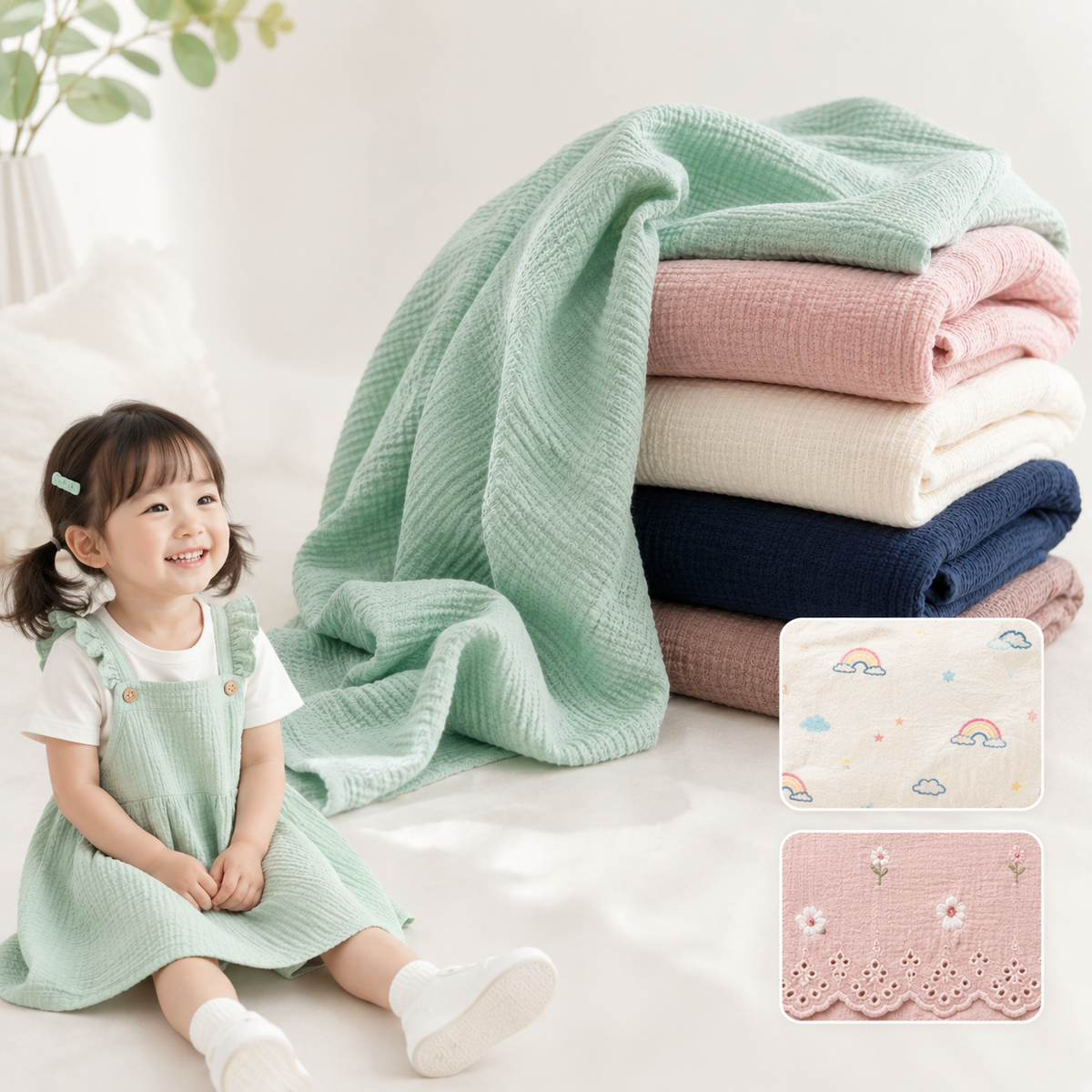
A reliable sample should show two lightweight cotton layers, a matte surface, fine plain-weave yarns and small breathable spaces.
The fabric should not look:
- Like coarse linen
- Like burlap
- Like regular bubble seersucker
- Shiny or coated
- Heavy and rigid
- Randomly crushed with hard creases
14. Control Finished GSM and Width
GSM and width influence all three target properties.
If the finished GSM is too high, the fabric may feel dense and less breathable. If it is too low, it may lack coverage or strength.
If the fabric is stretched too wide during finishing, the crinkle can become flatter. If it relaxes excessively, the width may become too narrow.
A common Double Gauze Cotton development range from Yilin Textile is:
| Specification | Common range |
| Composition | 100% cotton |
| Finished GSM | Approximately 125–145 gsm |
| Finished width | Approximately 135–140 cm |
| Surface | Fine, natural and irregular crinkle |
| Hand feel | Soft, lightweight and slightly fluffy |
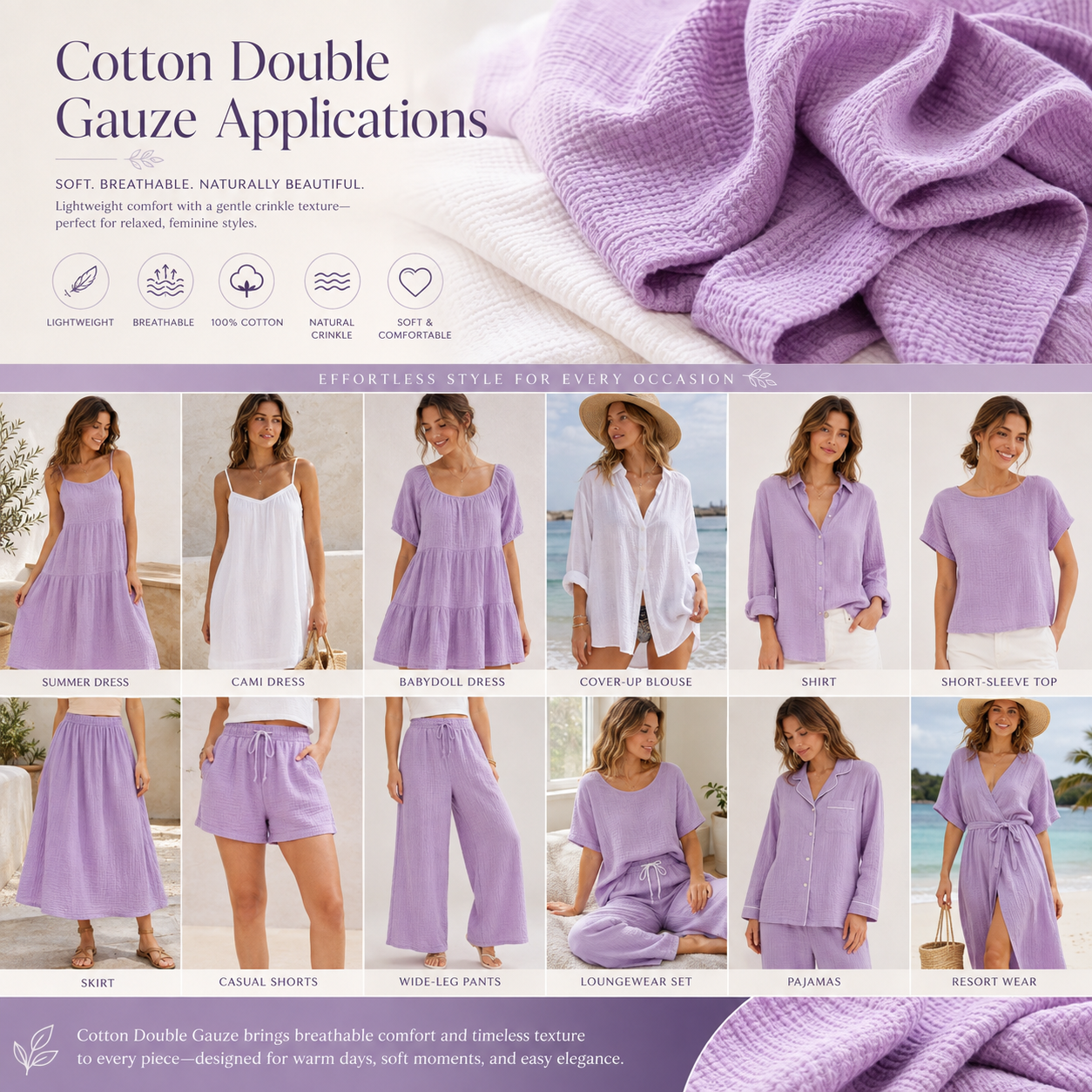
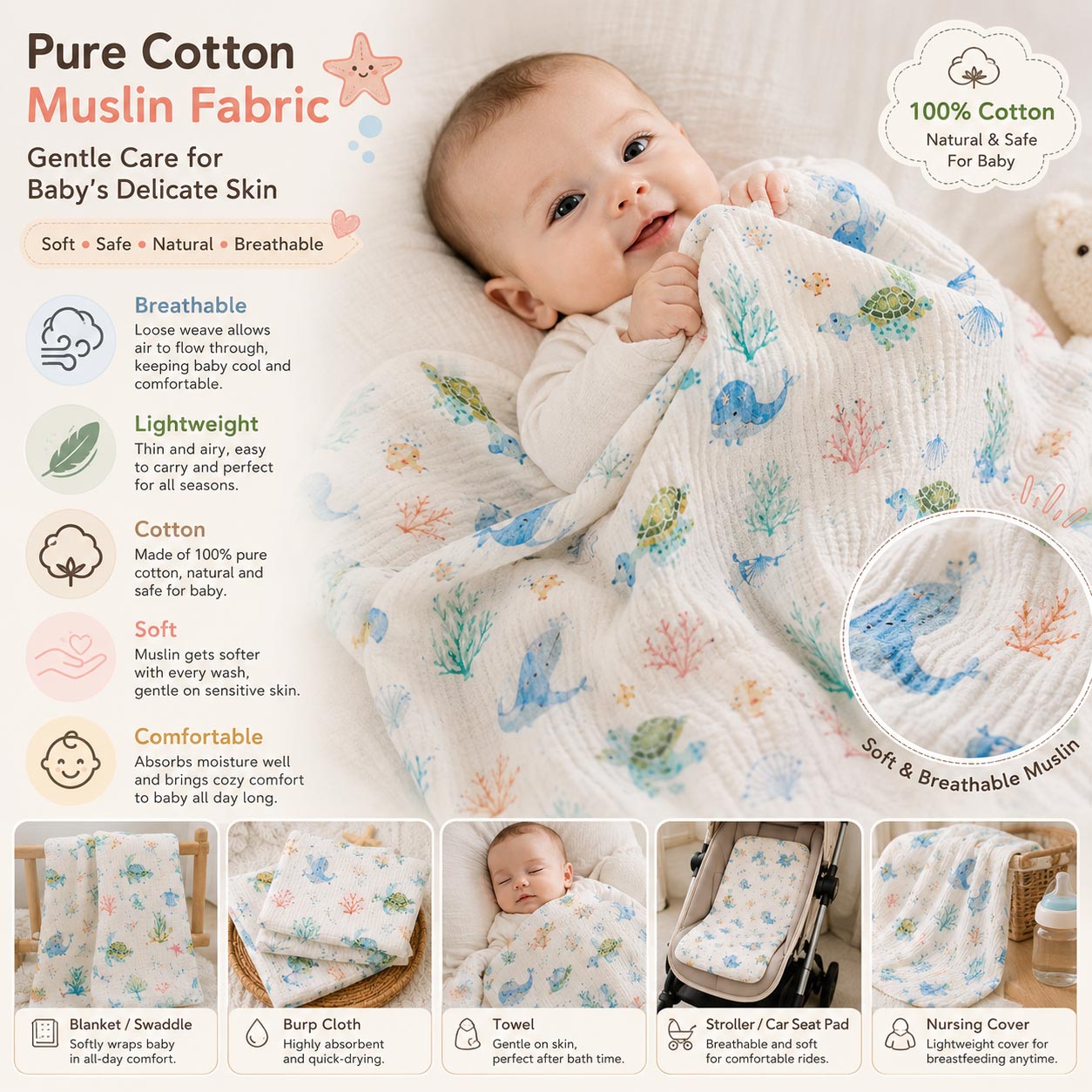
| Main applications | Babywear, summer dresses, shirts, sleepwear and children’s clothing |
The final specification should be confirmed according to the intended garment and approved physical sample.
15. Check Shrinkage After Washing
Cotton double gauze can change in both length and width after washing. Shrinkage can also increase the density and change breathability or crinkle size.
The factory should test:
- Lengthwise shrinkage
- Widthwise shrinkage
- Washing temperature
- Washing cycle
- Drying method
- Number of washes
- Appearance after washing
- GSM and width after washing
Garment factories should receive the final shrinkage result before pattern making and bulk cutting.
16. Control Printed Double Gauze Separately
Printed double gauze requires additional control because printing and fixation may affect softness, absorbency and texture.
The factory should inspect:
- Pattern clarity
- Registration
- Color penetration
- White spots on raised areas
- Print coverage
- Shade consistency
- Hand feel after printing
- Crinkle retention
- Appearance after washing
Heavy pigment application or excessive binder can make the fabric feel stiff and reduce its natural breathability. The printed strike-off should therefore be made on the intended double gauze base.
17. Compare the Beginning, Middle and End of Production
Checking one cutting is not enough to represent an entire bulk order.
Inspection should cover:
- Beginning, middle and end of each finishing batch
- Left, center and right sides
- Different rolls
- Different dye or print lots
- Areas near roll joins
- Production restarts
Inspectors should look for:
- Flat sections
- Excessively wrinkled sections
- Uneven softness
- Different crinkle density
- Width variation
- GSM variation
- Shade differences
- Broken binding yarns
- Holes
- Layer separation
- Oil marks
- Skewing or bowing
Off-shade or different-texture rolls should be marked and separated.
Common Quality Problems and Their Causes
| Problem | Possible cause | Recommended control |
| Fabric feels rough | High yarn twist or insufficient washing | Check yarn and pretreatment |
| Fabric feels artificially slippery | Excessive softener | Reduce dosage and compare absorbency |
| Fabric looks too flat | High finishing tension | Increase controlled relaxation |
| Crinkle is too coarse | Excessive mechanical action | Adjust washing and drying |
| Texture differs across width | Uneven tension or drying | Check machine settings across the width |
| Low breathability | High density, shrinkage or coating | Review construction and finishing |
| Layers separate | Weak or missing binding points | Inspect weaving construction |
| Finished width is too narrow | Excessive relaxation or shrinkage | Control overfeed and dimensional setting |
| Bulk differs from sample | Different yarn, greige lot or finishing | Lock production records and references |
| Printed fabric feels stiff | Excessive pigment binder | Adjust printing and finishing recipe |
Recommended Approval Process
A reliable production process normally includes:
- The buyer confirms the intended garment.
- The supplier recommends composition, GSM and width.
- A base-fabric hanger is submitted.
- The buyer approves the unwashed and washed appearance.
- A lab dip or printed strike-off is developed.
- The finished sample is sealed and labeled.
- The manufacturer records weaving and finishing parameters.
- The first bulk lot is compared with the approved sample.
- Shrinkage, colorfastness and required performance are tested.
- Different rolls are inspected before packing.
Testing Buyers Should Request
Depending on the product and destination market, testing may include:
- Fiber composition
- Finished GSM
- Finished and usable width
- Lengthwise and widthwise shrinkage
- Air permeability
- Absorbency
- Washing colorfastness
- Dry and wet rubbing fastness
- Perspiration fastness
- Saliva fastness for babywear when required
- pH
- Formaldehyde
- Seam strength
- Seam slippage
- Tearing strength
- Skewing or bowing
- Restricted-substance testing
Test methods, washing conditions and acceptance standards should be written into the purchase order.
Sampling and Lead Time
For common solid-dyed programs, the production process may include:
- Base-fabric hanger approval
- Lab dip development: approximately 3–5 days
- Bulk production: approximately 10–15 days after approval and deposit
- Testing and inspection before shipment
Actual lead time depends on greige-fabric availability, color, order quantity, finishing requirements and production schedule.
Printed programs may require additional time for artwork preparation, strike-off approval, printing, fixation and washing.
MOQ
For a typical solid-dyed program, MOQ may start from approximately 2,000 meters per color. However, the actual MOQ depends on:
- Available greige fabric
- Composition
- GSM and width
- Color
- Dyeing method
- Printing method
- Finishing
- Testing
- Packing requirements
Buyers should confirm whether the MOQ applies per color, per pattern or per total order.
Packaging
Double gauze should be protected from moisture, dirt and excessive compression during transport.
Buyers should confirm:
- Roll length
- Minimum roll length
- Short-roll tolerance
- Paper-tube requirements
- Inner plastic protection
- Outer packing
- Roll and batch numbers
- Color labels
- Meters or yards
- Shipping marks
Packing pressure can temporarily flatten the crinkle, so fabric should be allowed to relax before final texture evaluation.
Payment and Incoterms
The quotation should clearly state:
- Currency
- Deposit
- Balance-payment timing
- EXW, FOB, CIF or another Incoterm
- Named port or destination
- Sample and courier costs
- Testing charges
- Inspection responsibility
- Quantity tolerance
- Destination charges
These terms should be confirmed before bulk production begins.
After-Sales and Repeat-Order Control
For repeat orders, the supplier should retain:
- Yarn and greige-fabric quality code
- Approved finished sample
- Lab dip or strike-off
- Weaving parameters
- Washing and finishing recipe
- GSM and width records
- Shrinkage results
- Inspection reports
- Roll-packing instructions
If the original yarn or greige lot is no longer available, the supplier should advise the buyer and arrange a new sample before bulk production.
Buyer Checklist
Before placing an order with a Double Gauze Fabric Manufacturer & Supplier in China, confirm:
- Exact fiber composition.
- Two-layer construction.
- Finished GSM and tolerance.
- Finished and usable width.
- Approved softness.
- Natural crinkle appearance.
- Breathability or air-permeability requirement.
- Opacity.
- Lengthwise and widthwise shrinkage.
- Colorfastness.
- Seam performance.
- Babywear-related testing when required.
- Lab dip or printed strike-off.
- MOQ and production time.
- Roll length and packing.
- Procedure for off-shade or inconsistent rolls.
- Records retained for repeat orders.
Frequently Asked Questions
How can buyers judge double gauze softness?
Buyers should compare a conditioned and washed bulk sample with a sealed finished reference. The fabric should be evaluated for surface softness, compression, flexibility, drape and the absence of rough, oily or heavily coated areas.
Is a softer double gauze always better?
No. Excessive softener may reduce absorbency, affect breathability or create an artificial slippery hand. The correct softness should match the garment application and required performance.
How is double gauze breathability tested?
Air permeability can be measured by passing air through a conditioned fabric sample under a specified pressure. The buyer should define the test method, unit and minimum result when a numerical standard is required.
Why does double gauze develop more texture after washing?
Water, heat and mechanical movement allow the yarns and two layers to relax. This creates the fabric’s natural fine crinkle and slightly fluffy volume.
Should all rolls have exactly the same wrinkles?
Individual wrinkles will not be identical because the texture is naturally irregular. However, the overall crinkle size, density, softness, width and surface appearance should remain within the approved range.
Why can crinkle texture vary between batches?
Variation may result from different yarn lots, weaving tension, greige density, washing conditions, drying temperature, overfeed or finishing. Production records and a sealed sample help reduce batch differences.
Can heavy finishing reduce breathability?
Yes. Heavy coatings, excessive softeners or high fabric compaction can reduce open spaces and affect airflow. Finishing should preserve the natural double-layer structure.
What is a suitable double gauze specification for babywear?
A common option is 100% cotton double gauze at approximately 125–145 gsm and 135–140 cm finished width. Final selection should depend on opacity, softness, shrinkage, garment design and market requirements.
How can buyers reduce sample-to-bulk differences?
Approve a finished and washed physical sample, define measurable GSM and width tolerances, record test requirements and ask the supplier to compare the beginning, middle and end of bulk production with the approved reference.
Conclusion
A reliable Double Gauze Fabric Manufacturer & Supplier in China controls softness, breathability and crinkle consistency throughout the entire process—not only during final finishing.
Yarn quality, two-layer construction, weaving tension, washing, drying, soft finishing, GSM, width and shrinkage all influence the final fabric. The safest purchasing method is to approve a finished and washed physical sample and convert visual expectations into written bulk standards.
Shaoxing Yilin Textile supplies cotton double gauze in approximately 125–145 gsm and 135–140 cm finished width for babywear, children’s clothing, summer dresses, shirts, sleepwear and related collections. Buyers can provide the target garment, color or pattern, testing requirements and order quantity to develop a suitable sampling and bulk-production plan.

Leave a comment
This site is protected by hCaptcha and the hCaptcha Privacy Policy and Terms of Service apply.