
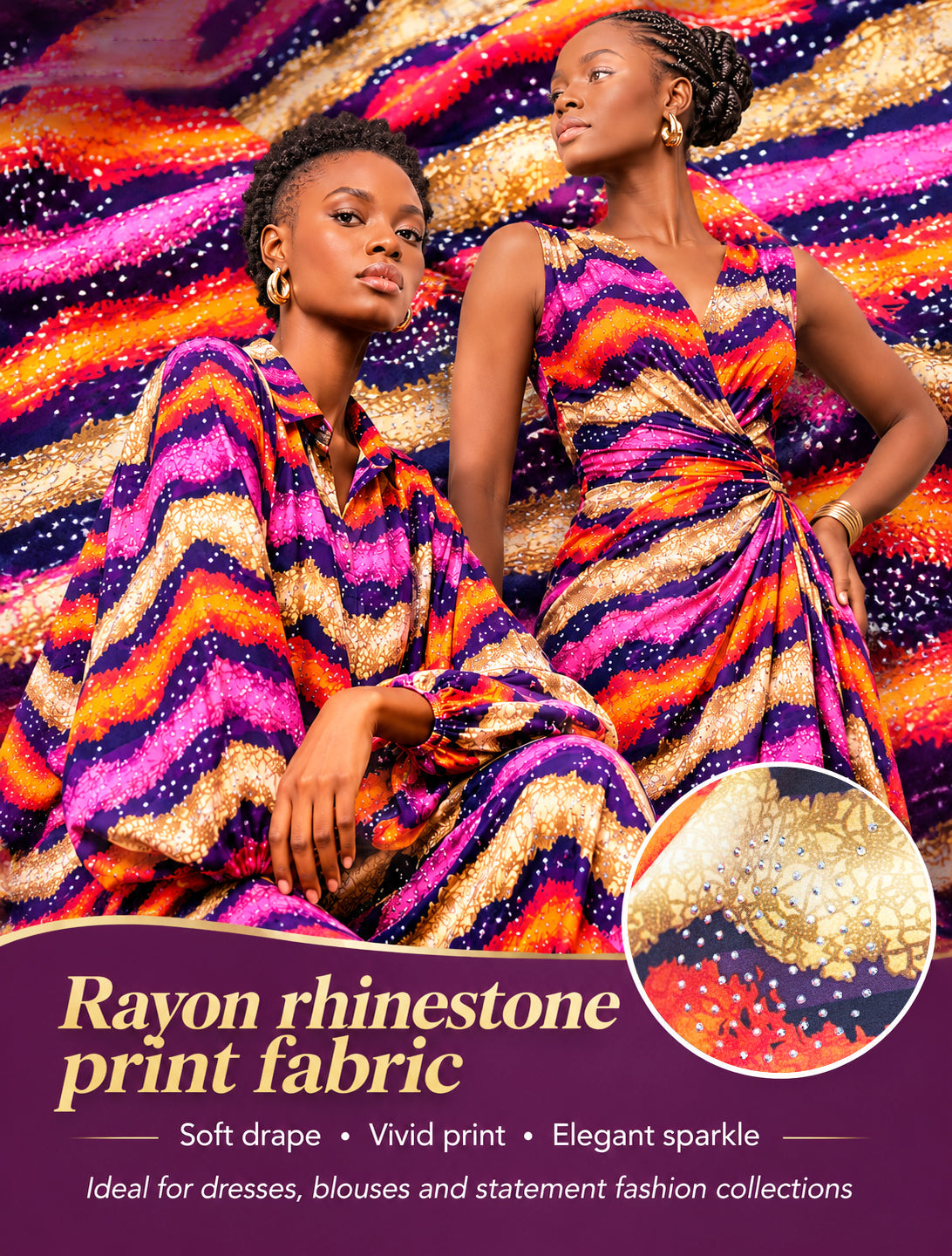
The most commercially relevant rayon diamond print fabrics for African women’s fashion are bold floral and botanical prints, geometric and ornamental patterns, animal and leaf designs, ethnic- or batik-inspired motifs, painterly abstracts, rich black-and-gold colorways and border or placement prints. For everyday fashion, buyers often select lightweight rayon with limited scattered rhinestones or stones highlighting parts of the pattern. For kaftans, boubous, wedding-guest dresses and occasionwear, larger motifs, jewel colors, metallic-looking accents and more concentrated rhinestone placement are more suitable. Market preference varies significantly between West, North, Central, East and Southern Africa, so wholesalers should test designs by country and garment category.
Top Answers Pack
1. Which rayon diamond prints are most popular for African dresses?
Large florals, tropical leaves, decorative geometrics, animal patterns, ethnic-inspired motifs and black-and-gold ornamental prints are strong starting categories. The best design depends on whether the garment is an everyday dress, boubou, kaftan, wrapper set, co-ord or formal gown.
2. Are floral rhinestone prints popular?
Yes. Floral and botanical prints are versatile because rhinestones can be placed in flower centers, along leaf veins or around selected outlines without covering the full design. Both large statement florals and smaller repeat florals can work for women’s dresses.
3. Which rhinestone layout is best for wholesale fabric?
Selective motif accents and controlled scattered layouts are usually easier to cut and use across different garment patterns. Heavy neckline or border placement can create more impact but requires the garment maker to follow the print direction and marker plan.
4. Which colors are suitable for African markets?
Strong commercial groups include black with gold or brown, royal blue, emerald green, burgundy, purple, orange, red, yellow, turquoise and cream with metallic-looking accents. Buyers should develop colorways for the specific country and customer level rather than treating Africa as one color market.
5. Is rayon diamond fabric suitable for kaftans and boubous?
Yes. Soft rayon drape can suit full-length kaftans, boubous and free gowns. Larger motifs, border prints and stones concentrated around the front panel, neckline or sleeve area are especially useful for these silhouettes.
6. Is it suitable for fitted dresses?
It can be used for wrap dresses, gathered gowns and softly fitted styles. Standard woven rayon has limited stretch, so tightly fitted mermaid or bodycon garments may require pattern ease, a suitable construction, lining or a different stretch base.
7. Should the rhinestones cover the whole fabric?
Not necessarily. Heavy all-over coverage increases cost, weight and cutting limitations. Many commercial programs use rhinestones to highlight selected pattern areas while keeping the fabric soft and wearable.
8. What should buyers test before bulk production?
Buyers should test stone attachment after rubbing and washing, print colorfastness, shrinkage, GSM, usable width, drape, stone distribution, missing stones, fabric damage and appearance after garment pressing.
9. Can buyers customize the print and rhinestone layout?
Yes. Buyers may customize artwork, pattern scale, colorway, base fabric, stone color, stone size, spacing and placement. A strike-off and rhinestone-placement sample should be approved before bulk production.
10. What is the best way to test a new African market?
Start with a focused assortment covering two or three print categories and several coordinated colorways. Digital printing can support lower-quantity design testing, while larger rotary-print programs can follow after sales feedback.
Why Rayon Diamond Print Fabric Fits African Women’s Fashion
African women’s fashion includes many different markets, cultural references, climates, occasions and garment silhouettes. A fabric that works for a Nigerian wedding-guest gown may not match a Moroccan caftan, an everyday Ghanaian dress or a contemporary South African co-ord.
Rayon diamond print fabric can serve several segments because it combines:
- Soft and fluid drape
- Bright or detailed printed patterns
- Decorative sparkle
- Lightweight or medium-weight constructions
- Suitability for dresses, kaftans and free gowns
- Custom pattern and color development
- Different rhinestone densities for different price levels
Recent Nigerian fashion coverage continues to highlight beads, crystals and rhinestones as statement-making elements, particularly for occasionwear and premium garments. Contemporary African print fashion also uses modern co-ords, wrap dresses, kaftans and fitted occasion silhouettes alongside traditional forms. These directions support the commercial potential of printed rayon with controlled sparkle, but the fabric must still be adapted to the target garment and market.
The Most Popular Print Categories
1. Large Floral and Botanical Prints
Large florals are one of the most practical categories for rayon diamond fabric because the stones can follow the printed motif.
Popular design directions include:
- Oversized tropical flowers
- Large leaves and branches
- Hibiscus-inspired florals
- Rose and peony arrangements
- Floral vines
- Layered flowers with contrasting outlines
- Dark-ground botanical prints
- Watercolor-style flowers
Rhinestones can be applied:
- In flower centers
- Along selected petal edges
- On leaf veins
- At intersections between stems
- Around metallic-looking printed details
This creates sparkle without making the whole fabric feel heavily coated.
Large florals are suitable for:
- Full-length dresses
- Boubou gowns
- Kaftans
- Wrap dresses
- Skirts
- Wedding-guest styles
- Resort dresses
2. Leaf and Nature Prints
Leaf patterns are useful when buyers want a statement print that feels less romantic than traditional flowers.
Common directions include:
- Large palm leaves
- Layered tropical foliage
- Gold-look leaves on dark grounds
- Abstract leaves
- Fine vine patterns
- Monochrome leaves with stone highlights
- Brown, olive and gold botanical groups
Clear or gold-tone rhinestones can emphasize leaf edges or central veins. Black, coffee, olive, cream and gold combinations are especially suitable for sophisticated occasionwear and mature women’s collections.
3. Bold Geometric Prints
Geometric prints offer strong visual order and work well for both traditional and contemporary garments.
Popular directions include:
- Large diamonds
- Interlocking circles
- Repeated squares
- Fan shapes
- Chain motifs
- Zigzags
- Optical lines
- Symmetrical medallions
- Geometric patchwork
Stones can be placed at repeat intersections or used to outline selected shapes. This makes the rhinestone layout easier to repeat and inspect.
Geometric designs are suitable for:
- Co-ord sets
- Shirt dresses
- Straight gowns
- Wrap dresses
- Skirts
- Modern kaftans
- Tailored tops
4. Ornamental and Baroque-Inspired Prints
Ornamental prints are particularly suitable for garments positioned as luxurious or ceremonial.
Design directions may include:
- Baroque scrolls
- Decorative medallions
- Paisley forms
- Gold-look chains
- Arabesque-inspired lines
- Jewel-like motifs
- Symmetrical border ornaments
- Palace-inspired patterns
Black-and-gold, burgundy-and-gold, emerald-and-gold and cream-and-gold groups are useful for kaftans, long gowns and wedding-guest fashion.
The print should remain the main visual structure. Rhinestones should support the design rather than create random heavy sparkle.
5. Ethnic- and Batik-Inspired Prints
Ethnic-inspired, batik-inspired and ikat-inspired designs remain useful categories for African women’s fashion, but suppliers should avoid presenting generic motifs as authentic cultural designs without evidence.
Commercial directions include:
- Hand-drawn marks
- Irregular resist-dye effects
- Decorative border motifs
- Ikat-style blurred geometry
- Symbol-inspired repeats
- Patchwork arrangements
- Earth-tone ethnic patterns
- Bold multicolor tribal-style graphics
Rhinestones may be used selectively at symbol centers or along border elements.
When developing for a specific country or customer group, buyers should provide reference designs or market feedback. One generic “African print” collection cannot accurately represent the continent’s different textile identities.
6. Abstract and Painterly Prints
Abstract designs are useful for contemporary boutiques and younger fashion markets.
Popular visual directions include:
- Watercolor washes
- Marble effects
- Brushstroke patterns
- Fluid color fields
- Ink-style marks
- Painted florals
- Irregular blocks
- Ombre transitions
Small clear stones can be scattered over light-catching sections, while colored stones can match selected areas of the print.
These fabrics work well for:
- Flowing maxi dresses
- Jumpsuits
- Contemporary boubous
- Loose shirts
- Co-ord sets
- Resortwear
7. Animal and Leopard Prints
Animal prints are strong statement categories, especially when buyers want glamorous or nightlife-oriented garments.
Possible directions include:
- Traditional brown-and-black leopard
- Grey-and-black animal patterns
- Blue, purple or red fashion leopard
- Abstract zebra
- Mixed animal and floral prints
- Small-scale animal texture
Rhinestones should be controlled carefully. Too many stones on an already active animal print can make the fabric visually crowded. Selective sparkle along darker spots or motif edges is usually more commercial.
8. Border and Placement Prints
Border prints are valuable for kaftans, boubous, long dresses and wrapper-style garments because they help the garment maker place decorative areas intentionally.
Typical layouts include:
- Embellished hem borders
- Front-panel motifs
- Neckline placement
- Sleeve-edge decoration
- Vertical side borders
- Central medallions
- Coordinated body and border designs
This category requires careful technical planning. The buyer must confirm:
- Border width
- Print direction
- Repeat length
- Garment marker
- Rhinestone placement
- Usable width
- Cutting allowance
Placement designs can command a higher price, but they are less flexible than non-directional all-over prints.
9. Polka Dots, Chains and Small Repeats
Not every African women’s fabric needs oversized motifs. Small repeats can work for everyday dresses, blouses and coordinated sets.
Useful directions include:
- Irregular polka dots
- Small chains
- Mini geometric repeats
- Fine floral sprigs
- Tiny medallions
- Mixed dot-and-line patterns
Small rhinestones can be spaced at selected repeat points. This creates wearable sparkle while keeping cutting flexible.
10. Black-and-Gold and Jewel-Tone Collections
Color can be as important as motif. Strong occasionwear groups include:
- Black and gold
- Coffee, cream and gold
- Burgundy and gold
- Emerald and gold
- Royal blue and silver
- Purple and gold
- Red and black
- Turquoise and gold
- Deep navy and metallic-look accents
These combinations are useful for long gowns, kaftans and wedding-guest styles. Clear, gold-tone or matching colored stones can reinforce the palette.
For everyday and younger fashion, brighter combinations such as orange, pink, yellow, turquoise, green and blue may be more suitable.
Popular Rhinestone Application Types
1. Scattered Rhinestones
Small stones are distributed across the fabric at controlled intervals.
Advantages:
- Flexible cutting
- Lighter weight
- Lower embellishment cost
- Suitable for multiple garments
- Easier wholesale resale
The spacing should remain consistent across the width and between rolls.
2. Motif-Highlight Rhinestones
Stones are placed on selected parts of the printed design, such as flower centers, leaves, medallions or geometric intersections.
This is one of the most commercially balanced options because the sparkle supports the print instead of competing with it.
3. Neckline and Bodice Placement
Rhinestones are concentrated around a planned neckline, chest panel or front garment area.
This works well for:
- Kaftans
- Boubous
- Free gowns
- Occasion dresses
- Tunics
The design must be developed with a clear garment layout. It is less suitable for buyers who sell the same fabric to many customers using different patterns.
4. Border Rhinestones
Stones follow a printed hem, sleeve or side border. This creates a finished decorative effect without requiring the garment factory to apply stones separately.
The supplier and buyer must agree on border direction, width and repeat placement.
5. Dense Occasionwear Clusters
Larger or more closely spaced stones create a premium and dramatic appearance.
This type is suitable for:
- Wedding-guest gowns
- Formal kaftans
- Celebration dresses
- Premium boubous
- Limited boutique collections
Dense decoration increases weight, price and cutting restrictions. Stone attachment testing becomes more important.
Popular Base-Fabric Types
The same print and rhinestone design can look different on different rayon constructions.
| Rayon base | Main appearance | Suitable applications |
|---|---|---|
| Plain woven rayon | Smooth, soft and fluid | Dresses, boubous, blouses and skirts |
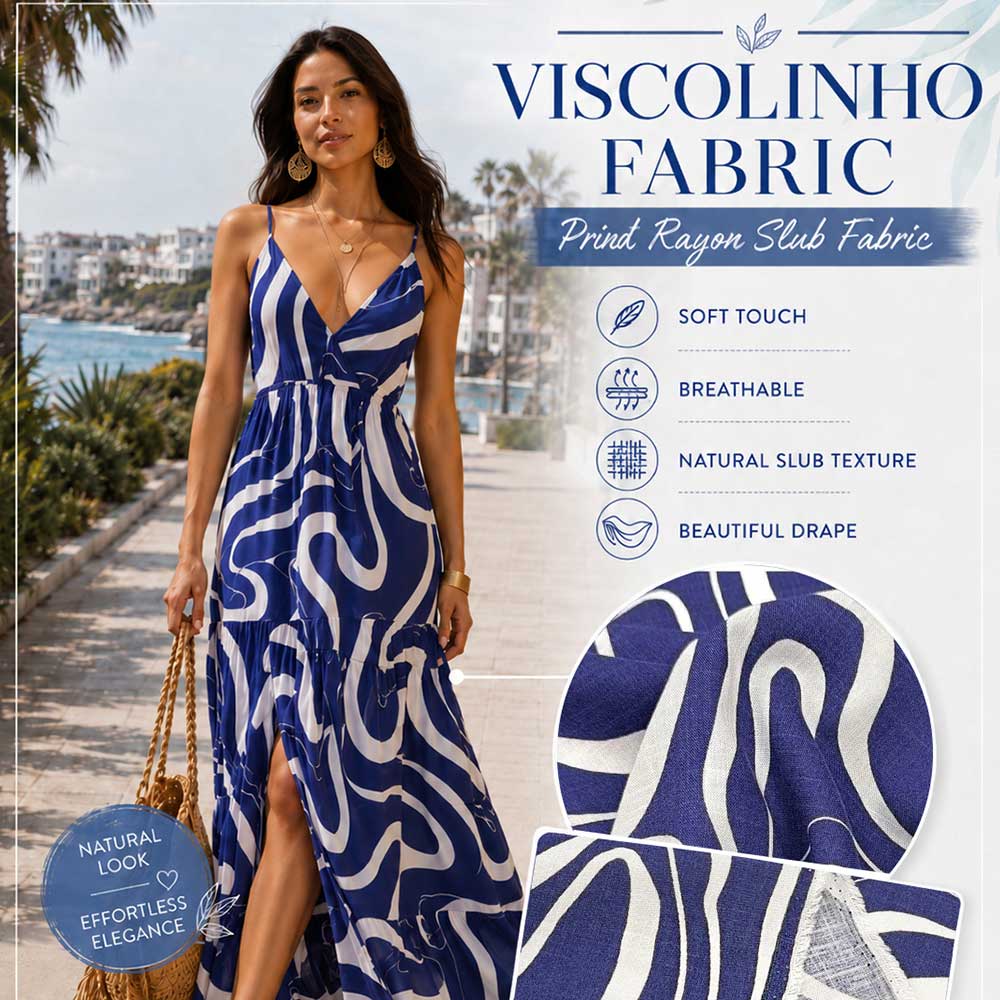
| Rayon slub | Fine natural yarn texture | Fashion dresses and relaxed occasionwear |
| Rayon twill | Slight diagonal structure and more body | Wrap dresses, trousers and structured gowns |
| Rayon sateen | Smoother surface with soft luster | Premium dresses and evening styles |
| Digital-print rayon | Detailed color and design flexibility | Lower-quantity custom collections |
| Reactive-print rayon | Soft print integration on cellulosic fibers | Larger commercial fashion programs |
The buyer should confirm the actual base construction, composition, finished GSM and usable width. “Rayon diamond fabric” alone is not a complete specification.
Regional Market Directions
West Africa
Markets such as Nigeria, Ghana, Côte d’Ivoire, Senegal and Cameroon often support bold print, color and occasionwear categories, but preferences vary by city, customer level and garment tradition.
Useful starting directions include:
- Large florals
- Strong geometric repeats
- Ethnic-inspired prints
- Black-and-gold ornamentals
- Jewel colors
- Border designs
- Motif-highlight rhinestones
- Concentrated stones for occasion garments
Kaftans, free gowns, boubous, wrap dresses, co-ords and event dresses provide different fabric opportunities.
North Africa
Morocco and Algeria have strong caftan, robe and modest-fashion traditions. Suitable rayon diamond directions may include:
- Refined florals
- Arabesque-inspired ornamentals
- Painterly designs
- Black, cream, burgundy or emerald with gold accents
- Border and front-panel layouts
- Controlled neckline and sleeve embellishment
North African buyers may prefer a more planned, elegant rhinestone layout rather than random heavy all-over decoration. The target garment and customer segment should be confirmed.
Central Africa
Large florals, leaf patterns, strong color contrasts, decorative geometrics and free-gown applications can be suitable starting points. Soft rayon drape works well for full silhouettes, but the buyer should confirm opacity and garment length requirements.
East Africa
Geometric, kitenge-inspired, floral, border and contemporary abstract designs may be relevant. Wholesalers should test color and scale locally because preferences differ across Kenya, Tanzania, Uganda and neighboring markets.
Southern Africa
Contemporary geometrics, animal prints, abstract designs, coordinated sets and boutique dresses can be suitable. Selective rhinestone accents may be easier to use across modern day-to-evening styles than dense ceremonial layouts.
Popular Garment Applications
Rayon diamond print fabric can be developed for:
- Boubou gowns
- Kaftans
- Free gowns
- Wrap dresses
- Maxi dresses
- Mermaid-inspired gowns with adequate pattern structure
- Iro-and-buba-inspired sets
- Skirts
- Blouses
- Jumpsuits
- Co-ord sets
- Tunics
- Occasionwear
Standard woven rayon normally has limited stretch. For very fitted garments, buyers should test seam strength, pattern ease, lining and movement before bulk production.
How Wholesalers Should Build an Assortment
A balanced first assortment can include:
| Category | Suggested role in the range |
|---|---|
| Large floral with motif stones | Main dress and occasion print |
| Geometric with scattered stones | Modern commercial option |
| Black-and-gold ornamental | Premium evening and kaftan group |
| Leaf or botanical print | Mature and sophisticated customer group |
| Abstract painterly print | Contemporary boutique option |
| Border or placement print | Higher-value specialty garment |
Instead of buying too many unrelated patterns, wholesalers can develop one design in several market-relevant colorways. This makes display, resale and repeat ordering easier.
Print and Rhinestone Customization Options
Buyers can customize:
- Print artwork
- Pattern scale
- Pattern direction
- Colorway
- Ground color
- Base-fabric construction
- Finished GSM
- Usable width
- Rhinestone color
- Rhinestone size
- Stone spacing
- Motif placement
- Border position
- Embellishment density
A complete approval process should include:
- Base-fabric hanger.
- Artwork and scale confirmation.
- Printed strike-off.
- Rhinestone-placement sample.
- Washed or rubbed sample.
- Garment cutting trial when placement is directional.
- First-bulk comparison.
Digital vs Rotary Printing
| Factor | Digital printing | Rotary printing |
|---|---|---|
| Typical use | Trial orders and multiple designs | Larger commercial quantities |
| Design detail | Strong for detailed artwork | Strong for repeat production |
| Color flexibility | High | Depends on screens and color separation |
| MOQ reference | From approximately 300 meters per design | Approximately 6,000 meters per design in one program |
| Colorway reference | Flexible | One design in three colors, about 2,000 meters each |
| Sampling | Digital proof or strike-off | Strike-off approximately 5–7 days |
These figures are Yilin Textile program references rather than universal market rules. Rhinestone application may add separate MOQ, sampling time and production time.
Quality-Control Points for Rhinestones
The decorative effect has little value if stones detach during cutting, sewing, washing or customer handling.
Buyers should check:
- Stone material and shape
- Stone size
- Color consistency
- Adhesive or heat-setting process
- Application temperature and pressure
- Missing-stone rate
- Alignment with the print
- Attachment after rubbing
- Attachment after washing
- Fabric damage around stones
- Yellowing or adhesive marks
- Hand feel on the reverse side
The test method should match the garment’s expected care conditions. “Not easy to fall off” should be converted into a defined washing, rubbing or pull-test procedure.
Fabric Quality-Control Points
In addition to rhinestone attachment, buyers should verify:
- Fiber composition
- Finished GSM
- Full and usable width
- Print registration
- Print penetration
- Dry and wet rubbing fastness
- Washing colorfastness
- Lengthwise shrinkage
- Widthwise shrinkage
- Skewing or bowing
- Seam slippage
- Roll length
- Batch shade
- Fabric defects
Commercial viscose qualities may show approximately 5–8% shrinkage depending on construction and finishing. Better-controlled apparel programs may require shrinkage within approximately 5% under the agreed wash method.
Colorfastness requirements should identify the exact method and grade. Grade 3–4 may be accepted for selected commercial tests, while stronger programs may require grade 4–5.
Price Factors
Rayon diamond print fabric price is affected by:
- Base-fabric composition
- Yarn and construction
- Finished GSM and width
- Reactive, pigment or digital printing
- Number of print colors
- Pattern complexity
- Rhinestone material
- Stone size and color
- Stone quantity per meter
- Placement complexity
- Order quantity
- Testing
- Fixed-length rolling
- Packing and labels
Buyers should compare quotations using the same base fabric, print method, stone density, usable width, packing and Incoterm.
A lower price may result from fewer stones, smaller usable width, lighter GSM, weaker attachment or excluded testing.
Packing Requirements
The fabric should be protected from crushing, moisture and stone abrasion.
Confirm:
- Rolling direction
- Whether the embellished face is protected
- Paper or film between layers when required
- Roll tension
- Strong paper tubes
- Inner plastic protection
- Outer packing
- Roll length
- Short-roll allowance
- Color and batch labels
- Palletization when required
- Moisture protection
Excessive roll pressure may mark the fabric or cause stones to press against adjacent layers. The packing method should be tested on the actual embellished quality.
Buyer Checklist
Before ordering rayon diamond print fabric for African women’s fashion, confirm:
- Target country and customer segment.
- Intended garment and occasion.
- Exact fiber composition.
- Base-fabric construction.
- Finished GSM and usable width.
- Print category and pattern scale.
- Colorway.
- Printing method.
- Print penetration.
- Rhinestone material and color.
- Stone size and density.
- Scattered, motif, border or placement layout.
- Stone-attachment test.
- Washing and rubbing fastness.
- Shrinkage.
- Seam performance.
- MOQ per design or colorway.
- Sampling and bulk lead time.
- Roll length and protective packing.
- First-bulk and multi-roll inspection.
Frequently Asked Questions
Is rayon diamond print fabric the same as diamond-pattern rayon?
Not always. “Diamond print” may describe a geometric diamond motif, but many suppliers use “diamond rayon fabric” to describe printed rayon decorated with rhinestones. The specification should clearly state the intended meaning.
Which print is best for Nigerian women’s fashion?
Large florals, bold geometrics, black-and-gold ornamentals, ethnic-inspired prints and strong jewel colors are useful starting groups. Occasionwear may support heavier motif or neckline embellishment, while everyday dresses may need lighter scattered stones.
Which print is best for Moroccan and Algerian kaftans?
Refined florals, painterly patterns, arabesque-inspired ornamentals, border layouts and deep colors with gold accents are suitable starting directions. Rhinestones should be planned around the neckline, front panel, sleeves or border.
Can rhinestone rayon be used for boubous?
Yes. Soft rayon drape suits full boubou silhouettes. Large motifs, free layouts and selective embellishment are generally easier to use than very small directional designs.
Do rhinestones make the fabric uncomfortable?
They can if stones are too large, densely applied or backed by excessive adhesive. Buyers should inspect flexibility, reverse-side feel and garment contact points.
Can the rhinestone layout follow the print?
Yes. Motif-following stones can highlight flower centers, leaf veins, geometric intersections or ornamental lines. This usually looks more intentional than random heavy decoration.
Can buyers order exclusive African print designs?
Yes. Artwork, scale, colorways and stone placement can be customized. Ownership, confidentiality, MOQ and repeat-order rights should be agreed in writing.
How should rhinestone attachment be tested?
The buyer and supplier should agree on rubbing, washing or pull-test conditions based on the garment care method. The result should be checked for missing stones, loose stones, adhesive marks and fabric damage.
Is digital printing suitable for rhinestone rayon?
Yes. Digital printing can support lower-quantity pattern development and detailed artwork. The print should be fixed and washed as required before rhinestone application, and the final decorated sample should be tested.
What garments are unsuitable for heavy rhinestone rayon?
Very tight stretch garments, heavily gathered seams, high-friction areas and garments requiring strong pressing may be unsuitable unless the base, adhesive and construction are specifically tested.
Conclusion
Popular rayon diamond print fabrics for African women’s fashion include floral and botanical designs, geometric patterns, animal prints, ethnic- and batik-inspired motifs, painterly abstracts, ornamental groups and border or placement layouts.
The most commercially useful rhinestone treatments are controlled scattered stones, motif highlights and planned neckline or border decoration. Heavy clusters are better reserved for premium occasionwear, kaftans, wedding-guest gowns and limited boutique collections.
Africa should not be treated as one uniform fashion market. West African, North African, Central African, East African and Southern African buyers may prefer different motif sizes, colors, garment forms and embellishment levels. The safest sourcing method is to define the country, customer segment, garment and price level before selecting prints.
Shaoxing Yilin Textile supports custom rayon and viscose print development with floral, geometric, animal, abstract and African-inspired artwork, together with controlled rhinestone application. Buyers can provide the target country, garment, reference artwork, colorways, stone layout, testing requirements, roll packing and order quantity to develop a strike-off, embellished sample and bulk-production plan.

Leave a comment
This site is protected by hCaptcha and the hCaptcha Privacy Policy and Terms of Service apply.