
Direct Answer
Neither fabric is better for every collection.
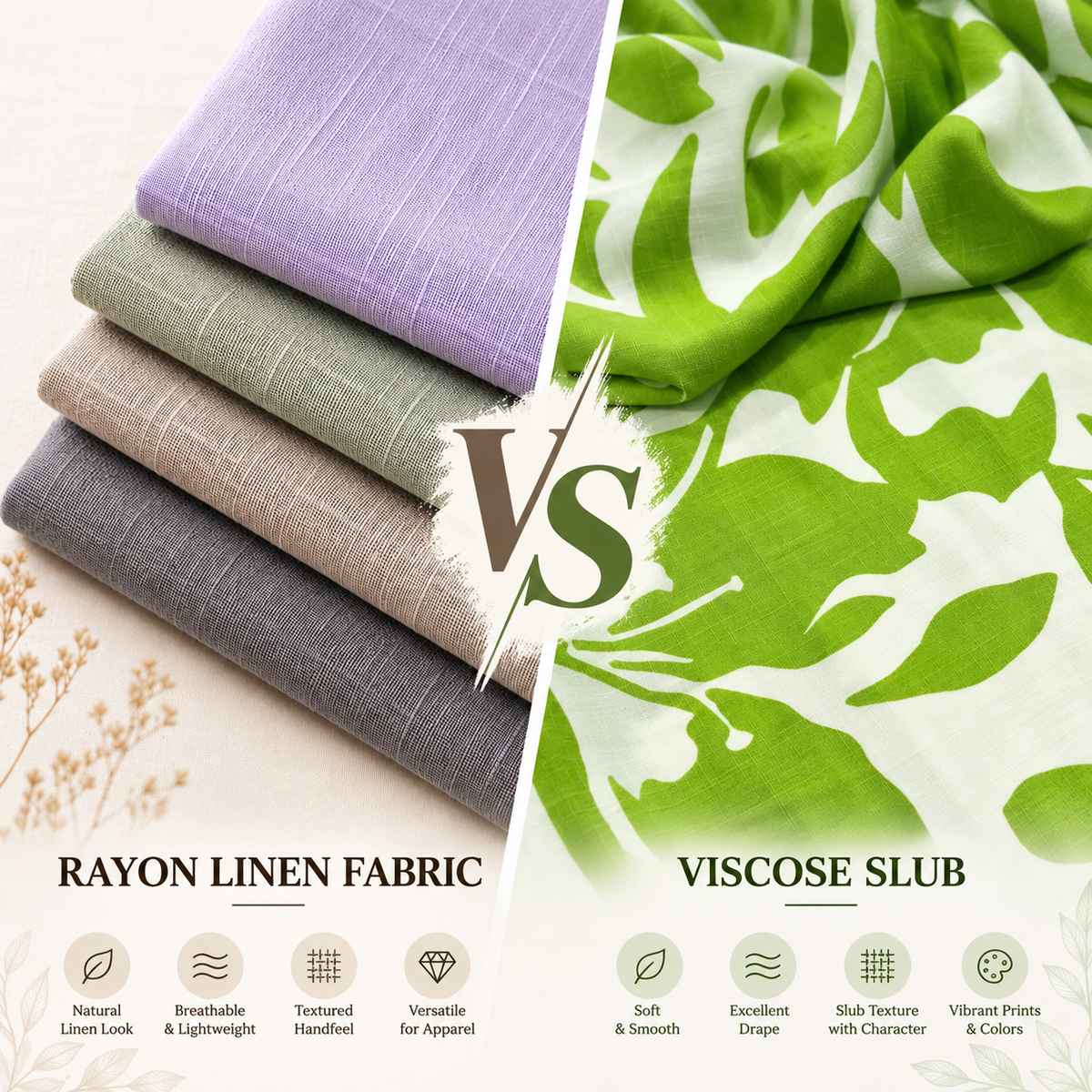
Viscose slub is usually the stronger choice for soft, flowing and lightweight women’s fashion. It works well for colorful prints, dresses, blouses, skirts and fast-moving summer collections.
Rayon linen is usually better for premium resortwear and garments requiring more body, texture and shape, such as shirt dresses, matching sets, trousers, jackets and structured skirts.
For many South American wholesalers, the most practical strategy is to use viscose slub for volume-driven fashion styles and rayon linen for higher-value capsule collections.
Top Answers Pack
1. What is the main difference between viscose slub and rayon linen?
Viscose slub is normally a viscose fabric made with irregular slub yarns. It has a soft hand, fluid drape and fine natural yarn texture.
Rayon linen is usually a blend of rayon or viscose with linen. It has more body, a drier hand and a more visible natural-fiber character. Buyers should confirm the composition because “rayon linen” can also be used commercially for linen-look fabrics.
2. Which fabric is better for hot South American climates?
Lightweight viscose slub is often more fluid and comfortable for loose dresses and blouses. Rayon linen also performs well in warm climates, especially when the linen content and construction support airflow.
Actual comfort depends on GSM, weave density, garment fit and finishing—not only the fiber name.
3. Which fabric has better drape?
Viscose slub usually has softer and more fluid drape. Rayon linen normally has more body and creates clearer garment shapes.
4. Which fabric is better for printing?
Viscose slub is commonly selected for floral, tropical, geometric, abstract and vacation-style prints. Its soft drape suits print-focused dresses and skirts.
Rayon linen can also be printed, but the textured surface may produce a more natural and slightly irregular appearance.
5. Which fabric looks more premium?
Rayon linen often creates a higher-value natural appearance because of its linen content, dry touch and visible texture. However, a well-finished viscose slub can also look premium when the yarn, print, hand feel and garment construction are properly controlled.
6. Which fabric is more suitable for dresses?
Viscose slub is better for flowing dresses, tiered dresses, wrap dresses, halter dresses and lightweight maxi dresses.
Rayon linen is better for shirt dresses, belted dresses, structured resort dresses and silhouettes that require more shape.
7. Which fabric is usually more expensive?
Rayon linen is normally more expensive because linen fiber, heavier constructions and special finishing can increase production cost. Usable width, GSM, composition and order quantity must be aligned before comparing quotations.
8. Which fabric wrinkles more easily?
Both fabrics may wrinkle. Rayon linen normally shows more visible natural creasing, while viscose slub tends to create softer wrinkles. Finishing and garment washing can change the result.
9. Which fabric has greater sourcing risk?
Viscose slub requires close control of shrinkage, slub distribution, skewing, print penetration and bulk hand feel.
Rayon linen requires close control of composition, surface hairiness, shade, width, shrinkage and batch-to-batch texture.
10. Can buyers use both fabrics in one collection?
Yes. Viscose slub can support lightweight printed fashion, while rayon linen can provide solid-colored or natural-textured premium coordinates. Using both fabrics allows wholesalers to cover different garment structures and price levels.
Quick Comparison Table
| Factor | Viscose slub fabric | Rayon linen fabric |
|---|---|---|
| Typical character | Soft, fluid and lightweight | Natural, dry and more substantial |
| Surface | Fine irregular slub yarns | More visible linen-like texture |
| Drape | High | Medium to high |
| Body | Soft and relaxed | Fuller and more structured |
| Wrinkle appearance | Soft natural wrinkles | More visible linen-style creases |
| Common GSM | Depends on construction; 140–150 gsm is one common slub option | Often medium or heavier; 220 gsm is one available blend option |
| Common width | Around 150 cm for some qualities | Around 138 cm for some qualities |
| Printing | Suitable for fashion and tropical prints | Suitable for natural-looking prints and solids |
| Opacity | Lightweight colors may require checking | Usually better in heavier qualities |
| Typical price position | Commercial to premium | Mid-range to premium |
| Main garments | Dresses, blouses, skirts and loose trousers | Shirt dresses, sets, trousers and resortwear |
| Main risk | Shrinkage, skewing and print penetration | Wrinkling, composition and texture variation |
These are sourcing references rather than fixed industry standards. Buyers should evaluate the actual finished fabric.
What Is Viscose Slub Fabric?
Viscose slub fabric is made with yarns containing fine, irregular thick-and-thin sections. The slub effect creates natural visual texture without requiring a heavy or coarse surface.
A suitable womenswear quality should generally show:
- A fine woven base
- Small-scale yarn texture
- Irregular rather than mechanical slubs
- A soft, matte surface
- Fluid drape
- Lightweight or medium body
- Rounded natural folds
The fabric should not automatically look like coarse linen or burlap. Excessively thick or regular slubs can make lightweight garments appear rough.
One common Yilin Textile development uses:
| Specification | Reference |
|---|---|
| Composition | 100% viscose |
| Yarn | 30S slub |
| Finished GSM | Approximately 140–150 gsm |
| Finished width | Approximately 150 cm |
| Main uses | Dresses, blouses, skirts and summer trousers |
The final specification should be selected according to opacity, garment shape and target price.
What Is Rayon Linen Fabric?
Rayon linen normally refers to fabric combining rayon or viscose with linen. The rayon component contributes softness and drape, while linen adds body, dry texture and a more natural appearance.
One available construction example is:
| Specification | Reference |
|---|---|
| Composition | Approximately 70% rayon / 30% linen |
| Finished GSM | Approximately 220 gsm |
| Finished width | Approximately 138 cm |
| Possible finish | Sandwashed |
| Main uses | Dresses, trousers, sets, skirts and resortwear |
The exact composition must be confirmed. Some suppliers use “rayon linen” to describe a linen-look surface even when the actual linen content is low or absent.
Which Fabric Is Better for South American Climate Conditions?
Viscose Slub
Viscose slub works well for loose, flowing clothing in warm markets because it feels soft and does not create excessive garment rigidity.
It is particularly suitable for:
- Lightweight summer dresses
- Resort dresses
- Loose blouses
- Tiered skirts
- Wide-leg trousers
- Beach cover-ups
- Relaxed matching sets
However, viscose absorbs moisture and may dry more slowly than synthetic performance fabrics. Buyers should also evaluate shrinkage after washing.
Rayon Linen
Rayon linen combines warm-weather visual appeal with more garment structure. It can be suitable for coastal, resort and urban collections where buyers want a natural appearance.
It is commonly considered for:
- Shirt dresses
- Structured sleeveless dresses
- Wide-leg trousers
- Coordinated shirt-and-short sets
- Midi skirts
- Resort jackets
- Premium casualwear
A 220 gsm rayon-linen blend will feel fuller and potentially warmer than a 140 gsm viscose slub. GSM and weave density therefore matter as much as fiber composition.
Which Fabric Is Better for South American Fashion Styles?
Choose Viscose Slub for Flowing Silhouettes
Viscose slub is particularly suitable for the lightweight, feminine shapes frequently used in South American fashion:
- Halter-neck dresses
- Off-shoulder dresses
- Wrap dresses
- Flowing maxi dresses
- High-slit skirts
- Gathered blouses
- Loose printed trousers
- Beach and vacation styles
The fluid surface allows the garment to move naturally, while the fine slub provides texture without competing with the print.
Choose Rayon Linen for Defined Silhouettes
Rayon linen works better when the garment needs to retain a clearer outline:
- Belted shirt dresses
- Straight trousers
- Structured matching sets
- Utility-style dresses
- Midi skirts
- Cropped jackets
- Premium resortwear
- Minimalist solid-color styles
The additional body can make seams, collars, pockets and waist details appear more defined.
Which Fabric Is Better for South American Prints?
Viscose slub is generally the more flexible choice for print-driven collections.
It works particularly well with:
- Tropical flowers
- Large botanical patterns
- Small florals
- Geometric prints
- Ethnic-inspired patterns
- Leaves
- Abstract designs
- Vintage motifs
- Resort patterns
The print should penetrate the fabric rather than sitting on the surface like a plastic coating. Buyers should inspect the front, back and raised slub areas.
Rayon linen can also carry prints, but its stronger surface texture may soften fine lines or create slightly irregular color coverage. This effect can support natural and artisanal designs but may be less suitable for extremely sharp miniature details.
A strike-off should always be produced on the intended bulk base fabric.
Printed Fabric Development Options
For a typical supplier program:
| Printing option | Possible MOQ structure | Best suited to |
|---|---|---|
| Digital printing | From approximately 300 meters | Trial orders, many designs and lower quantities |
| Rotary printing | Approximately 6,000 meters per design | Larger commercial programs |
| Rotary color combination | Three colors at approximately 2,000 meters each | One design sold in coordinated colorways |
| Strike-off time | Approximately 5–7 days | Color and pattern approval |
| Rotary bulk production | Approximately 20–25 days after approval | Planned wholesale orders |
These are Yilin Textile program references, not universal market rules. Availability depends on the base fabric, artwork, color count and production schedule.
Which Fabric Has Better Commercial Potential?
Viscose Slub: Broader Volume Potential
Viscose slub can support broader wholesale sales because it offers:
- Familiar soft rayon hand feel
- Strong suitability for prints
- Multiple garment applications
- Fluid appearance on mannequins
- Easier coordination across dress and blouse collections
- Commercially accessible price positioning
It is often suitable for wholesalers selling frequent fashion updates and wider print selections.
Rayon Linen: Higher-Value Positioning
Rayon linen may support a higher selling price because it offers:
- Natural linen-associated appearance
- More substantial hand feel
- Better visual structure
- Strong solid-color presentation
- Premium resortwear positioning
- Suitability for coordinated sets
Its higher fabric cost and heavier weight may require more selective purchasing and retail positioning.
Price Comparison
Rayon linen normally costs more than viscose slub, but price per meter alone is not enough.
Buyers should compare:
- Actual composition
- Finished GSM
- Usable width
- Dyeing or printing method
- Sandwashing or other finishing
- Order quantity
- Testing
- Packing
- Freight
- Fabric consumption per garment
- Shrinkage and cutting loss
For example, a 220 gsm rayon-linen fabric at 138 cm may have a higher material and freight cost than a 140–150 gsm viscose slub at 150 cm. The finished garment may therefore need a higher wholesale or retail price.
Shrinkage and Dimensional Stability
Both fabrics require washing tests.
Viscose Slub Risks
- Lengthwise and widthwise shrinkage
- Skewing
- Fabric distortion
- Change in slub appearance
- Increased surface wrinkling
- Garment measurement changes
Rayon Linen Risks
- Dimensional change
- Increased creasing
- Surface hairiness
- Change in hand feel
- Seam puckering
- Different shrinkage between rayon and linen fibers
Some commercial viscose qualities may have shrinkage around 7–8%, while better-controlled programs may target approximately 5%. These values are not automatic standards. Buyers must specify the test method, washing temperature and drying process.
Colorfastness Comparison
Both fabrics can achieve acceptable colorfastness when the dyeing process matches the composition and end use.
A commercial requirement may be grade 3–4, while stronger programs may target grade 4–5 for selected tests.
Buyers should confirm:
- Washing fastness
- Dry rubbing
- Wet rubbing
- Perspiration
- Water fastness
- Light fastness when required
- Color change after washing
- Staining on adjacent fabrics
Dark colors, saturated tropical shades and strong printed grounds deserve particular attention.
Sewing and Garment-Production Comparison
Viscose Slub
Possible production issues include:
- Movement during cutting
- Fraying
- Seam slippage
- Needle marks
- Distortion during sewing
- Uneven feeding
- Stretching around curved seams
The garment factory should avoid excessive fabric tension and test the needle, stitch density and seam construction.
Rayon Linen
Possible production issues include:
- Fraying
- Visible needle damage
- Seam puckering
- Bulk at folded areas
- Wrinkling during production
- Yarn movement around seams
Rayon linen may be easier to control when the construction has sufficient body, but heavier qualities can create bulk around collars, pockets and waistbands.
Buyer Decision Guide
| Collection requirement | Better starting option |
|---|---|
| Lightweight printed dresses | Viscose slub |
| Flowing maxi dresses | Viscose slub |
| Tropical and floral print collections | Viscose slub |
| Low-quantity digital print testing | Viscose slub |
| Soft blouses and gathered skirts | Viscose slub |
| Natural solid-color resortwear | Rayon linen |
| Shirt dresses and structured sets | Rayon linen |
| Wide-leg trousers requiring more body | Rayon linen |
| Premium linen-look capsule | Rayon linen |
| Coordinated multi-price collection | Use both |
What Should Buyers Check Before Ordering?
For Viscose Slub
Confirm:
- Exact composition.
- Yarn count and slub direction.
- Slub size and distribution.
- Finished GSM.
- Full and usable width.
- Drape and opacity.
- Lengthwise and widthwise shrinkage.
- Skewing.
- Colorfastness.
- Print penetration.
- Hand feel after printing.
- Roll-to-roll texture consistency.
For Rayon Linen
Confirm:
- Actual rayon and linen percentages.
- Yarn and weave construction.
- Finished GSM and width.
- Surface hairiness.
- Natural texture.
- Sandwashed or other finishing.
- Shrinkage after washing.
- Wrinkle appearance.
- Shade consistency.
- Seam performance.
- Fabric strength.
- Batch-to-batch composition and texture.
Recommended Sampling Process
A reliable approval process should include:
- Base-fabric hanger.
- Washed fabric cutting.
- Lab dip for solid colors.
- Strike-off for printed styles.
- Drape and opacity evaluation.
- Garment sewing trial.
- Shrinkage and colorfastness testing.
- First-bulk comparison.
- Multi-roll inspection.
- Retained sample for repeat orders.
Solid-color lab dips may require approximately 3–5 days, depending on color difficulty and scheduling.
Frequently Asked Questions
Is viscose slub the same as rayon linen?
No. Viscose slub normally obtains its texture from irregular yarn thickness. Rayon linen normally contains rayon or viscose blended with linen, although buyers must verify the actual composition.
Which fabric is softer?
Viscose slub is generally softer and more fluid. Rayon linen normally has a drier, more substantial hand.
Which fabric is more breathable?
Both can be comfortable in warm conditions. Actual airflow depends on GSM, yarn size, weave density and finishing. A lightweight viscose slub may feel cooler than a heavy rayon-linen quality.
Which fabric is better for Brazilian women’s fashion?
Viscose slub is a strong choice for colorful, flowing dresses and print-led collections. Rayon linen is suitable for natural-looking resortwear, structured sets and higher-price garments. The garment style and sales channel should determine the choice.
Does rayon linen always contain linen?
No. Some commercial names describe only the appearance. Buyers should confirm the fiber composition through written specifications and testing when necessary.
Can viscose slub be digitally printed?
Yes. Digital printing is suitable for detailed designs, multiple colors and lower-quantity development. The design should be sampled on the actual slub base.
Which fabric is better for trousers?
Rayon linen is generally better for trousers requiring structure and coverage. Viscose slub is suitable for loose, flowing wide-leg trousers when the GSM and opacity are adequate.
Can both fabrics be used in the same fashion collection?
Yes. A collection can use printed viscose slub for dresses and blouses, with solid rayon linen for trousers, skirts or matching sets. This creates different price and styling levels without losing seasonal coordination.
Conclusion
Viscose slub fabric is generally better for lightweight, fluid and print-focused South American women’s fashion. Its soft drape and subtle yarn texture suit dresses, blouses, skirts and relaxed summer garments.
Rayon linen fabric is better when the collection requires more body, a natural surface and a higher-value resortwear appearance. It is particularly suitable for shirt dresses, matching sets, trousers and structured casualwear.
South American buyers do not necessarily need to choose only one. Viscose slub can support commercial print volume, while rayon linen can strengthen premium solid-color and natural-texture categories.
Shaoxing Yilin Textile supplies 30S viscose slub at approximately 140–150 gsm and 150 cm finished width, together with rayon-linen qualities such as 70% rayon/30% linen at approximately 220 gsm and 138 cm. Buyers can provide the target garment, reference sample, artwork, color requirements and order quantity to develop the appropriate base fabric and sampling plan.


Leave a comment
This site is protected by hCaptcha and the hCaptcha Privacy Policy and Terms of Service apply.