
Direct Answer
South American buyers should compare China viscose slub fabric manufacturers and suppliers with a standardized scorecard rather than selecting the lowest quotation. Each candidate should quote the same finished composition, GSM, usable width, color or print method, testing standard, packing and Incoterm. Buyers should approve a washed physical sample, verify bulk-production capability, compare test results, inspect several rolls before shipment and confirm how the supplier controls shade, shrinkage, slub texture and repeat orders.
Top Answers Pack
1. What is the first point to compare between viscose slub suppliers?
Compare the actual finished fabric specification, not only the product name. Two suppliers may both quote “viscose slub,” while offering different yarn counts, weights, widths, weave densities, slub effects, finishing processes and usable cutting widths.
2. Is a factory always better than a trading company?
Not automatically. A factory may provide stronger process control, while an experienced supplier or trading company may coordinate weaving, dyeing, printing, testing and export documentation more effectively. Buyers should verify who controls each production stage and who accepts responsibility for quality problems.
3. Which samples should buyers request?
Buyers should request a finished base-fabric hanger, a washed cutting, a lab dip for solid colors or a strike-off for prints, and a pre-production or first-bulk sample. All references should be labeled with composition, GSM, width, finish, color and approval date.
4. How should buyers compare fabric hand feel and slub texture?
Condition all samples under similar conditions and compare softness, drape, surface hairiness, slub size, slub distribution and recovery after compression. The approved sample should show a natural irregular slub rather than thick, rigid or overly regular yarn effects.
5. Which test results are most important?
Important checks include fiber composition, finished GSM and width, dimensional change after washing, colorfastness to washing and rubbing, skewing, tearing strength and seam performance. Printed qualities may also require print durability and appearance-after-washing tests.
6. How should buyers compare MOQ?
Confirm whether the MOQ applies per fabric quality, color, print design, colorway or total order. Also check greige-fabric availability, minimum dye lot, minimum print run and allowable over-delivery or under-delivery.
7. How should price quotations be compared?
Place all quotations on the same basis: composition, finished GSM, usable width, process, finish, testing, packing, quantity, payment terms and Incoterm. A lower price may result from a lighter weight, narrower usable width, simpler finish or excluded testing costs.
8. What production evidence should a buyer request?
Ask for current production records, machine or partner-factory information, recent inspection examples, test reports, batch identification methods and a realistic production schedule. A video call or third-party audit can help confirm facilities when the order value justifies it.
9. How can buyers reduce sample-to-bulk differences?
Seal a finished and washed approval sample, define measurable tolerances, approve the first bulk output and inspect the beginning, middle and end of different rolls. The supplier should keep production recipes and reference samples for future orders.
10. What is the best final decision method?
Use a weighted comparison covering quality, consistency, delivery, communication, commercial terms and risk control. A controlled trial order is usually safer than moving directly from a small sample to a large multi-color program.
Why Supplier Comparison Is More Complex for Viscose Slub
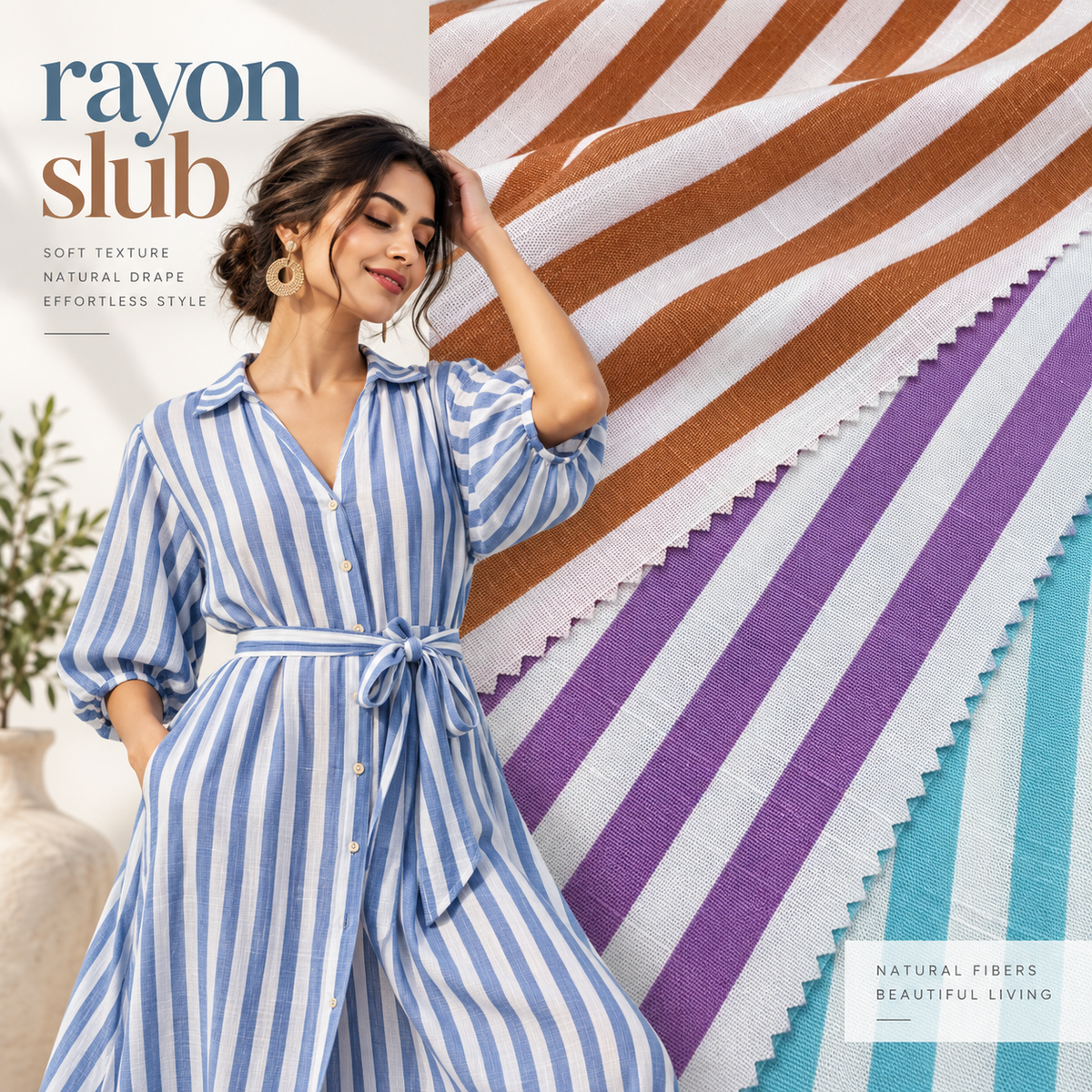
Viscose slub fabric is not a single standardized product. Its appearance and performance are influenced by the fiber, yarn count, slub yarn design, weave density, wet processing, dyeing or printing, washing, drying and final finishing.
The fabric may look similar in supplier photographs but behave differently during garment cutting, sewing and washing. Small production changes can affect:
- Finished GSM
- Usable width
- Softness and drape
- Slub thickness and distribution
- Surface hairiness
- Shrinkage
- Skewing
- Shade
- Print penetration
- Seam stability
For South American wholesalers, these differences can influence both cutting yield and resale acceptance. The comparison process should therefore connect the physical fabric with the full commercial offer.
Recommended Supplier Comparison Scorecard
| Evaluation area | Suggested weight | What to verify |
|---|---|---|
| Finished fabric quality | 25% | Composition, GSM, width, hand feel, drape and slub texture |
| Bulk consistency | 20% | Shade, shrinkage, texture, roll-to-roll and batch control |
| Testing and inspection | 15% | Test methods, reports, internal QC and third-party access |
| Price and commercial terms | 15% | Comparable price basis, payment terms and quantity tolerance |
| MOQ and flexibility | 10% | MOQ per color or design, trial order and color combination |
| Lead time and capacity | 10% | Greige availability, realistic schedule and production tracking |
| Communication and claims | 5% | Response accuracy, records, corrective action and after-sales terms |
The weighting can be adjusted. A fashion wholesaler developing many colorways may give more weight to MOQ and sampling, while a garment factory may prioritize shrinkage, usable width and sewing performance.
1. Confirm the Supplier’s Legal and Commercial Identity
Before comparing fabric, verify who will receive the payment, issue the commercial invoice and accept responsibility for the order.
Buyers should confirm:
- Registered company name
- Business address
- Exporting entity
- Bank-account beneficiary
- Invoice and contract entity
- Main contact person
- Production and warehouse locations
- Years of experience with viscose or rayon fabrics
- Relevant audit or certification documents when required
The company name on the quotation, sales contract, bank account and shipping documents should be consistent or clearly explained. A mismatch does not automatically indicate fraud, but it should be resolved before a deposit is paid.
2. Identify Who Controls Each Production Stage
Viscose slub production may involve yarn sourcing, weaving, pretreatment, dyeing, printing, finishing, inspection and packing at different facilities. The key question is not simply “Are you a factory?” but “Who controls each stage and who is accountable?”
Ask the supplier to explain:
- Where the greige fabric is woven.
- Whether greige fabric is regularly available.
- Where dyeing or printing is completed.
- Who approves the finishing recipe.
- Where testing is performed.
- Who conducts final roll inspection.
- Who handles corrective action when bulk does not match the standard.
A supplier that outsources some processes can still be reliable if it has stable production partners, documented standards and strong final inspection.
3. Compare the Exact Fiber Composition
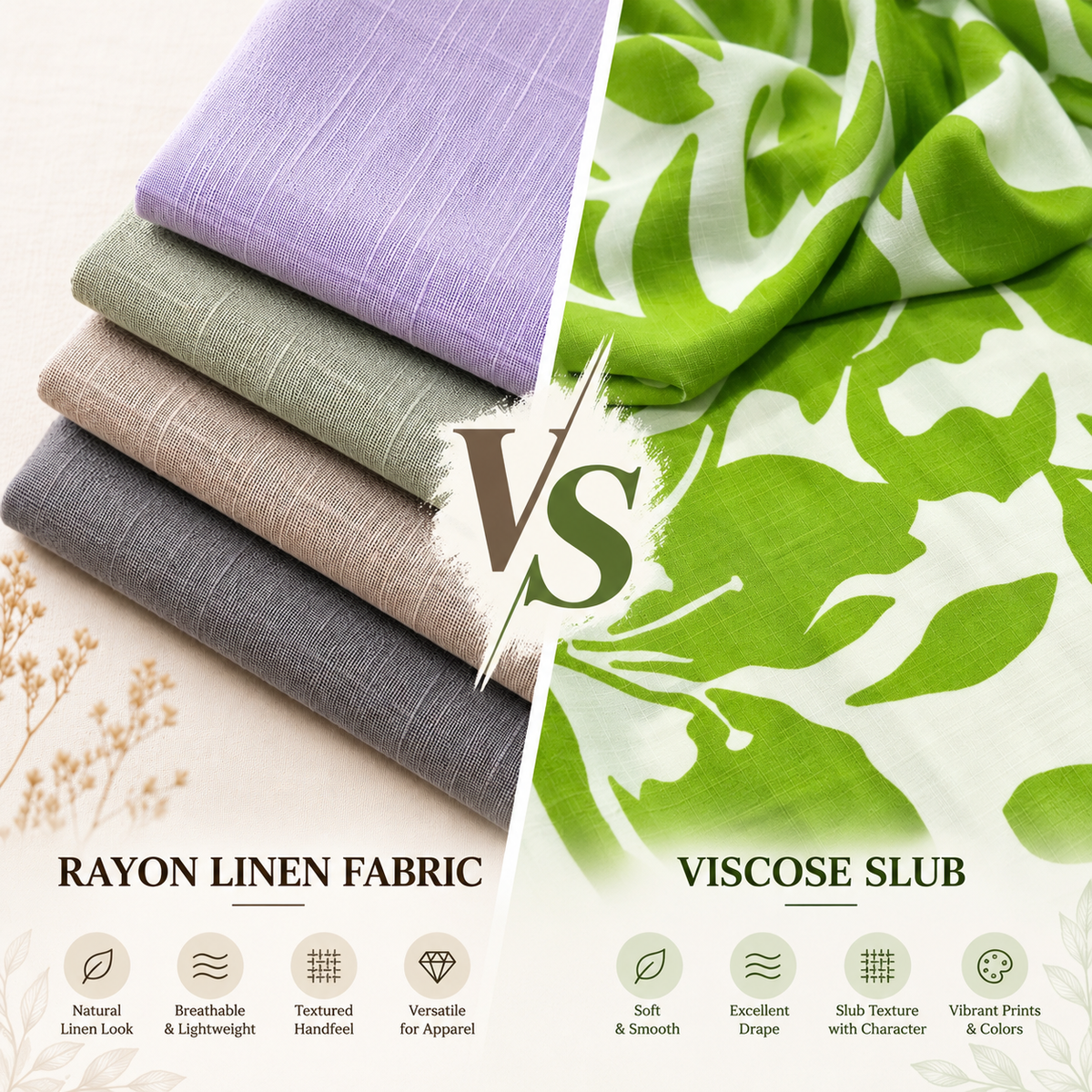
“Rayon” and “viscose” are sometimes used interchangeably in commercial communication, but the purchase order should state the exact declared composition required for labeling and customs documents.
Buyers should confirm whether the fabric is:
- 100% viscose
- Viscose blended with linen
- Viscose blended with polyester
- Viscose blended with nylon
- Another rayon-based blend
Different blends can change moisture absorption, drying time, drape, strength, shrinkage, price and garment-care instructions. A fiber-content test may be appropriate for new suppliers or sensitive programs.
4. Lock the Yarn and Slub Character
The slub effect is one of the main visual selling points, but descriptions such as “natural slub” are too subjective for bulk control.
Compare:
- Yarn count
- Slub-yarn direction
- Average slub length
- Thick and thin yarn contrast
- Slub frequency
- Distribution regularity
- Surface hairiness
- Yarn strength
- Appearance after washing
A good apparel slub normally appears fine, elongated and naturally irregular. It should not automatically resemble coarse linen, heavy burlap or thick decorative yarn unless that look is specifically requested.
The buyer should keep a sealed physical sample showing the approved slub scale and distribution.
5. Compare Finished GSM and Usable Width
Suppliers should quote finished specifications rather than only greige-fabric data. Confirm both full width and usable cutting width, because damaged selvedges, unprinted edges or finishing distortion can reduce actual garment yield.
One common viscose slub development for dresses, blouses and relaxed trousers uses 30S slub yarn at approximately 140–150 gsm and around 150 cm finished width. This is a sourcing reference, not a universal standard. Lightweight or heavier alternatives should be selected according to the garment.
The purchase order should specify:
- Target finished GSM
- Acceptable GSM tolerance
- Full finished width
- Minimum usable width
- Measurement method
- Condition before measurement
- Width and GSM after washing when relevant
Price per meter can be misleading if one supplier offers a lighter or narrower fabric. Buyers can also compare approximate fabric cost per usable square meter.
6. Evaluate Hand Feel, Drape and Garment Appearance
South American womenswear programs often require a soft hand, fluid drape and enough body to display floral, tropical, geometric or solid-color designs clearly. The correct balance depends on the final garment and customer level.
Compare samples for:
- Surface softness
- Fluidity and drape
- Dry, smooth or peach-like touch
- Fabric body
- Transparency
- Recovery after folding
- Natural wrinkle appearance
- Static cling
- Odor or excessive chemical finish
Do not evaluate only a small folded swatch. Hang a larger cutting vertically, place it over a mannequin or sew a basic garment panel. A fabric that feels soft in the hand may still become too limp, transparent or unstable in a finished garment.
7. Approve Both Unwashed and Washed Samples
Viscose can change noticeably during laundering. A washed reference helps buyers understand the final hand feel, dimensions, slub definition and surface appearance.
The washing trial should record:
- Sample dimensions before washing
- Washing temperature and cycle
- Detergent conditions
- Drying method
- Number of cycles
- Lengthwise dimensional change
- Widthwise dimensional change
- Skewing or twisting
- Color and surface change
- Hand feel after drying
The same washing and drying method must be used when comparing suppliers. Results from different conditions are not directly comparable.
8. Compare Shrinkage Control, Not Only One Test Number
Ask each supplier how shrinkage is controlled through greige selection, pretreatment, relaxation, drying, finishing and final inspection.
The buyer should define:
- Test method
- Washing conditions
- Drying conditions
- Maximum lengthwise change
- Maximum widthwise change
- Whether the requirement applies before or after garment washing
Commercial viscose qualities may show different shrinkage levels depending on construction and finishing. Some programs accept approximately 7–8%, while more demanding buyers may request results closer to 5% or another agreed limit. These figures should never be assumed; they must be confirmed for the approved quality and care method.
Garment factories should receive the final shrinkage report before pattern adjustment and bulk cutting.
9. Compare Colorfastness and Shade Control
For warm climates, strong colors and frequently washed garments, colorfastness can directly affect customer claims.
Depending on the product, buyers may request:
- Colorfastness to washing
- Dry rubbing fastness
- Wet rubbing fastness
- Perspiration fastness
- Water fastness
- Light fastness
- Color migration testing when relevant
A common commercial target may be grade 3–4, while higher-quality programs may request grade 4–5 for selected tests. The exact test method and acceptance grade should be written into the order because one overall “colorfastness” statement is not sufficient.
For solid colors, compare the lab dip under an agreed light source and record the approved color standard. Lab-dip development may take approximately 3–5 days for a typical program, subject to color difficulty and production schedule.
10. Evaluate Printed Viscose Slub on the Actual Base Fabric
A print strike-off made on smooth viscose cannot accurately predict the result on a slub base. Raised yarns and surface irregularity can affect pattern edges, color coverage and penetration.
Compare:
- Print method
- Pattern scale and repeat
- Color registration
- Color saturation
- Penetration through the fabric
- White marks around raised slubs
- Backside appearance
- Hand feel after printing
- Rubbing fastness
- Appearance after washing
Reactive printing often provides a soft hand and good integration with cellulosic fibers, while pigment or digital systems may offer other commercial advantages. The correct process depends on the design, quantity, color requirement, price target and fastness standard.
Strike-off development for a conventional print program may require approximately 5–7 days. Buyers should approve the strike-off on the intended slub base before bulk production.
11. Compare MOQ by Color, Design and Printing Method
A headline MOQ does not provide enough information. Buyers should ask whether it applies per:
- Fabric quality
- Solid color
- Print design
- Colorway
- Dye lot
- Print screen or rotary set
- Total order
For example, a rotary-print program may require approximately 6,000 meters per design, arranged as three colorways of approximately 2,000 meters each. A digital-print program may begin from approximately 300 meters, depending on base-fabric availability and design conditions.
These figures are supplier-program examples rather than market-wide rules. Buyers should request a written quantity breakdown, including allowable over-delivery or under-delivery.
12. Compare the Total Commercial Offer
To compare prices fairly, send every supplier the same inquiry sheet. The quotation should state:
- Composition
- Construction and yarn
- Finished GSM and tolerance
- Finished and usable width
- Solid dye or print process
- Required finish
- Color or artwork quantity
- MOQ basis
- Order quantity
- Testing included or excluded
- Packing method
- Payment terms
- Incoterm and named place
- Quotation validity
- Sample and courier charges
Buyers should investigate unusually low prices. The difference may come from lower weight, narrower width, lower-grade yarn, a simpler finish, excluded testing, different packing or less favorable payment terms.
13. Convert Price per Meter into Usable Value
Fabric buyers ultimately sell or cut usable material. A practical comparison can include:
| Cost factor | Why it matters |
|---|---|
| Price per meter | Basic quotation comparison |
| Usable width | Determines cutting area and yield |
| Finished GSM | Affects substance, coverage and fabric cost |
| Shrinkage | Changes usable dimensions after washing |
| Defect allowance | Reduces saleable or cuttable meters |
| Roll length | Influences handling and customer requirements |
| Freight and duty basis | Changes landed cost |
| Payment terms | Affects working capital and risk |
A slightly higher-priced fabric may create a lower total cost if it provides better usable width, fewer defects, controlled shrinkage and more reliable delivery.
14. Verify Sampling and Approval Discipline
A reliable supplier should be able to separate development references clearly.
The approval sequence may include:
- Base-fabric hanger.
- Washed base-fabric sample.
- Lab dip or printed strike-off.
- Pre-production sample.
- First-bulk cutting.
- Final bulk comparison.
Each approved sample should be sealed or signed and labeled with the quality code, composition, GSM, width, color, finish, artwork version and approval date.
WhatsApp photographs can support communication but should not replace the physical standard. Camera settings, lighting and screens can change color and texture appearance.
15. Check Production Capacity with Evidence
Capacity claims should be linked to the buyer’s exact fabric and time window. A supplier may have strong total capacity but limited availability for a specific greige base, dyeing route or printing machine.
Ask for:
- Greige-fabric availability
- Current production schedule
- Sampling capacity
- Dyeing or printing capacity for the requested process
- Finishing capacity
- Quality-control staffing
- Warehouse and packing arrangements
- Planned production start and completion dates
- Contingency for failed colors or reprocessing
For rotary printing, a realistic bulk cycle may be approximately 20–25 days after strike-off approval and deposit, depending on greige availability, order size, color difficulty and factory workload. The promised delivery date should be written into the contract with an agreed update procedure.
16. Test Communication Quality Before Placing the Order
Good communication is measurable. During sampling, assess whether the supplier:
- Answers every specification point
- Separates confirmed facts from estimates
- Identifies technical risks early
- Uses consistent units
- Records revised artwork and colors
- Explains deviations instead of hiding them
- Provides dated progress updates
- Sends test reports linked to the correct quality and batch
Fast replies are useful, but accurate and traceable replies are more important. A short development order can reveal communication quality before a high-value shipment.
17. Start with a Controlled Trial Order
A trial order allows the buyer to evaluate the complete process rather than only the sample.
The trial should test:
- Quotation accuracy
- Sample approval
- Bulk hand feel
- GSM and usable width
- Shrinkage
- Shade and print consistency
- Roll inspection
- Packing
- Document accuracy
- Delivery performance
- Claims response
The first order should be commercially meaningful but limited enough to control exposure. Avoid launching too many new qualities, colors and prints simultaneously with an untested supplier.
18. Approve the First Bulk Output
The first bulk cutting should be compared with the sealed reference before the entire order is completed.
Check:
- Color under the agreed light source
- Fabric hand feel
- Slub scale and distribution
- Finished GSM
- Full and usable width
- Shrinkage
- Skewing
- Print clarity and penetration
- Odor and finish
The approval procedure should state whether production may continue while the buyer reviews the first bulk sample. The schedule must include enough time for correction if the result is outside tolerance.
19. Inspect Multiple Rolls and Production Positions
One top cutting cannot represent a complete shipment. Inspection should cover different rolls and different positions within rolls.
Inspectors should sample:
- Beginning, middle and end of production
- Different dye or print batches
- Left, center and right sides
- Long rolls and short rolls
- Areas around joins or production restarts
Check for:
- Shade variation
- Uneven slub appearance
- Barre or weaving lines
- Holes and broken yarns
- Oil marks and stains
- Uneven print registration
- Poor penetration
- Width variation
- GSM variation
- Bowing and skewing
- Excessive defects or short lengths
The purchase order should define the inspection standard, defect calculation method and action required when a lot fails.
20. Confirm Batch Identification and Repeat-Order Control
Wholesalers often need repeat colors or related color groups. The supplier should label each batch and retain enough information to reproduce the approved quality.
Useful records include:
- Yarn and greige-fabric quality code
- Dye or print batch number
- Approved lab dip or strike-off
- Finishing recipe
- Finished GSM and width
- Shrinkage report
- Inspection report
- Packed roll list
- Retained bulk cutting
The same recipe does not guarantee an identical result if the raw material, greige lot or production conditions change. A repeat-order lab dip or bulk reference may still be necessary.
21. Match Roll Packing to South American Distribution
Packing requirements can affect wholesale resale, warehouse handling and customer satisfaction.
Buyers may request:
- Fixed 30-, 50- or 75-meter rolls
- Natural rolls of approximately 100–150 meters
- A maximum percentage of short rolls
- Strong paper tubes
- Inner transparent plastic protection
- Outer woven or protective packing
- Palletization when required
- Circular or customized roll labels
- Buyer logo and shipping marks
- Meters, yards or both units
- Color, batch and roll numbers
For some Brazilian wholesale programs, 75-meter fixed rolls may be preferred. This should be confirmed before quotation because fixed-length rolling can affect production loss, packing cost and delivery time.
22. Check Shipping Documents and Incoterms
The contract should specify the Incoterm with the named port or place and the applicable Incoterms version.
Confirm responsibility for:
- Export customs clearance
- Inland transport
- Port charges
- Ocean freight
- Insurance
- Destination charges
- Import customs clearance
- Required certificates
Before shipment, verify the commercial invoice, packing list, bill-of-lading instructions, country-of-origin documentation and any market-specific documents required by the importer. Document errors can delay customs clearance even when the fabric is acceptable.
23. Establish Payment and Claims Protection
Payment terms should match the relationship, order value and available safeguards. Buyers can reduce risk by linking payments to clear production milestones and retaining documentation for every approval.
The contract should define:
- Deposit and balance timing
- Inspection rights
- Shipping-document release
- Quantity tolerance
- Quality acceptance criteria
- Notice period for visible and hidden defects
- Evidence required for a claim
- Method for measuring shortage or defects
- Possible remedies
- Responsibility for testing and inspection costs
Possible remedies may include replacement fabric, credit, discount or another negotiated solution. The contract should not leave the process until after a problem occurs.
Supplier Warning Signs
South American buyers should investigate further if a supplier:
- Quotes without confirming GSM, width or composition
- Sends only edited photographs and refuses physical samples
- Avoids explaining the production chain
- Changes company or bank details without documentation
- Promises every specification at the lowest price
- Gives the same MOQ and lead time for every process
- Refuses to provide a washed sample
- Uses test reports that cannot be linked to the offered quality
- Rejects multi-roll inspection
- Cannot identify production batches
- Pushes for full payment before agreed inspection
- Provides inconsistent answers about printing, finishing or packing
One warning sign may have a reasonable explanation. Several combined signs indicate higher sourcing risk.
Recommended RFQ Template
Buyers can send the following information to every candidate supplier:
- Intended market and garment.
- Required fiber composition.
- Yarn or construction reference.
- Finished GSM and tolerance.
- Full width and minimum usable width.
- Approved slub appearance or reference sample.
- Solid colors, print artwork and number of colorways.
- Required dyeing or printing method.
- Hand feel and finishing requirement.
- Shrinkage method and maximum result.
- Colorfastness methods and grades.
- Order quantity per color or design.
- Packing and roll-length requirements.
- Inspection standard.
- Required shipment date.
- Destination port.
- Incoterm.
- Required documents and certifications.
Using one RFQ format makes price and quality differences much easier to identify.
Final Buyer Checklist
Before choosing a China Viscose Slub Fabric Manufacturer & Supplier, confirm:
- Legal company and payment identity.
- Production-chain responsibility.
- Exact fiber composition.
- Yarn count and slub character.
- Finished GSM and tolerance.
- Full and usable width.
- Hand feel, drape and opacity.
- Unwashed and washed references.
- Lengthwise and widthwise shrinkage.
- Required colorfastness grades.
- Lab dip or strike-off approval.
- Print penetration and hand feel.
- MOQ per color, design or colorway.
- Realistic sampling and bulk lead time.
- Comparable price basis.
- First-bulk approval process.
- Multi-roll inspection plan.
- Batch traceability.
- Roll length and packing.
- Payment milestones and claims procedure.
Frequently Asked Questions
Is 100% viscose slub suitable for South American womenswear?
Yes. Its soft hand, fluid drape and natural yarn texture can suit dresses, blouses, skirts, relaxed trousers and resortwear. The buyer should select the GSM, opacity, print style and shrinkage standard according to the garment and price level.
What is a common specification for viscose slub fabric?
One common apparel option uses 30S viscose slub yarn, approximately 140–150 gsm and around 150 cm finished width. This is only a sourcing reference. Lighter and heavier constructions should be approved through physical samples and garment trials.
Should buyers choose the lowest-priced China supplier?
Not without aligning specifications. A low price may reflect lower GSM, narrower usable width, different fiber content, simpler finishing, excluded tests or weaker quality control. Compare landed usable value rather than price per meter alone.
How can buyers compare shrinkage reports correctly?
Require every supplier to use the same test method, washing temperature, cycle, drying method and number of washes. Compare lengthwise and widthwise results separately and verify the result on a sealed bulk-quality sample.
Is digital printing or rotary printing better for trial orders?
Digital printing is often more flexible for lower quantities and rapid design testing, while rotary printing may become more economical for larger repeat programs. The decision should also consider color, hand feel, penetration, fastness and base-fabric availability.
How many rolls should be checked before shipment?
The number depends on order size, risk and the agreed inspection standard. Inspection should cover multiple rolls and production batches rather than only one top cutting, including samples from different positions across the width and length.
Can a trading supplier be reliable for viscose slub fabric?
Yes. A supplier that coordinates stable weaving, dyeing, printing and finishing partners can provide strong service. Buyers should verify process control, accountability, inspection capability and traceable production records rather than relying only on the “factory” label.
How can buyers protect repeat-order consistency?
Keep a sealed finished and washed sample, color standard, test report and specification sheet. Ask the supplier to retain the greige quality code, production recipe, batch data, bulk cutting and inspection records, and approve a new sample if raw materials change.
Conclusion
South American buyers should compare China viscose slub fabric manufacturers, suppliers and factories with one standardized specification and a weighted risk score—not only with photographs and price per meter.
The strongest supplier is the one that can reproduce the approved slub texture, drape, color, GSM, usable width and washed performance across bulk rolls while meeting the agreed MOQ, delivery, packing and documentation requirements.
Shaoxing Yilin Textile supports dyed and printed viscose slub development for South American wholesalers, garment factories and fashion brands. A common development option is 30S viscose slub at approximately 140–150 gsm and around 150 cm finished width. Buyers can provide a reference sample, target garment, color or artwork, testing requirements, packing method and order quantity to receive a matched sampling and bulk-production plan.


Leave a comment
This site is protected by hCaptcha and the hCaptcha Privacy Policy and Terms of Service apply.