
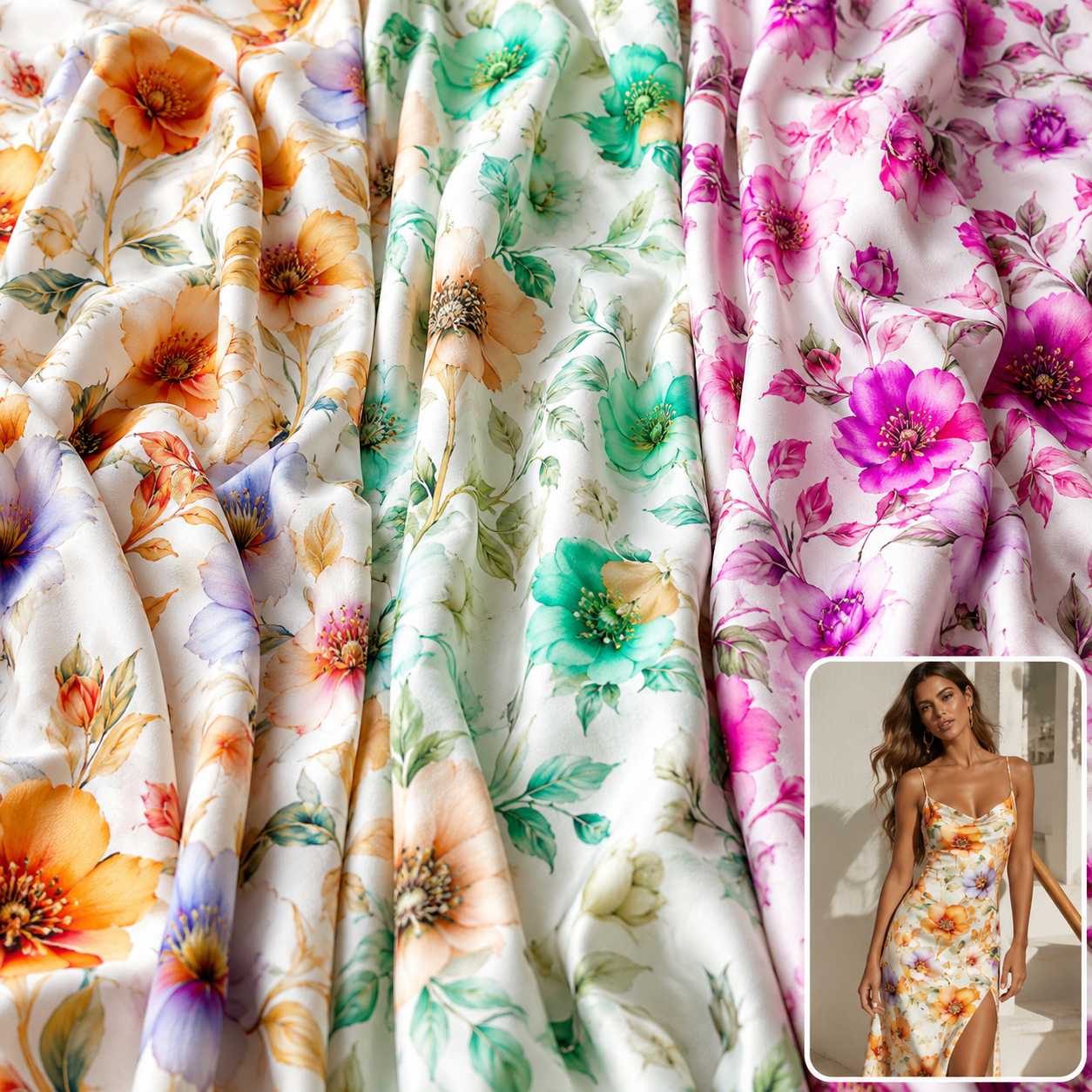
What Affects the Final Price from China Rayon Digital Print Fabric Manufacturers, Suppliers, and Factories?
The final price of rayon digital print fabric from China is not determined by digital printing alone. Manufacturers and suppliers calculate quotations by combining the cost of the rayon base fabric, printing process, ink or dye consumption, pre-treatment, steaming, washing, finishing, quality control, order quantity, packing, and delivery requirements.
Public supplier listings demonstrate how widely commercial offers can vary. Visible China listings include rayon digital print fabrics at different compositions, weights, widths, MOQs, and price ranges. Examples include 100% rayon qualities around 100–150 GSM and 145–150 cm width with a 500-meter MOQ, while other digital printed rayon programs list minimums of approximately 1,000, 3,000, or 5,000 meters.
This variation does not necessarily mean that one factory is expensive and another is cheap. It often means that the suppliers are quoting different fabrics, quantities, designs, finishing standards, or commercial terms.
For buyers, the most useful price is therefore not the lowest number received. It is the quotation based on the correct fabric and the full order requirement.
Quick Answers
The rayon base fabric is one of the largest price factors because composition, yarn count, GSM, width, weave, and finishing affect the cost before printing begins.
A heavier fabric usually costs more per meter because it contains more fiber and may require a denser construction.
Wider fabric may change the meter price because it uses more material, although it can sometimes improve garment-cutting efficiency.
High print coverage usually consumes more ink or dye than a design with substantial unprinted background space.
Dark grounds, saturated colors, and complex designs may require more process control, testing, and color adjustment.
Digital printing avoids traditional screen preparation, but artwork cleanup, color separation, profiling, and strike-off development can still add cost.
Small orders usually have a higher unit price because sampling, machine preparation, color management, and finishing costs are distributed across fewer meters.
Public supplier listings show digital printed rayon MOQs ranging from approximately 500 meters to several thousand meters, confirming that order volume can change the quotation structure significantly.
Special finishing such as sand washing, softening, wrinkle effects, or performance treatment can increase the final price.
Urgent production may cost more when the supplier must prioritize greige fabric, printing capacity, finishing, or inspection.
FOB, CIF, and delivered quotations should not be compared directly because they include different responsibilities and logistics costs.
The most accurate quotation comes from confirming composition, GSM, width, print file, quantity, finish, quality requirements, packing, and destination before pricing.
The Base Rayon Fabric Specification
The base fabric is the foundation of every rayon digital print quotation. Before the design is printed, the manufacturer must source or produce a rayon article with a specific composition, yarn count, construction, GSM, and width.
Public supplier pages show how different rayon products can be. One listing describes 100% rayon digital print fabric in a range of approximately 100–150 GSM and widths of 145 cm or 150 cm. Another supplier catalog lists multiple rayon digital print articles and other rayon constructions at different commercial prices.
Common base-fabric variables include:
Fiber composition
Yarn count
Plain, twill, satin, or crepe construction
Finished GSM
Finished usable width
Fabric whiteness
Absorbency
Surface smoothness
Shrinkage target
Pre-treatment condition
Two quotations described as “100% rayon digital print fabric” may refer to entirely different base qualities. A lightweight challis for a summer dress should not be compared directly with a denser twill or satin article.
The buyer should therefore confirm the base-fabric article before comparing prices.
Fiber Composition
Most woven rayon digital print dress fabrics are sold as 100% rayon or viscose, but rayon blends and rayon-spandex qualities are also available.
Composition affects fiber cost, print behavior, stretch, drape, shrinkage, and processing. For example, a public listing for printed rayon-spandex knit fabric shows 96% rayon and 4% spandex at 180 GSM and 160 cm width, which is a very different commercial product from a lightweight 100% woven rayon print.
Blended fabrics may require different:
Pre-treatment
Printing chemistry
Drying conditions
Heat control
Finishing
Inspection methods
Buyers should specify whether they need 100% rayon, rayon-spandex, rayon-linen, or another blend. Otherwise, suppliers may calculate prices on different constructions.
GSM and Fabric Weight
GSM refers to grams per square meter and is one of the clearest material-cost variables.
A heavier rayon fabric normally uses more fiber per square meter. It may also require a different yarn count, denser weave, longer processing time, or additional finishing.
Visible supplier listings show rayon digital print and printed rayon fabrics across ranges such as approximately 90–110 GSM, 100–150 GSM, 110 GSM, and heavier constructions.
For apparel sourcing, common positioning may include:
Lightweight rayon:
Summer dresses, blouses, skirts, resortwear
Medium-weight rayon:
Shirts, dresses requiring more coverage, matching sets
Heavier rayon or rayon blends:
Trousers, structured fashion items, stretch garments
A quotation without a target GSM is usually provisional. Even a difference of several grams can affect raw-material cost and garment performance when multiplied across a large order.
Finished Width
Finished width affects both fabric cost and garment yield.
Common public specifications include approximately 145 cm, 150 cm, 57/58 inches, and other widths depending on the article.
A wider fabric contains more material per linear meter, so the price per meter may be higher. However, the wider quality may reduce garment consumption by improving marker efficiency.
This creates an important buying distinction:
Lower price per meter does not always mean lower cost per garment.
Buyers should compare:
Finished usable width
Price per linear meter
Fabric consumption per garment
Cutting loss
Pattern placement requirements
The supplier should quote against finished width rather than only greige width.
Weave and Surface Construction
The fabric construction influences weaving cost, print appearance, and final handfeel.
Common rayon bases may include:
Challis
Plain weave
Twill
Satin
Crepe
Slub
Crinkle
Jacquard
Knitted rayon-spandex
A smooth base can produce sharper detail than a heavily textured construction. Twill, crepe, and slub effects may require different raw materials and finishing routes.
Public supplier catalogs list rayon twill satin, challis, and other rayon articles at different price points, showing that the construction itself is a commercial variable.
The buyer should request the same construction from every supplier before comparing quotations.
Printing Method and Dye System
Rayon is a cellulosic fiber, and reactive digital printing is commonly used when buyers want good color depth, softness, and wash performance.
The printing route may include:
Fabric preparation
Chemical pre-treatment
Digital inkjet printing
Drying
Steaming
Washing
Soaping
Final finishing
Inspection
Each stage adds material, energy, labor, and processing cost.
The price may also depend on whether the supplier is offering:
Reactive digital printing
Pigment digital printing
Discharge-related effects
Single-sided printing
Special double-sided visual effects
A combined print and finishing program
Buyers should ask which printing method is included because two processes may produce different color, handfeel, and fastness results.
Print Coverage and Ink Consumption
Print coverage is one of the most important design-related price factors.
A design with a mostly white background generally uses less ink or dye than a full dark-ground print. Saturated black, navy, red, emerald, or other deep backgrounds may require higher ink coverage and tighter process control.
Price can be influenced by:
Percentage of printed surface
Dark or light background
Color saturation
Number of dominant colors
Fine tonal gradients
Large solid-color areas
Required color depth
Penetration expectations
X-Rite explains that print-quality workflows use controlled color targets, profiles, and ink-density corrections to maintain consistency, while Datacolor notes that color formulation often balances appearance with dye or pigment cost.
In practical buying terms, two patterns printed on the same rayon base can have different production costs if one requires substantially more colorant or correction work.
Design Complexity
Digital printing can reproduce complex artwork without traditional rotary screens, but complexity can still affect pre-production cost.
A simple two-tone floral may require less preparation than a design containing:
Many tonal gradients
Photographic effects
Fine lines
Multiple coordinated colorways
Large seamless repeats
Complex geometric alignment
Detailed hand-painted artwork
Color-sensitive skin tones
Very dark backgrounds
The supplier may need to:
Clean the artwork
Increase resolution
Repair the repeat
Separate or edit colors
Adjust the scale
Create multiple colorways
Build or update print profiles
Produce additional strike-offs
The buyer should provide production-ready artwork whenever possible. Commonly requested file types may include TIFF, PSD, AI, or PDF, depending on the supplier’s workflow.
Artwork Resolution and File Preparation
Poor artwork increases development time.
A low-resolution image taken from social media is not the same as a production-ready seamless print file. The factory may need to redraw motifs, repair edges, remove compression artifacts, or rebuild the repeat.
Artwork-related charges may depend on:
File quality
Repeat preparation
Motif redrawing
Colorway creation
Scale adjustment
Copyright or exclusivity requirements
Number of revisions
A supplier may include basic file adjustment in the price but charge separately for substantial design work.
To avoid unexpected costs, buyers should ask whether artwork preparation is included in the fabric quotation.
Number of Colorways
The number of colors in digital printing does not create screens in the same way as traditional rotary printing, but multiple colorways still increase development and management work.
Each colorway may require:
Color adjustment
Separate strike-off
Buyer approval
File identification
Production scheduling
Shade checking
Roll labeling
Separate packing
For example, one design ordered in one colorway is simpler than the same design ordered in six color combinations at small quantities.
Buyers should clarify:
Total quantity per design
Quantity per colorway
Whether colorways can share the MOQ
Whether each colorway requires a new strike-off
Whether color-development charges apply separately
Small quantities across many colorways can result in a higher average meter price.
MOQ and Total Order Quantity
MOQ strongly affects the final price.
Public listings show highly variable digital printed rayon minimums. One product listing shows approximately 500 meters, another catalog commonly lists 1,000 meters, and broader market listings show examples of 3,000 or 5,000 meters.
Lower MOQ normally increases unit cost because the supplier still needs to cover:
Artwork preparation
Strike-off development
Machine preparation
Pre-treatment
Color adjustment
Quality inspection
Finishing setup
Roll handling
Packing and documentation
These costs are spread over fewer meters.
Larger orders may receive a lower meter price because production becomes more efficient. However, the size of the price reduction depends on whether the base fabric, printing, and finishing can be run continuously.
MOQ per Design vs MOQ per Color
Buyers should not assume that MOQ refers only to the entire purchase order.
A supplier may define MOQ as:
Meters per design
Meters per colorway
Meters per fabric base
Meters per order
Kilograms per color
A combined quantity across several designs
For example, 500 meters per design is different from 500 meters divided across five patterns.
This distinction should be confirmed before the buyer calculates collection quantities or compares suppliers.
Strike-Off Sampling
A strike-off is a small printed sample produced to confirm the pattern, scale, and color before bulk production.
Strike-off cost may depend on:
Number of designs
Number of colorways
Size of the sample
Urgency
Base-fabric availability
Number of revisions
Courier charges
Some suppliers absorb basic strike-off charges into an eventual bulk order. Others charge sampling separately.
Multiple correction rounds increase development cost. Buyers can reduce this by providing:
Clear Pantone or color references
A physical color standard
The final artwork
Correct pattern scale
Target fabric specification
One consolidated set of comments
A vague approval process often creates more revisions and a less predictable final quotation.
Color-Matching Requirements
Color accuracy affects cost because tighter tolerances require stronger measurement, process control, and correction.
Datacolor provides textile color formulation systems designed to find accurate, lower-cost recipes, while its textile and apparel solutions emphasize color control from development through final production.
Professional color control may involve:
Spectrophotometer measurement
Digital color standards
ICC or printer profiles
Controlled-light visual assessment
Delta E tolerance
Strike-off comparison
Early-bulk approval
Final shade inspection
A standard commercial match may cost less to develop than an extremely tight brand-specific color requirement involving multiple approvals.
Buyers should specify their actual tolerance instead of asking for “exactly the same color,” which is not a measurable production instruction.
Pre-Treatment
Rayon often requires controlled pre-treatment before reactive digital printing. Pre-treatment helps the dye remain in the intended location, improves color yield, and supports print sharpness.
Cost can change according to:
Chemical formulation
Fabric absorbency
Required color depth
Pre-treatment uniformity
Batch size
Drying method
If the base fabric already has an appropriate pre-treatment, the workflow may be simpler. A fresh or unusual construction may require testing and adjustment.
Steaming and Washing
After reactive digital printing, the fabric normally undergoes steaming and washing to develop and remove unfixed dye.
These stages influence:
Color depth
Fastness
Handfeel
Shrinkage
Water and energy use
Processing time
Deep colors or demanding performance targets may require tighter process control.
Buyers should check whether the quoted price includes the complete post-print process rather than printing only.
Finishing Requirements
Finishing can significantly change the final price and appearance.
Common rayon finishing options may include:
Standard soft finish
Sand wash
Peach finish
Wrinkle or crinkle effect
Enzyme-related treatment
Anti-pilling treatment
Shrinkage control
Easy-care treatment
Calendering
Special luster adjustment
A soft sand-washed rayon print should not be compared directly with a standard-finished fabric, even when the composition, GSM, and design are similar.
Special finishing may require extra processing, increase shrinkage risk, or alter usable width. The supplier should therefore quote the finished specification rather than only the printed base.
Quality and Testing Standards
Higher quality-control requirements can add cost but reduce the risk of claims.
Possible checks include:
Fiber composition
Finished GSM
Usable width
Shrinkage
Colorfastness to washing
Colorfastness to rubbing
Colorfastness to perspiration
pH
Print sharpness
Roll-to-roll shade
Fabric defects
Restricted substances
Third-party laboratory testing is usually an additional cost unless it is included in the commercial agreement.
The buyer should state:
Required test methods
Acceptance levels
Testing frequency
Who pays for testing
Whether third-party reports are required
Whether every colorway must be tested
Without clear requirements, suppliers may quote only their standard internal QC.
Colorfastness Target
Higher fastness requirements may require more careful dye selection, washing, fixation, and testing.
The price may change when buyers request:
Higher dry-rubbing fastness
Higher wet-rubbing fastness
Stricter wash fastness
Perspiration testing
Light-fastness requirements
Buyer-specific chemical restrictions
Not every fashion dress print needs the same performance target. Buyers should select realistic standards based on garment use, color depth, destination market, and care instructions.
Color Management and Repeatability
Strong repeatability requires investment in color-management systems, measurement devices, controlled standards, and trained operators.
X-Rite and Datacolor both describe digital workflows designed to improve repeatability, reduce corrections, and control color from development through production.
A factory using structured color management may not always offer the lowest price, but it may reduce:
Repeated strike-offs
Rejected bulk
Shade claims
Production delays
Garment matching problems
Reprint inconsistency
For buyers, this can create a lower total sourcing cost even when the initial meter price is slightly higher.
Delivery Time and Urgency
Normal lead time allows the supplier to schedule greige fabric, pre-treatment, printing, steaming, washing, finishing, inspection, and packing efficiently.
Urgent orders may require:
Priority greige booking
Machine rescheduling
Overtime
Faster sampling
Expedited finishing
Priority inspection
Express document or sample delivery
These changes may increase the price or reduce the supplier’s flexibility.
Buyers should provide:
Required ex-factory date
Required shipment date
Destination
Garment-production deadline
Whether partial shipment is acceptable
A clear timeline helps the supplier quote a realistic rather than theoretical price.
Repeat Orders vs New Designs
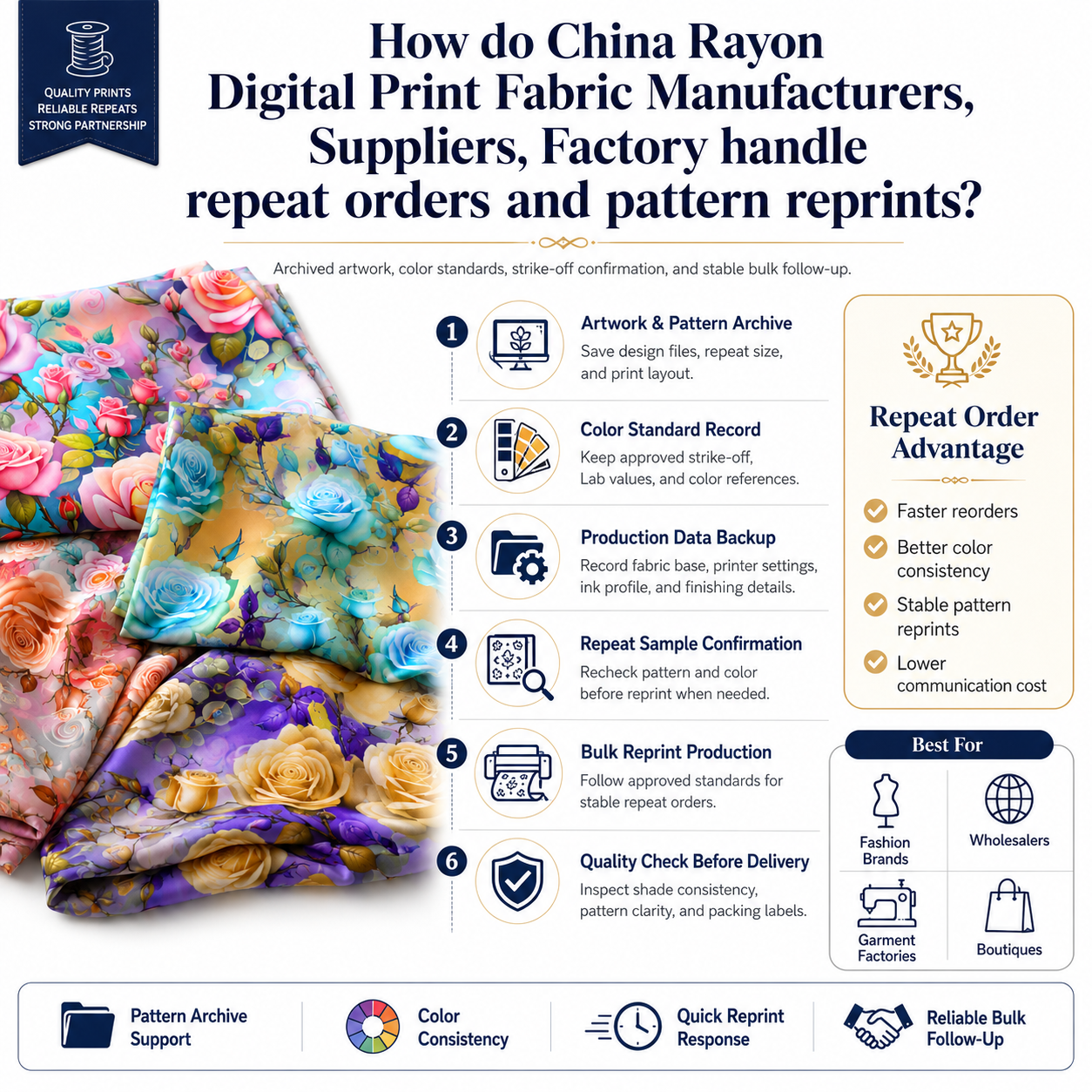
A repeat order can be less expensive to develop when the supplier still has:
Final artwork
Approved colorway
Printer profile
Strike-off standard
Base-fabric record
Finishing instructions
Previous production data
However, the fabric price may still change because of current raw-material and processing costs.
A repeat order also may require a new strike-off if:
The original base is unavailable
The artwork has changed
The colorway has changed
The order was produced a long time ago
The printing process has changed
The buyer requests tighter tolerances
Reusing a file reduces design work, but it does not freeze all future production costs.
Ready Designs vs Exclusive Custom Prints
Supplier-owned designs may be less expensive to start because the artwork and repeat are already prepared.
Exclusive custom prints may involve:
Artwork-development fees
Design confidentiality
Nondisclosure agreement
Restricted resale
Unique colorway development
Secure file storage
Additional approval steps
Buyers should ask whether the quoted design is:
Open-market
Supplier-owned
Buyer-exclusive
Regionally restricted
Reserved for a specific period
Exclusivity is a commercial service and may influence the final quotation.
Stock Base vs Custom Base Fabric
A supplier using an existing rayon base may offer a faster and more competitive price.
A custom base may require:
Yarn sourcing
New weaving
Higher greige MOQ
Longer lead time
Separate testing
More development risk
Small-batch brands often achieve better pricing by selecting an existing base and customizing only the print.
If the buyer requires a unique GSM, yarn count, width, or surface texture, the quotation should include both fabric development and printing.
Packaging Requirements
Standard roll packing is usually the simplest option.
Price can change when buyers require:
Fixed meters per roll
Fixed yards per roll
Double folding
Cardboard tubes of a specific size
Brand labels
Printed roll stickers
Individual polybags
Cartons
Moisture protection
Pallets
Special marks
Country-specific packing
For example, a buyer requesting exactly 30, 50, 75, or 100 meters per roll may create more cutting, measuring, and packing work than natural roll lengths.
Packaging requirements should be included in the inquiry rather than added after the price is confirmed.
Inspection Level
The supplier’s standard internal inspection may be included in the price.
Additional costs can arise from:
100% roll inspection
Third-party inspection
Buyer-appointed inspector
More restrictive defect standards
Individual shade grouping
Detailed roll maps
Pre-shipment sample courier
Extra testing by colorway
The buyer should define the inspection standard before the purchase order is issued.
Payment Terms
Payment terms influence supplier risk and working capital.
Common commercial structures may include:
Deposit with balance before shipment
Letter of credit
Payment against documents
Platform-based trade assurance
Negotiated credit for established buyers
More favorable buyer credit terms may not receive the same price as a standard deposit arrangement because the supplier carries greater financial risk.
The quotation should clearly state:
Currency
Deposit
Balance timing
Bank charges
Validity period
Whether testing or sample charges are refundable
Trade Terms
FOB, CIF, CFR, EXW, and delivered prices include different responsibilities.
An FOB quotation may include:
Fabric production
Standard export packing
Inland transport to port
Export customs procedures
A CIF quotation may additionally include freight and insurance to the destination port.
An EXW quotation may exclude most local and export logistics.
Buyers should compare only quotations based on the same Incoterm and port.
Currency and Quote Validity
Rayon fiber, chemicals, energy, labor, freight, and exchange rates may change.
For this reason, suppliers often set a quotation-validity period. A price quoted for immediate confirmation may not remain valid for several months.
Buyers should check:
Currency
Quote-validity period
Raw-material adjustment clause
Whether freight is fixed or estimated
Whether the price applies only to the stated quantity
A repeat pattern does not guarantee a permanently fixed price.
Buyer-Specific Compliance
Destination-market requirements can influence testing and chemical selection.
Possible requirements include:
OEKO-TEX-related testing
REACH-related restricted substances
Buyer RSL
Formaldehyde limits
Azo colorant restrictions
pH limits
Traceability documents
Third-party inspection
Compliance should be defined before production. Adding requirements after printing can create retesting, delay, or rejection risk.
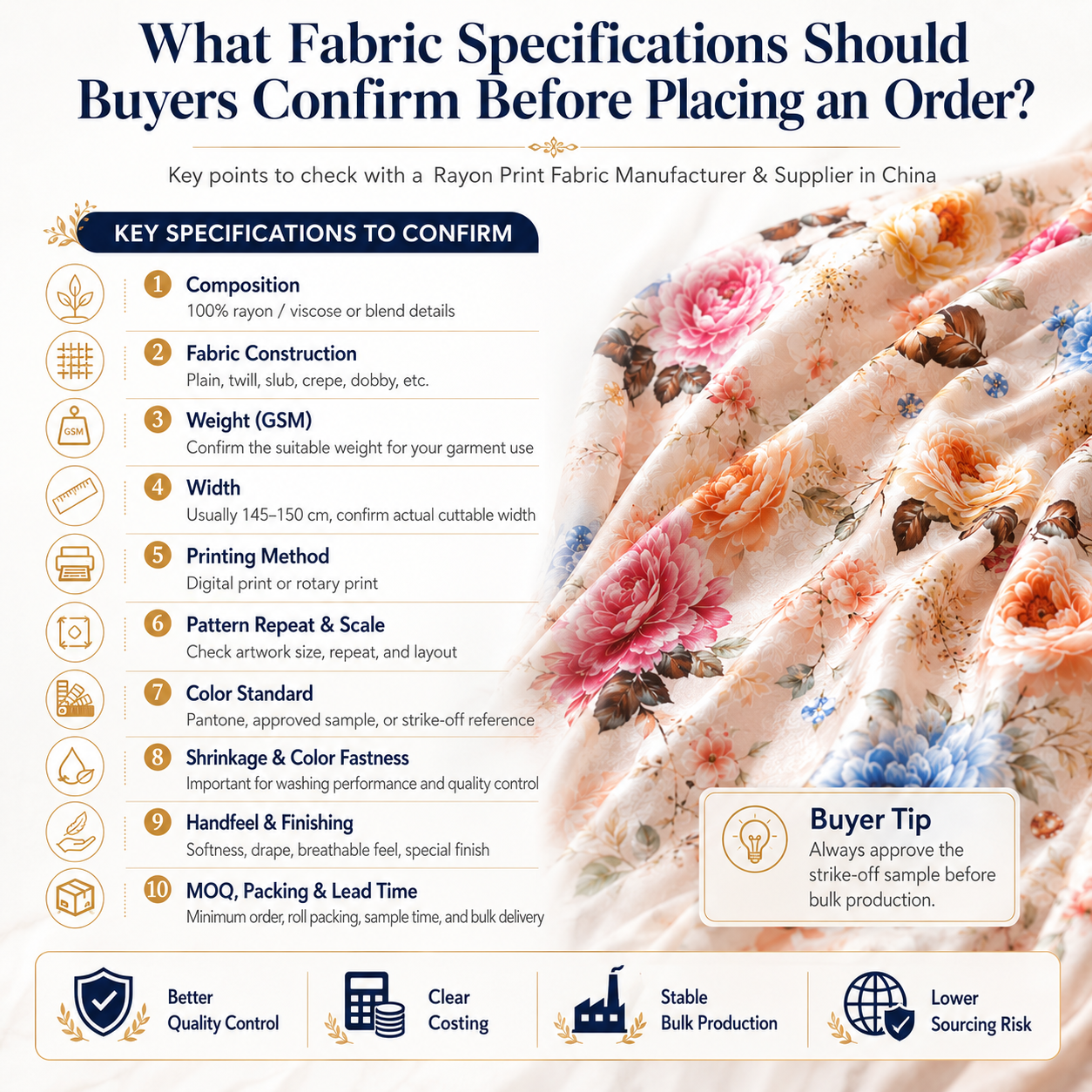
How Buyers Can Get a More Accurate Quote
A complete inquiry should include:
Fabric composition
Target GSM
Finished width
Weave or article
Print design file
Pattern scale
Number of designs
Number of colorways
Meters per design
Meters per colorway
Print method
Finish
Colorfastness target
Shrinkage target
Testing requirements
Packing method
Delivery deadline
Destination port
Trade term
Payment expectation
The supplier can then separate:
Base-fabric cost
Printing cost
Development charges
Finishing cost
Testing cost
Packing cost
Freight or logistics
A complete specification also makes supplier quotations easier to compare.
Rayon Digital Print Fabric Price Factor Table
Price Factor
| Why It Changes the Price | What Buyers Should Confirm |
Composition
| fiber and processing requirements differ | 100% rayon or exact blend |
GSM
| heavier fabric generally uses more raw material | finished GSM target |
Width
| wider fabric changes material use and garment yield | finished usable width |
Construction
| challis, twill, satin, and crepe have different costs | exact weave and handfeel |
Print coverage
| deep or full-ground designs may consume more ink | artwork and background coverage |
Design complexity
| complex files require more preparation and control | final high-resolution repeat |
Colorways
| each variation may require sampling and management | number of color combinations |
MOQ
| smaller runs spread setup cost across fewer meters | quantity per design and colorway |
Strike-off
| sampling and revisions add development work | number and size of samples |
Finishing
| special handfeel or performance treatments add processing | exact finished effect |
Testing
| third-party or stricter tests add cost | required methods and pass levels |
Lead time
| urgent production may require priority capacity | realistic ex-factory date |
Packing
| fixed roll lengths and custom labels add handling | complete packing instructions |
Trade term
| EXW, FOB, and CIF include different services | Incoterm and destination |
Payment
| terms affect supplier financing and risk | deposit and balance structure |
Example Price Comparison Logic
Order A
| Base Fabric | Print | Quantity | Finish | Commercial Result |
Small test order
| standard 100% rayon | one light-ground design | 300–500 m | standard soft finish | higher unit price, lower inventory risk |
Regular collection
| standard 100% rayon | several approved designs | 1,000 m/design | standard finish | more efficient unit pricing |
Custom premium program
| special GSM or weave | deep-ground exclusive print | limited colorways | sand wash plus testing | higher development and finishing cost |
Large repeat order
| established base | archived approved pattern | larger quantity | repeated standard finish | lower development risk, subject to current material cost |
This table is illustrative. Final prices must be based on the supplier’s current specification and quotation.
Conclusion
The final price from China rayon digital print fabric manufacturers, suppliers, and factories is affected by the complete product and order structure, not simply by the printed pattern.
The most important variables are:
Rayon composition
GSM
Finished width
Fabric construction
Print coverage
Design complexity
Number of colorways
MOQ
Strike-off requirements
Finishing
Testing
Lead time
Packing
Payment
Trade terms
Public supplier listings confirm that rayon digital print fabrics are offered across widely different weight, width, MOQ, and pricing structures. This is why a low price from one listing cannot be treated as the market price for every rayon digital print order.
For B2B buyers, the best approach is to provide the same complete specification to every supplier. The most valuable quotation is not necessarily the lowest. It is the price that covers the correct base fabric, approved print result, required quality level, reliable delivery, and repeatable bulk production.
FAQ
Q: What is the biggest factor affecting rayon digital print fabric price?
A: The base fabric and order quantity are usually among the largest factors. Composition, GSM, width, construction, and MOQ all influence the production cost before additional finishing and testing are considered.
Q: Does a higher GSM increase the price?
A: Usually yes, because heavier fabric contains more material per square meter. The exact difference also depends on yarn count, weave, width, and finishing.
Q: Does a dark-ground print cost more than a light-ground print?
A: It can. Dark or highly saturated designs may consume more ink or dye and require tighter color and process control. The supplier should review the actual artwork before confirming the price.
Q: Does the number of colors affect digital print pricing?
A: Digital printing does not require a separate physical screen for every color, but multiple colorways and complex tonal designs can increase artwork preparation, strike-off, approval, and production-management costs.
Q: Why are small digital print orders more expensive per meter?
A: Sampling, artwork preparation, pre-treatment, machine setup, finishing, inspection, and packing still need to be completed. With a small order, those costs are divided across fewer meters.
Q: What MOQ is common for rayon digital print fabric from China?
A: Public listings show examples ranging from approximately 500 meters to 1,000, 3,000, or 5,000 meters depending on the supplier and article. Small custom programs may be available, but MOQ must be confirmed per design and colorway.
Q: Does a custom design cost more than a supplier’s existing pattern?
A: It may. A custom design can require file cleanup, repeat creation, colorway development, strike-offs, confidentiality controls, or exclusive-use arrangements.
Q: Does sand washing increase the rayon print price?
A: Usually yes. Sand washing or other special finishing adds processing and may change handfeel, shrinkage, width, and inspection requirements.
Q: Are testing fees included in the fabric price?
A: Internal factory checks may be included, but third-party laboratory reports and buyer-specific testing are often quoted separately. Buyers should confirm this before placing the order.
Q: Can repeat orders receive a lower price?
A: Repeat orders may reduce artwork and development work when the approved design, base fabric, and production data remain available. The meter price can still change because of current raw-material, processing, quantity, and delivery conditions.
Q: Does urgent delivery increase the price?
A: It can. Priority production may require machine rescheduling, faster sample approval, overtime, or expedited finishing and logistics.
Q: Why do two suppliers quote very different prices for the same pattern?
A: They may not be quoting the same base fabric, GSM, width, print coverage, finish, MOQ, testing, packing, or trade term. Buyers should align the full specification before comparing prices.
Q: What information should buyers send for an accurate quotation?
A: Send the composition, GSM, finished width, construction, design file, quantity per pattern and colorway, finish, test requirements, packing, deadline, destination, and trade term.

Leave a comment
This site is protected by hCaptcha and the hCaptcha Privacy Policy and Terms of Service apply.