
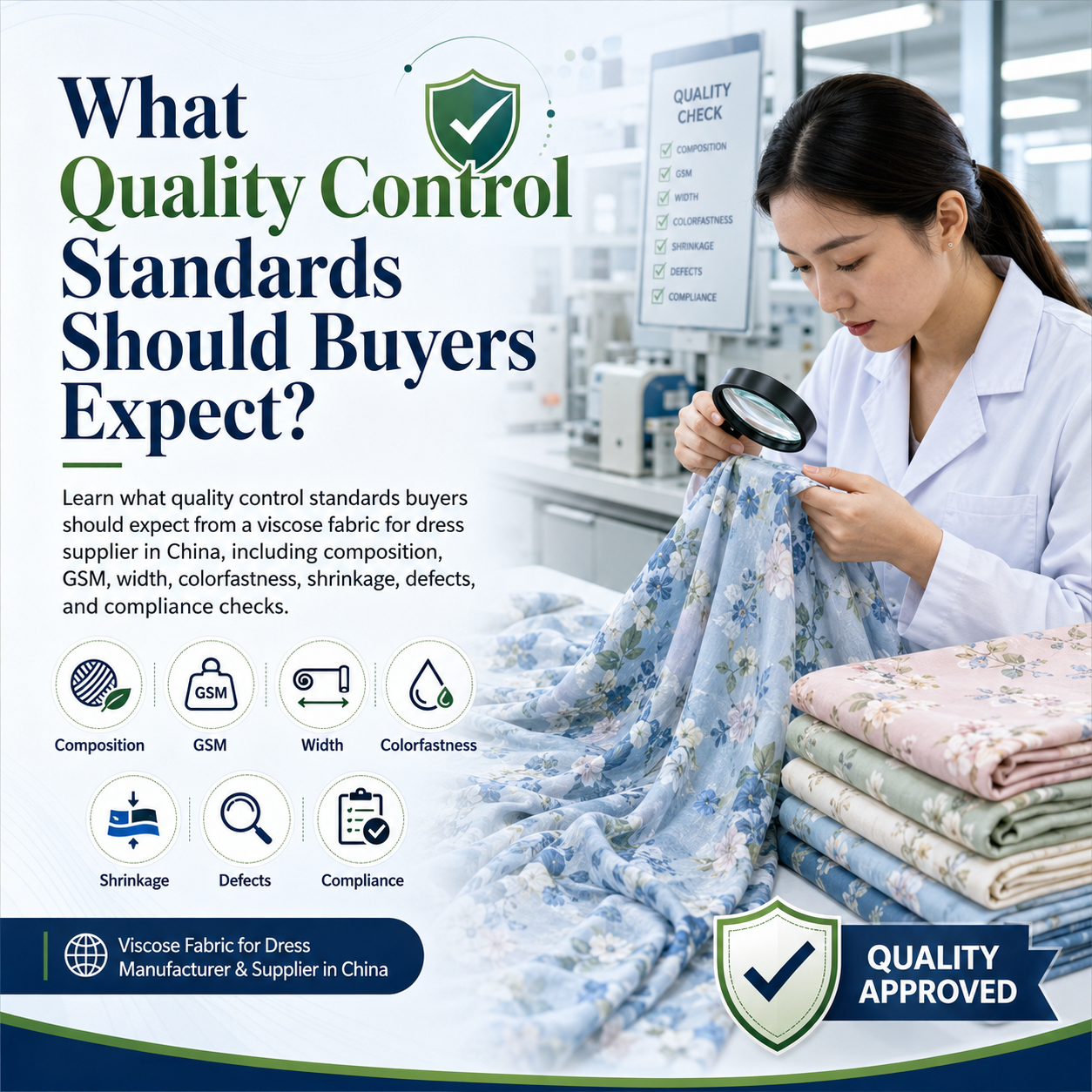
When buyers source viscose fabric for dresses from China, quality control should be treated as a system, not a single test report. A reliable supplier is usually expected to control fiber content, GSM, width, shade consistency, shrinkage, colorfastness, fabric defects, and basic chemical compliance before shipment. Public sourcing and testing references also show that common checkpoints include colorfastness to washing, rubbing, perspiration, and light, plus shrinkage, tensile or tear-related performance, pH, and composition verification.
For dress fabric, the practical expectation is simple: the approved sample and the bulk lot should match closely enough for real garment production. That means buyers should expect not only lab testing, but also in-line inspection, final roll inspection, and clear tolerance control on key specs such as weight, width, and shade. QIMA’s textile inspection guidance highlights visual defects, measurements, workmanship, and on-site tests as standard parts of fabric inspection, while OEKO-TEX testing documentation references recognized textile test methods used in compliance programs.
Quick Answers
Buyers should expect fiber-content verification so the delivered fabric matches the agreed viscose composition.
GSM and width should be checked against the approved standard because these two specs directly affect dress yield, drape, and garment consumption.
Colorfastness testing should normally include at least washing and rubbing, and many buyers also ask for light and perspiration fastness depending on the market.
Shrinkage testing should be expected before bulk approval, especially for lightweight viscose dress fabrics.
Visual inspection should cover holes, stains, weaving faults, printing defects, bowing, skewing, and shade variation. QIMA includes visual defects and workmanship as standard textile inspection checkpoints.
Dress-fabric buyers should expect shade consistency from roll to roll and lot to lot, not just a good-looking swatch. This is an inference based on standard textile inspection practice and batch verification.
A good supplier should confirm whether shrinkage tolerance, colorfastness targets, and defect tolerance are based on ISO, AATCC, OEKO-TEX-related, or buyer-specific standards.
Chemical compliance may be required depending on the destination market, and OEKO-TEX is one of the most commonly referenced frameworks in textile sourcing conversations.
Pre-shipment inspection is important because passing a lab test alone does not guarantee that the full bulk lot is free from defects or shade inconsistency. This is an inference based on QIMA inspection guidance.
The best suppliers do not just promise quality. They define measurable acceptance standards before production starts. This is an inference based on the quality-control checkpoints cited above.
Fiber Content Should Match the Approved Specification
The first quality-control expectation is composition accuracy. If the buyer ordered 100% viscose or a defined viscose blend, the delivered fabric should match that agreed content. Textile sourcing references list composition verification as a core quality test, and yarn-focused sourcing guidance also recommends checking fiber content alongside colorfastness and other technical parameters.
This matters because composition affects drape, absorbency, handle, and final garment performance. If the fiber content shifts, the dress fabric may not behave the same way in cutting, sewing, washing, or wearing.
Weight and Width Should Stay Within Agreed Tolerance
A viscose dress fabric supplier should be able to control GSM and width within agreed tolerances. Alibaba seller guidance for fabric sourcing explicitly mentions GSM verification with an example tolerance of plus or minus 5 percent, alongside shrinkage and colorfastness checks.
For buyers, this is not a small detail. If the GSM is too low, the dress may become too transparent or lose body. If the width is unstable, fabric consumption and marker efficiency change immediately. The safest expectation is that both finished GSM and finished usable width are checked roll by roll or batch by batch before shipment. The roll-by-roll expectation is an inference based on standard inspection practice.
Colorfastness Is a Basic Requirement, Not an Extra
For dress fabric, colorfastness is one of the most important quality-control checkpoints. Public testing references list colorfastness to rubbing, washing, perspiration, and wet ironing among standard textile checks, while OEKO-TEX testing documents reference recognized test methods such as ISO 105-related procedures in relevant compliance contexts.
Buyers should therefore expect the supplier to define which fastness standards apply to the order. At minimum, a viscose dress-fabric program should normally address washing and rubbing fastness. Depending on the end market and product type, light fastness and perspiration fastness may also be important.
Shrinkage Control Should Be Discussed Before Bulk
Shrinkage should be treated as a standard control item, especially for dress fabrics that depend on stable drape and sizing. Public textile testing references list shrinkage as a routine fabric check, and one Alibaba supplier example explicitly claims shrinkage within 3% for its fabric batches.
That 3% figure should not be treated as a universal rule for every viscose article, but it does show the kind of measurable target buyers often ask suppliers to define. In practice, buyers should expect the supplier to state the test condition, the expected tolerance, and whether the result is based on pre-wash or after-finish testing. The last sentence is an inference based on standard QC practice.
Visual Defect Inspection Still Matters
Even when a fabric passes lab testing, it can still fail in production if the rolls contain visual defects. QIMA’s sourcing guidance lists visual inspection for defects such as holes, stains, weaving errors, and other appearance issues as a core part of fabric quality control.
For viscose dress fabric, buyers should also watch for print misalignment, uneven dyeing, slubs outside the approved standard, crease marks, shading differences, and handfeel inconsistency. These are common garment-production risks, and while not every item appears explicitly in the cited summary, they are reasonable extensions of the visual-defect and workmanship checks described by textile inspection frameworks. This sentence is an inference.
Shade Consistency Is Critical for Dress Production
Dress programs often use multiple rolls in the same production run, so shade consistency should be part of the expected quality-control standard. A supplier may send one beautiful hanger sample, but if the bulk lot varies from roll to roll, garment matching becomes difficult and cutting plans become risky. This is an inference from standard batch inspection logic and QIMA’s emphasis on inspection consistency.
For that reason, buyers should expect the supplier to compare bulk shade against the approved standard and to separate rolls if any measurable variation exceeds the agreed tolerance. That expectation is also an inference grounded in common textile QC practice.
Chemical and Safety Compliance May Be Required
Quality control for viscose dress fabric is not only about physical performance. Depending on the destination market, buyers may also expect the supplier to support harmful-substance screening or third-party certification. Made-in-China sourcing guidance references OEKO-TEX Standard 100 as a commonly expected compliance framework for textile market entry, and OEKO-TEX testing documentation sets out recognized testing methods used in its program.
This does not mean every order must carry the same certification, but buyers should expect the supplier to state clearly whether the order is being produced to a compliance target such as OEKO-TEX, buyer-restricted-substances requirements, or another agreed standard.
Inspection Should Happen Before, During, and After Production
The strongest suppliers usually do not rely on one final check alone. The best expectation is a layered system: pre-production confirmation, in-line production monitoring, and final pre-shipment inspection. QIMA’s fabric inspection approach supports this broader idea by combining visual checks, measurement checks, workmanship review, and on-site verification.
For buyers, this means quality control should begin with approved standards, continue with batch monitoring, and end with shipment release only after the bulk lot passes the agreed checkpoints. This workflow description is an inference based on inspection best practice.
What a Buyer Should Ask a Supplier to Confirm
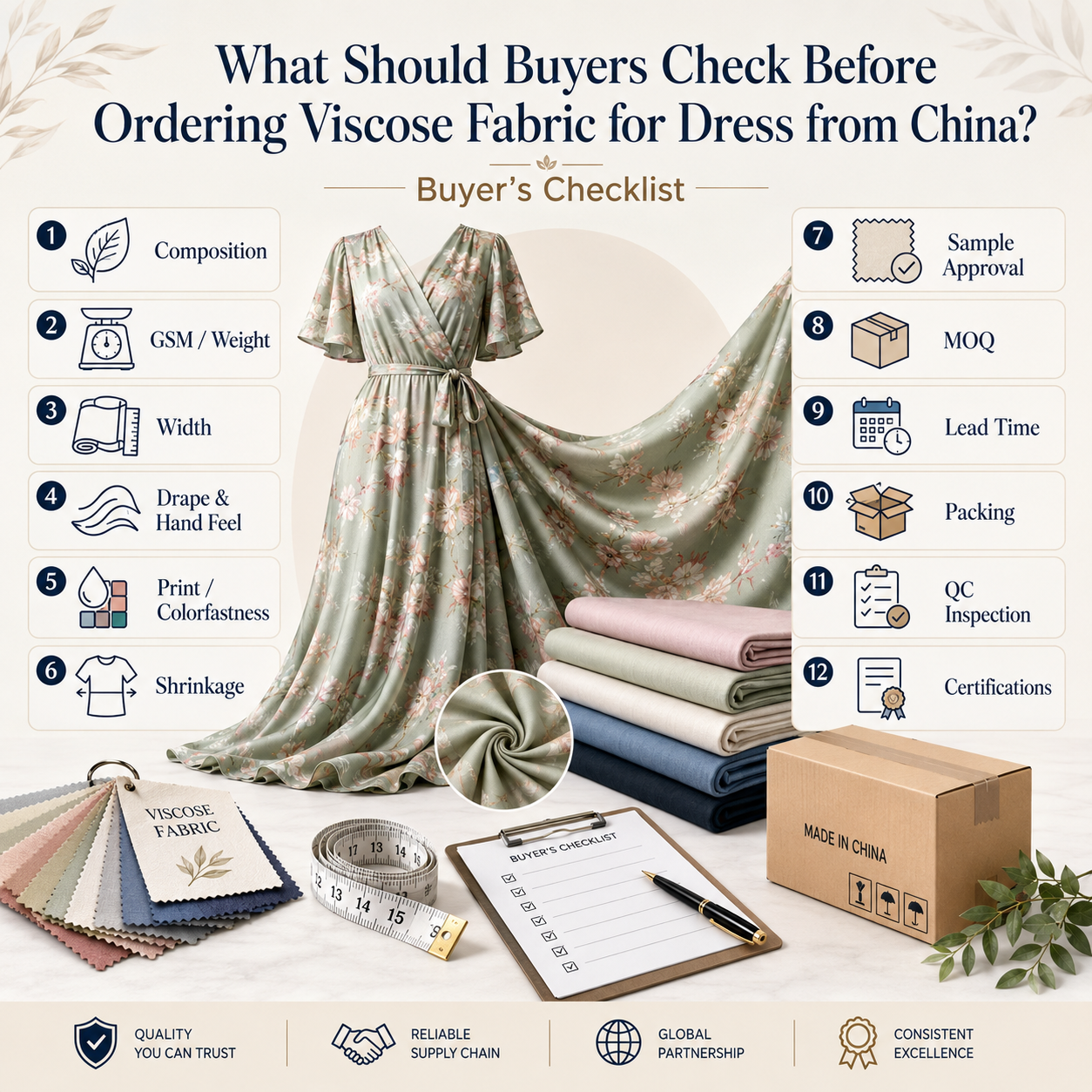
Before placing an order, buyers should ask the supplier to confirm the exact composition, GSM tolerance, width tolerance, shrinkage target, colorfastness requirement, visual-inspection standard, and any chemical compliance target. If the supplier cannot define these clearly, the quoted quality level may still be too vague for safe bulk production. This is an inference drawn from the cited testing and inspection references.
A good quote is helpful. A good quality standard is safer.
Viscose Dress Fabric Quality Control Checklist Table
Checkpoint
| What Buyers Should Expect | Why It Matters |
Composition
| fiber-content verification | confirms the delivered article matches the approved spec |
GSM
| finished weight check, often within agreed tolerance | affects drape, opacity, and garment feel |
Width
| finished usable width check | affects marker efficiency and consumption |
Colorfastness
| washing, rubbing, and often light or perspiration testing | reduces complaint risk after wear and care |
Shrinkage
| pre-approved shrinkage target | protects garment sizing and repeatability |
Visual defects
| inspection for holes, stains, weaving or print issues | prevents cutting and sewing losses |
Shade consistency
| batch and roll shade control | protects garment matching in production |
Compliance
| OEKO-TEX or buyer-required chemical screening where needed | supports market-entry and safety expectations |
Inspection process
| pre-production, in-line, and final inspection workflow | reduces bulk-order risk |
Conclusion
Buyers ordering viscose fabric for dresses from China should expect clear and measurable quality-control standards, not only verbal quality promises. At a practical level, that usually means composition verification, GSM and width control, colorfastness testing, shrinkage checks, visual-defect inspection, shade consistency, and any required compliance screening. Textile sourcing and testing references show that these are normal and reasonable expectations for apparel-fabric buying.
For most B2B buyers, the safest supplier is not the one who says “quality is good.” It is the one who can define what “good” means, measure it, and repeat it in bulk.
FAQ
Q: What quality control standards should buyers expect from a viscose dress-fabric supplier in China?
A: Buyers should expect control of composition, GSM, width, colorfastness, shrinkage, visual defects, and any agreed compliance requirements.
Q: Should buyers ask for composition verification?
A: Yes. Composition verification is a core textile quality check and helps confirm that the delivered fabric matches the approved article.
Q: Is GSM tolerance important for dress fabric?
A: Yes. Fabric sourcing guidance highlights GSM verification, including example tolerances such as ±5%, because weight affects drape, opacity, and garment performance.
Q: Which colorfastness tests are commonly expected?
A: Washing and rubbing are common basics, and depending on the market, buyers may also require light and perspiration fastness.
Q: Should shrinkage be checked before bulk shipment?
A: Yes. Shrinkage is a routine textile quality checkpoint, and some supplier examples even state specific shrinkage targets such as within 3% for their batches.
Q: What visual defects should be inspected?
A: Textile inspection guidance includes holes, stains, weaving errors, and other visual or workmanship faults as standard checkpoints.
Q: Is OEKO-TEX relevant for viscose dress fabric?
A: It can be. OEKO-TEX is one of the most commonly referenced textile compliance frameworks, especially when buyers need harmful-substance screening.
Q: Is a lab test report alone enough?
A: Usually no. Lab testing is important, but buyers should also expect in-line and final inspection to control defects and shade consistency in the full bulk lot. This is an inference based on inspection guidance.
Q: What should buyers ask suppliers to confirm before placing an order?
A: Buyers should confirm composition, GSM tolerance, width tolerance, shrinkage target, fastness requirements, inspection rules, and any compliance target before production starts. This is an inference based on the cited QC frameworks.
Q: What is the safest way to define quality in a viscose fabric order?
A: The safest way is to write measurable acceptance standards into the order and approve the bulk standard against those checkpoints. This is an inference based on the cited testing and inspection guidance.

Leave a comment
This site is protected by hCaptcha and the hCaptcha Privacy Policy and Terms of Service apply.