
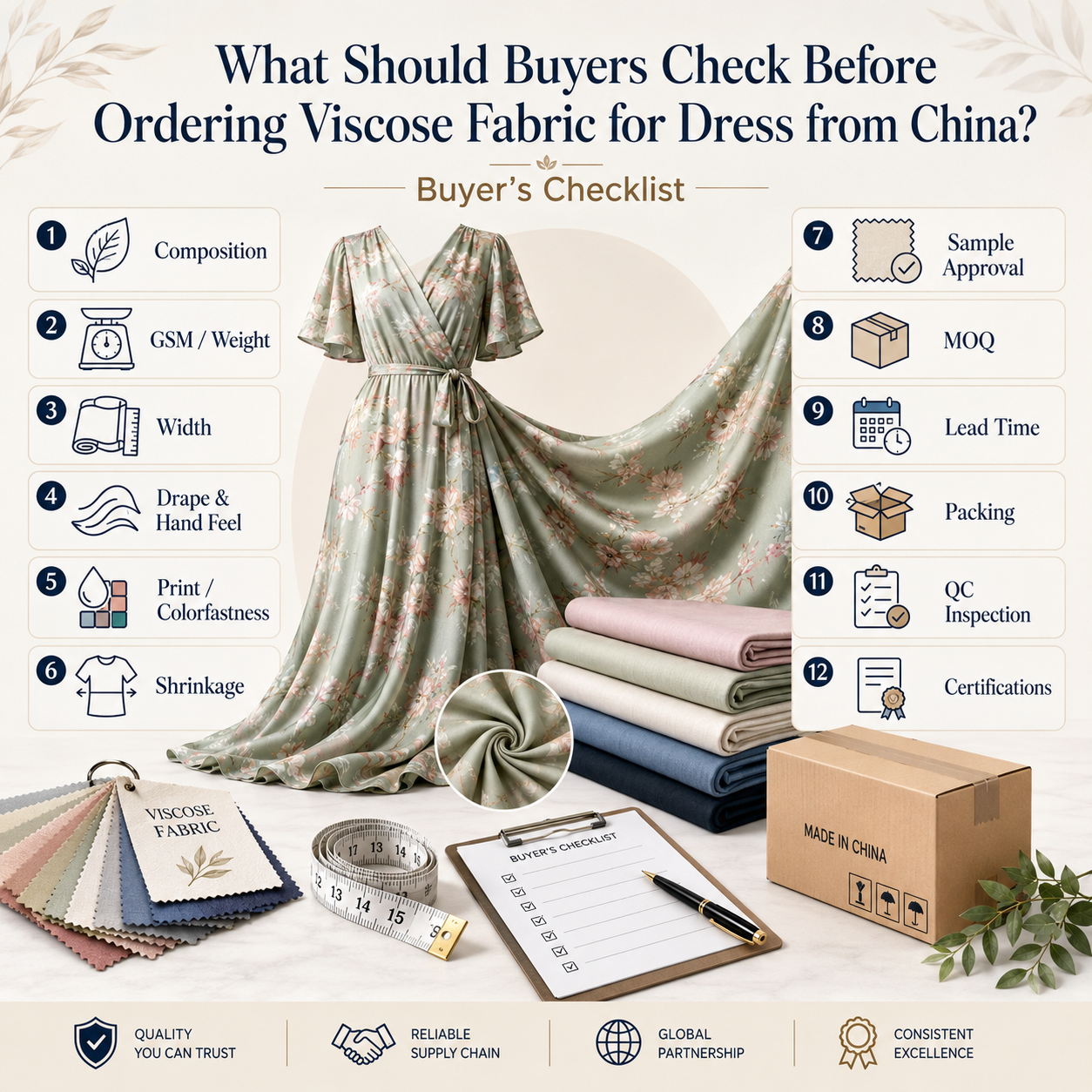
Before ordering viscose fabric for dresses from China, buyers should not focus on price alone. The safest order decision usually depends on checking the exact composition, GSM, width, weave, print or dyeing method, sample consistency, MOQ, lead time, shrinkage, colorfastness expectations, and the supplier’s ability to repeat the same quality in bulk. Public supplier listings already show why this matters: visible viscose dress fabrics range from about 60 GSM to 160 GSM, widths commonly range from about 140–150 cm to 58/59 inches, and MOQ can vary from about 1,000 meters to 3,000 meters depending on the article and order model.
For most buyers, the goal is not simply to “buy viscose.” The goal is to order the right viscose dress fabric with the right drape, opacity, print result, and commercial terms. Lenzing’s official product information describes viscose fibers as moisture-absorbing and pleasant to wear, which helps explain why viscose remains a preferred fiber for fashion clothing fabrics.
Quick Answers
Buyers should first confirm whether the fabric is really 100% viscose or a viscose blend, because public market offers include both pure and blended constructions.
GSM must be checked before ordering because visible viscose dress fabrics range from very light printed qualities around 60 GSM to heavier woven options around 160 GSM.
Width matters because public listings show apparel widths such as 140–150 cm, 145 cm cuttable width, and 58/59 inches, all of which affect garment yield and fabric consumption.
Buyers should verify whether the fabric is plain dyed, printed, digital printed, satin, georgette, challis, or twill, because the same fiber can perform very differently across constructions.
MOQ should be checked early because supplier pages show visible examples around 1,000 meters, 1,500 meters, and 3,000 meters.
Lead time should be confirmed before order placement, especially when the supplier advertises fast delivery or custom design support.
Buyers should approve a real sample before bulk because public listings often mention customization, custom print, or custom design support.
Colorfastness and chemical compliance should be checked against agreed standards, especially for printed dress fabrics. OEKO-TEX testing documents reference official textile test methods such as ISO 14362 and ISO 105-E04.
Shrinkage and transparency should be checked before bulk because lightweight viscose dress fabrics can behave very differently after finishing and washing. This is an inference based on the visible lightweight GSM range in supplier listings.
The best purchase decision comes from approving the full fabric standard, not only the quotation sheet. This is an inference supported by the variation in public specs above.
Check the Exact Composition First
One of the first things buyers should confirm is the exact composition. Many sourcing conversations begin with the word “viscose,” but the commercial market includes both 100% viscose and blended fabrics. Public listings show 100% rayon/viscose dyed fabric, 100% viscose printed fabric, and also viscose blends used in different apparel constructions.
This matters because composition directly affects handfeel, drape, opacity, cost, and performance. If one supplier quotes 100% viscose and another quotes a viscose blend, the prices are not truly comparable. Buyers should lock the composition before comparing offers.
Check GSM Based on the Dress Style
GSM is one of the most important checkpoints before ordering viscose fabric for dresses. Public supplier pages show that visible viscose dress fabrics can range from around 60 GSM printed fabric to about 95 GSM, 111 GSM, and 160 GSM commercial woven options.
That wide range is important because a soft summer dress, a printed boho dress, and a more structured fashion dress do not need the same weight. Lightweight GSM is usually better for flowy dresses and blouses, while heavier woven viscose may be more practical when buyers want more body and coverage. That final sentence is an inference based on the listed weights and end uses.
Check Width and Usable Cutting Yield
Width is not just a technical number. It changes marker efficiency, garment yield, and cost per piece. Public listings show widths such as 140–150 cm, 145 cuttable cm, 131 cm, and 58/59 inches for viscose or rayon dress fabrics.
Before ordering, buyers should confirm the finished usable width, not just the nominal width. This is especially important for printed and washed fabrics, where finishing may affect the final cuttable width. The second sentence is an inference based on the importance of finished specs in commercial fabric listings.
Check the Fabric Type, Weave, and Surface Look
Not all viscose dress fabrics look or behave the same. Public supplier pages show viscose georgette satin, rayon challis, plain woven fabric, printed twill or plain fabric, and other dress-oriented constructions.
This is why buyers should confirm the actual construction before bulk booking. A digital printed georgette satin for women’s apparel is a very different product from a 160 GSM plain woven rayon or a lightweight printed challis. If the construction is unclear, the order risk goes up.
Check Print or Dyeing Quality
For dress fabric, color and surface appearance often decide whether the garment sells. Buyers ordering printed viscose should confirm whether the article is rotary printed, digital printed, or plain dyed. Public listings explicitly show custom digital printing, printed rayon/viscose dress fabrics, and ready design options.
Before ordering, ask for a strike-off, lab dip, or sample meterage whenever possible. Pattern sharpness, color depth, back penetration, and print consistency matter much more in bulk than they do on a small swatch. This is an inference based on how public listings emphasize custom design and printed fabric offers.
Check MOQ and Order Structure
MOQ should never be treated as a minor detail. Public listings show visible MOQ examples of 1,000 meters, 1,500 meters, and 3,000 meters, depending on the fabric type and supplier.
For buyers, this changes both pricing and planning. A supplier quoting at 3,000 meters is working on a different production logic than one quoting at 1,000 meters. Ask whether the MOQ is per color, per design, or per total order, because that can change the real buying commitment significantly.
Check Lead Time and Delivery Readiness
Lead time should be confirmed before payment or production approval. One public viscose georgette satin listing highlights low MOQ and fast delivery with custom digital printing support, but that does not mean every supplier or every design can move at the same speed.
Buyers should ask whether the quote is based on ready greige, stock-supported quality, or full custom production. This one question often reveals whether the delivery promise is realistic.
Check Shrinkage, Transparency, and Dress Performance
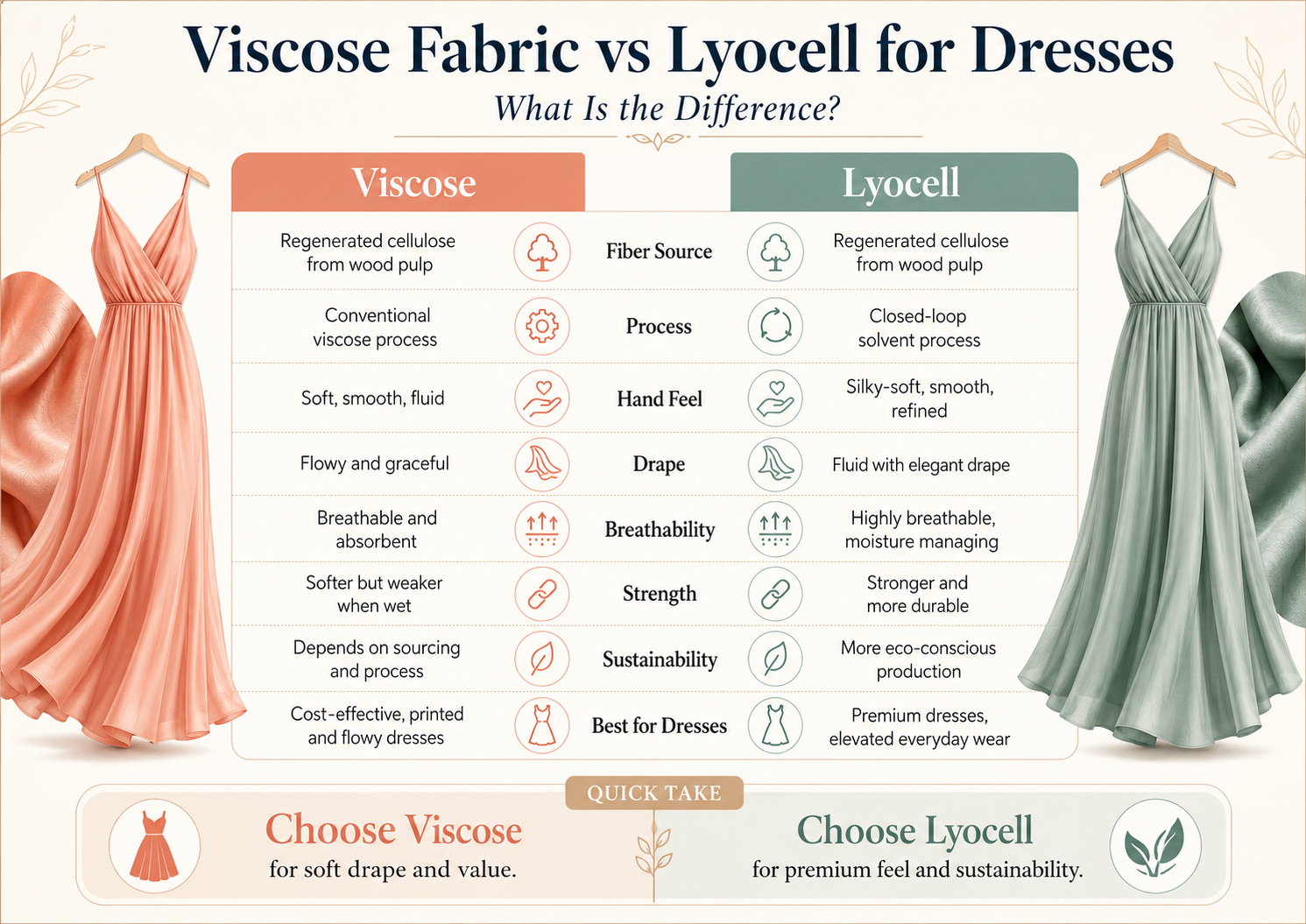
Viscose is popular in dresses because it is soft, moisture-absorbing, and pleasant to wear. Lenzing’s official product information highlights these comfort-related strengths.
But for buyers, comfort alone is not enough. Lightweight viscose can be more transparent, more fluid, and more sensitive to post-finish changes than heavier constructions. That is why buyers should request shrinkage data, check opacity under light, and test whether the fabric still performs after finishing or washing. This recommendation is an inference based on the visible lightweight GSM range and dress end uses in supplier listings.
Check Colorfastness and Compliance Requirements
Before ordering printed or dyed viscose fabric from China, buyers should align on colorfastness and chemical compliance requirements. OEKO-TEX testing documents reference official textile methods including ISO 14362 for certain azo dye-related testing and ISO 105-E04 for extraction in artificial acid sweat solution in heavy metal testing contexts.
This does not mean every viscose dress order needs the same certification path, but it does mean buyers should define the testing standard before bulk production. If the market requires OEKO-TEX, REACH-related screening, or buyer-specific fastness standards, those requirements should be written into the sampling and approval process.
Check Sample Approval and Bulk Repeatability
A buyer should never approve bulk on description alone. Public supplier pages repeatedly show customization, custom design support, and fabric offers across different weights and constructions.
That is exactly why sample approval matters. The safest process is to approve the actual article standard: composition, GSM, width, print or dye route, handfeel, and test expectation. A low-priced swatch is easy to send. Repeatable bulk quality is the real product.
Viscose Dress Fabric Pre-Order Checklist Table
Checkpoint
| What to Confirm | Why It Matters |
Composition
| 100% viscose or blend | changes price, drape, and performance |
GSM
| lightweight or heavier option | affects opacity, movement, and dress structure |
Width
| finished usable width | changes yield and garment consumption |
Construction
| challis, satin, georgette, plain, twill | determines surface look and dress behavior |
Print/Dye Route
| plain dyed, printed, digital printed | affects approval and bulk consistency |
MOQ
| per color, per design, or total | changes order planning and price |
Lead Time
| stock, greige, or custom route | affects delivery reliability |
Testing
| shrinkage, colorfastness, compliance | reduces bulk risk |
Sample Approval
| real sample or meterage approval | confirms bulk standard before payment |
Conclusion
Before ordering viscose fabric for dresses from China, buyers should check much more than price. The safest order decision usually depends on confirming composition, GSM, width, construction, print or dyeing route, MOQ, lead time, shrinkage, colorfastness, compliance needs, and sample approval. Public supplier listings show that these variables can change significantly from one offer to another, even when all fabrics are described simply as viscose dress fabric.
For most B2B buyers, the best strategy is simple: approve the real fabric standard before approving the quote. A quotation becomes useful only when the product behind it is clearly defined.
FAQ
Q: What should buyers check first before ordering viscose dress fabric from China?
A: Buyers should first confirm the exact composition, because public market offers include both 100% viscose and blended constructions.
Q: Why is GSM important for viscose dress fabric?
A: GSM affects drape, opacity, and garment suitability. Public supplier listings show visible dress-fabric weights from about 60 GSM to 160 GSM.
Q: What width is common for viscose dress fabric from China?
A: Public listings show examples such as 140–150 cm, 145 cm cuttable width, and 58/59 inches, depending on the article.
Q: Should buyers check print quality before bulk?
A: Yes. Printed and digital-printed viscose fabrics require approval for color, pattern sharpness, and consistency before mass production.
Q: What MOQ is common for viscose dress fabric?
A: Visible supplier examples include about 1,000 meters, 1,500 meters, and 3,000 meters, depending on the fabric and supplier.
Q: Why should buyers ask about lead time before ordering?
A: Lead time depends on whether the supplier is quoting stock-supported fabric, ready greige, or full custom production.
Q: Is viscose a good choice for dresses?
A: Yes. Official Lenzing information says viscose absorbs moisture well and is pleasant to wear, which supports its use in fashion clothing fabrics.
Q: Should buyers check shrinkage and transparency?
A: Yes. Lightweight viscose dress fabrics can behave differently after finishing or washing, so these points should be tested before bulk. This is an inference based on public GSM ranges and dress uses.
Q: What testing standards may be relevant for viscose dress fabrics?
A: Buyers may need to align on colorfastness and chemical compliance requirements; OEKO-TEX testing documents reference official methods such as ISO 14362 and ISO 105-E04 in relevant testing contexts.
Q: What is the safest way to place a viscose fabric order from China?
A: The safest way is to approve the full article standard, including composition, GSM, width, finish, test requirements, and a real sample before bulk production. This is an inference supported by the variability in public supplier specs.


Leave a comment
This site is protected by hCaptcha and the hCaptcha Privacy Policy and Terms of Service apply.