
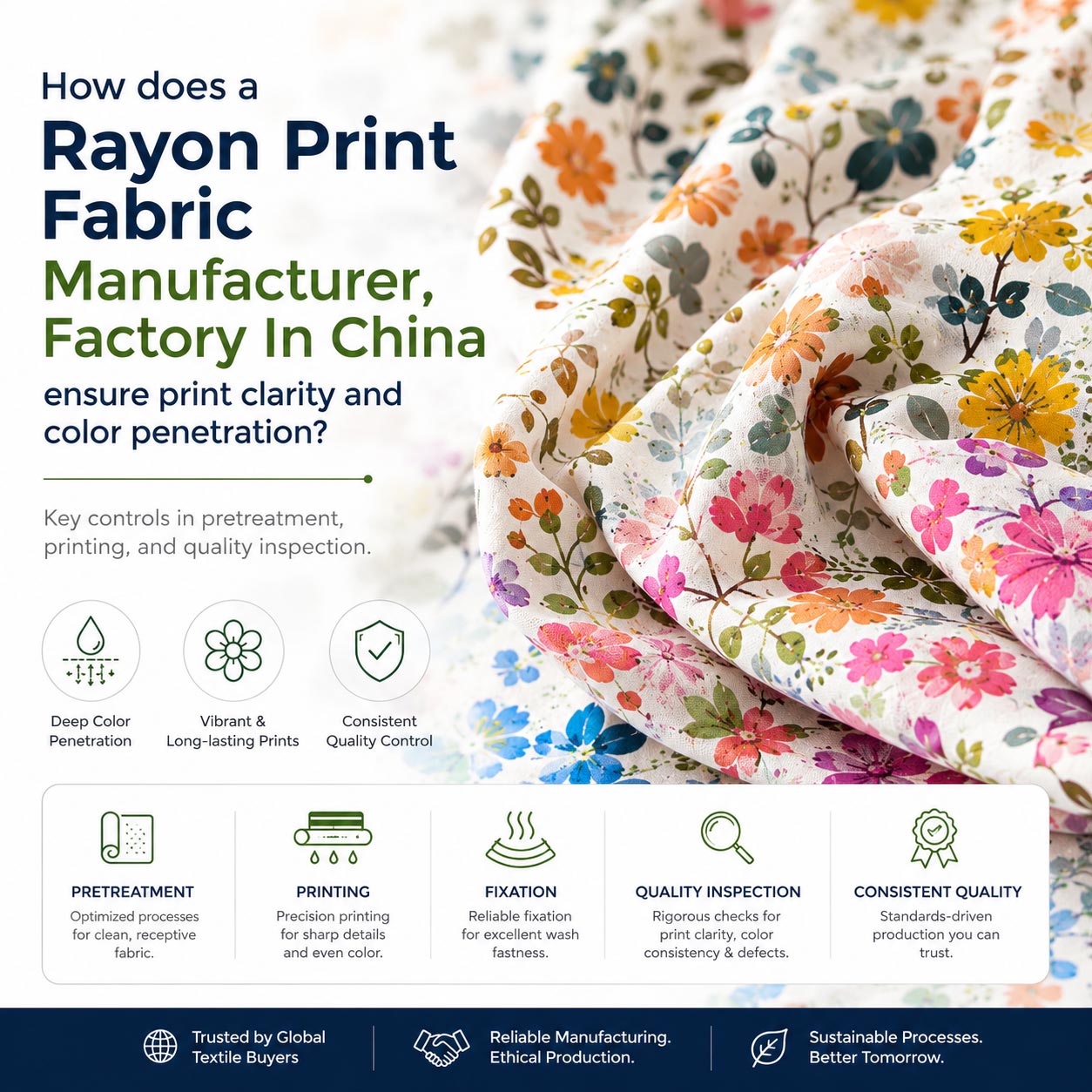
How Does a Rayon Print Fabric Manufacturer, Factory In China Ensure Print Clarity and Color Penetration?
Direct Answer
A rayon print fabric manufacturer controls print clarity and color penetration by standardizing the base fabric, pretreatment, ink or paste viscosity, printing speed, color application, fixation and finishing. Bulk production is then compared with an approved strike-off for pattern edges, registration, color depth, reverse-side penetration and roll-to-roll consistency.
However, deeper penetration is not always better. The correct result balances clear pattern edges, strong face-side color and sufficient penetration without causing spreading, blurred motifs or excessive color loss.
Key Quality-Control Points
| Production stage | Main control point | Problem being prevented |
|---|---|---|
| Base-fabric inspection | Construction, GSM, width and absorbency | Uneven color absorption |
| Pretreatment | Cleanliness, moisture and surface condition | White spots and patchy printing |
| Strike-off | Pattern scale, color and penetration | Difference between artwork and bulk |
| Printing | Ink or paste volume, speed and pressure | Blurred edges or weak color |
| Registration | Alignment of print colors and repeats | Overlapping or misplaced colors |
| Fixation | Temperature, time and moisture | Poor colorfastness and low saturation |
| Washing and finishing | Removal of unfixed color and controlled softness | Bleeding, harsh hand feel or shade change |
| Final inspection | Clarity, shade and penetration across each roll | Inconsistent bulk quality |
1. Start with a Consistent Rayon Base Fabric
Print quality begins before the fabric enters the printing machine. Rayon is absorbent, so variations in construction, surface condition or moisture can create visible differences in color depth.
The factory should check:
- Fiber composition
- Fabric construction
- Yarn and greige-fabric lot
- GSM and width
- Surface hairiness
- Fabric moisture
- Absorbency
- Oil marks, stains and weaving defects
- Skewing or bowing
Plain-weave rayon, rayon twill and rayon slub do not absorb color in exactly the same way. A print recipe developed for one base fabric should not automatically be used for another quality.
Using greige fabric from a controlled production lot helps reduce differences between the approved strike-off and bulk production.
2. Pretreat the Fabric for Even Absorption
Pretreatment prepares the rayon surface to receive the ink, dye or printing paste evenly. If pretreatment is inconsistent, even accurate machinery cannot produce a stable print.
Depending on the printing method and color system, pretreatment may include:
- Removing oils and processing residues
- Controlling the fabric’s pH
- Applying a printing pretreatment
- Drying the fabric evenly
- Controlling residual moisture
- Smoothing the fabric before printing
Insufficient pretreatment may cause pale colors, white spots or uneven penetration. Excessive absorption may allow the color to spread sideways, reducing pattern clarity.
The goal is controlled absorption—not simply maximum absorption.
3. Approve a Physical Strike-Off Before Bulk Printing
A physical strike-off is one of the most important quality-control tools for custom rayon print fabric.
Before approval, buyers should check:
- Pattern scale
- Repeat size
- Print direction
- Motif edges
- Small lines and fine details
- Color saturation
- Color balance
- Reverse-side penetration
- Ground-color coverage
- Hand feel after finishing
Colors should not be approved only from a computer or phone screen. Displays, file formats and lighting conditions can make digital colors look different from the printed fabric.
The approved strike-off should be sealed or clearly coded. It then becomes the physical reference for bulk production and final inspection.
4. Control Digital Printing Parameters
Digital printing is often selected for detailed patterns, many colors and smaller fashion collections. Print clarity depends on the condition and settings of the digital printing system.
The factory should control:
- Print-head and nozzle condition
- Nozzle cleaning and testing
- Print resolution
- Droplet size
- Number of printing passes
- Fabric-feeding accuracy
- Printing speed
- Ink volume
- Color profile
- Drying conditions
Blocked or unstable nozzles can create missing lines, banding or uneven colors. Excessive ink volume may cause bleeding, while insufficient ink can make the print pale or leave too much white on the reverse side.
The fabric must also move evenly through the machine. Uneven feeding can distort motifs or create visible horizontal lines.
5. Control Rotary Screen Printing Parameters
Rotary screen printing is commonly used for larger orders and repeat programs. The factory must control both the screens and the printing paste.
Important factors include:
- Screen engraving accuracy
- Screen mesh
- Alignment between color screens
- Printing-paste viscosity
- Squeegee or blade pressure
- Screen speed
- Fabric speed
- Paste supply
- Repeat matching
If the printing paste is too thin, the color may spread beyond the motif edge. If it is too thick, it may not enter the fabric sufficiently.
Incorrect screen registration can cause outlines, overlapping colors or white gaps between motifs. The operator should therefore inspect the first printed meters before allowing the full production run to continue.
6. Balance Print Clarity and Color Penetration
Print clarity describes how cleanly the pattern, lines and motif edges appear. Color penetration describes how far the color enters the fabric structure and how much of the print is visible from the reverse side.
These two requirements must be balanced.
Insufficient penetration may cause:
- Excessive whiteness on the reverse side
- White marks around seams
- A pale appearance when the fabric moves
- Poor coverage on textured rayon
- Uneven appearance after garment construction
Excessive penetration may cause:
- Blurred motif edges
- Color spreading
- Reduced face-side saturation
- Lower definition in small details
- Increased risk of color bleeding
The correct penetration level depends on the fabric construction, print method, color depth and garment application. A lightweight dress fabric does not necessarily require the front and back to look identical.
Buyers should define the acceptable visual result using an approved physical sample instead of requesting “full penetration” without a measurable standard.
7. Adjust the Process for the Pattern and Color
Not every pattern should use the same printing settings. Large solid areas, dark grounds and fine outlines create different production challenges.
For example:
- Fine lines require precise application and controlled spreading.
- Dark colors may require stronger color application and more careful fixation.
- Large ground colors require even coverage across the full width.
- High-contrast patterns make registration errors more visible.
- Rayon slub fabric may require adjustments because its textured surface absorbs color unevenly.
The manufacturer should test the actual design on the selected base fabric before confirming the bulk recipe.
8. Control Steaming, Fixation and Washing
Printing is not complete when the color first appears on the fabric. The color must be properly fixed according to the selected dye or pigment system.
The factory should control:
- Fixation temperature
- Fixation time
- Steam or heat conditions
- Fabric moisture
- Washing sequence
- Removal of unfixed color
- Drying conditions
Insufficient fixation can cause weak color saturation and poor washing or rubbing fastness. Excessive heat or unsuitable processing may affect the rayon fabric’s softness, width or shrinkage.
After fixation, unfixed color should be removed without washing away too much of the approved shade.
9. Maintain the Approved Hand Feel During Finishing
A print may look clear but still be unsuitable if the finishing process makes the rayon fabric too stiff or changes its drape.
The factory should compare the finished bulk fabric with the approved sample for:
- Softness
- Drape
- Surface smoothness
- Width
- GSM
- Shrinkage
- Color change
- Pattern distortion
Finishing chemicals and mechanical treatments must be controlled because they can influence both the appearance and hand feel of the printed fabric.
10. Inspect the Beginning, Middle and End of Production
Checking only one small cutting is not enough to represent an entire order. The manufacturer should inspect different sections of the production run.
Recommended inspection points include:
- Beginning, middle and end of each printing batch
- Left, center and right sides of the fabric
- Different rolls from the same order
- Areas containing fine lines and solid colors
- Roll joins and production restarts
Inspectors should look for:
- Blurred pattern edges
- Poor registration
- Missing print areas
- Pinholes or white spots
- Streaks and banding
- Uneven penetration
- Shade variation
- Color migration
- Incorrect repeat size
- Skewed or bowed patterns
- Oil marks and stains
Rolls with noticeable shade differences should be identified and separated rather than mixed randomly in the same garment cutting lot.
11. Test Colorfastness and Shrinkage
A visually clear print is not automatically a durable print. Buyers should confirm the relevant performance tests before shipment.
Common tests include:
- Colorfastness to washing
- Dry rubbing fastness
- Wet rubbing fastness
- Colorfastness to perspiration
- Water fastness
- Shrinkage in the length and width
- Fabric skewing or bowing
Dark colors and high-contrast designs usually require closer attention to wet rubbing and washing performance.
The test method, required grade and washing conditions should be written into the purchase order. Terms such as “good colorfastness” are too subjective for bulk-quality control.
Digital Print vs Rotary Print Quality Control
| Quality factor | Digital printing | Rotary screen printing |
| Fine pattern details | Usually stronger for detailed artwork | Depends on screen engraving and mesh |
| Color registration | Controlled digitally | Requires accurate screen alignment |
| Main penetration control | Pretreatment, ink volume, passes and speed | Paste viscosity, pressure, mesh and speed |
| Common defects | Banding, missing nozzles and uneven feeding | Misregistration, paste marks and uneven pressure |
| Suitable order type | Smaller orders and multiple designs | Larger, repeat production |
| Bulk consistency focus | Nozzle condition and color profile | Recipe, viscosity and screen settings |
Neither method is automatically better for every order. The correct choice depends on the pattern, order quantity, target cost, base fabric and required print effect.
What Should Buyers Confirm Before Bulk Production?
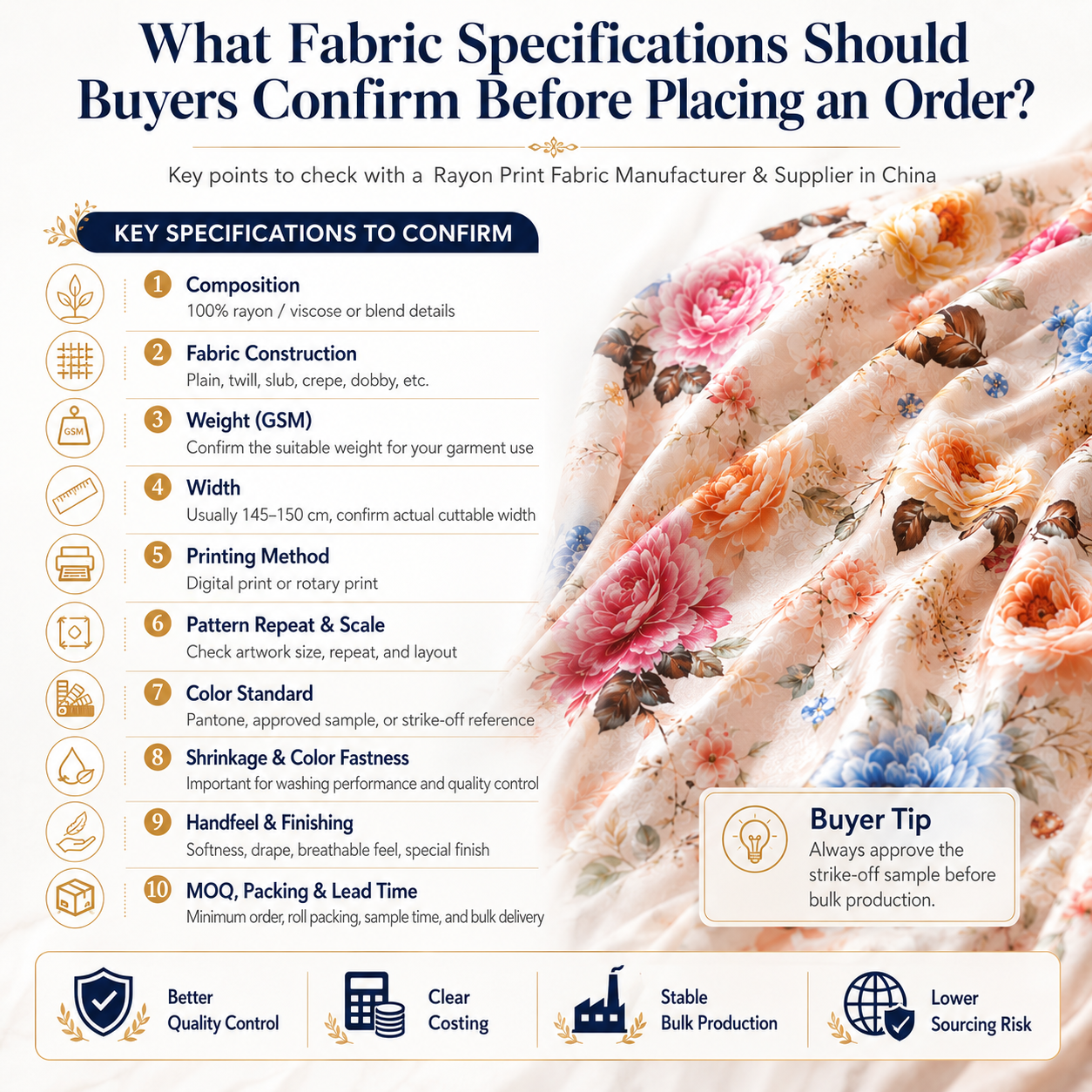
Buyers should ask the Rayon Print Fabric Manufacturer, Factory In China to confirm:
- The exact base-fabric composition and construction.
- Target GSM and usable width.
- Digital or rotary printing method.
- Pattern repeat, scale and direction.
- Approved physical strike-off number.
- Required front-side clarity.
- Acceptable reverse-side penetration.
- Color standard and viewing light source.
- Colorfastness and shrinkage requirements.
- Bulk shade and defect tolerances.
- Inspection method.
- Procedure for handling rejected rolls.
- Records required for future repeat orders.
These requirements should be included in the purchase order or technical specification sheet.
Frequently Asked Questions
What causes unclear printing on rayon fabric?
Unclear printing may result from excessive ink or paste, uncontrolled fabric absorption, incorrect viscosity, poor screen registration, unstable nozzles, excessive printing speed or unsuitable fixation conditions.
Should rayon print fabric have the same color on both sides?
Not necessarily. Many fashion prints are designed primarily for the face side. The required reverse-side penetration depends on the fabric construction, color and garment application. The buyer should approve an acceptable physical sample.
Does deeper color penetration mean better print quality?
No. Excessive penetration can reduce face-side saturation and cause blurred pattern edges. Good quality requires enough penetration for the intended garment while maintaining clear motifs and strong surface color.
Why does bulk printing sometimes look different from the strike-off?
Differences may be caused by a change in the base-fabric lot, moisture, pretreatment, printing recipe, machine settings, fixation or finishing. A factory should record the approved production parameters and compare bulk fabric with the sealed strike-off.
How can buyers check print penetration?
Buyers can compare the face and reverse sides under consistent lighting, inspect folded and moving fabric, and check areas containing dark colors and fine details. The result should be compared with the approved strike-off.
How does a factory prevent color differences between rolls?
The factory should use controlled base-fabric lots, standardized recipes, recorded machine settings and consistent fixation. Different rolls should be compared under the same light source and separated when noticeable shade variation occurs.
Is digital printing clearer than rotary printing?
Digital printing is often suitable for detailed, multicolor artwork, while rotary printing can produce stable results for larger repeat orders. Actual clarity depends on the base fabric, artwork, machinery and process control.
What sample should a buyer approve before production?
The buyer should approve a finished physical strike-off made on the intended base fabric. It should represent the required pattern scale, colors, clarity, penetration and final hand feel.
Conclusion
A reliable rayon print fabric manufacturer does not depend on the printing machine alone. Print clarity and color penetration are created through the combined control of the base fabric, pretreatment, printing parameters, fixation, washing, finishing and inspection.
For buyers, the most effective way to reduce bulk-quality disputes is to approve a physical strike-off and convert visual expectations into written production standards. The standard should cover pattern clarity, reverse-side penetration, shade tolerance, colorfastness, shrinkage and defect acceptance.
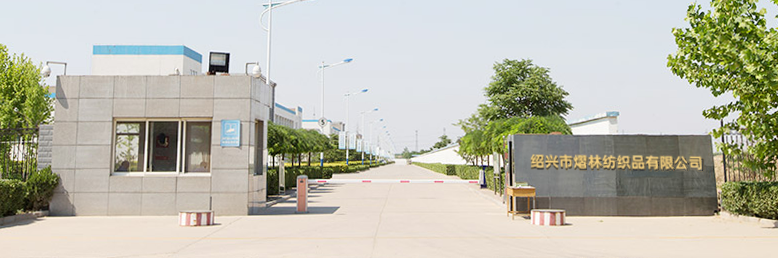
Shaoxing Yilin Textile supports custom rayon print fabric development through digital and rotary printing. Buyers can provide the intended garment, base-fabric requirement, pattern artwork, target color and order quantity to develop a suitable strike-off and bulk-production plan.

Leave a comment
This site is protected by hCaptcha and the hCaptcha Privacy Policy and Terms of Service apply.