
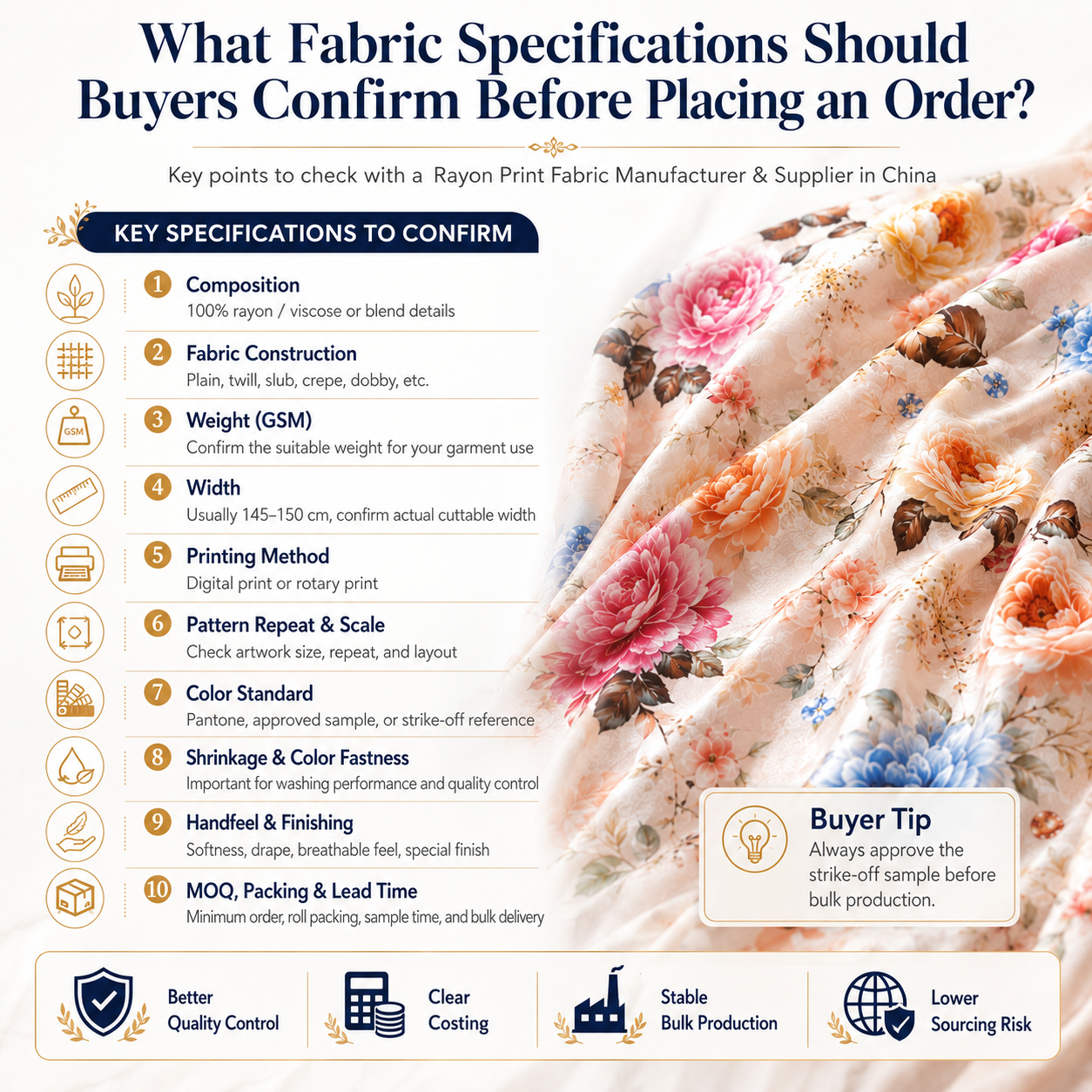
What Fabric Specifications Should Buyers Confirm with a Rayon Print Fabric Manufacturer & Supplier in China Before Placing an Order?
Direct Answer
Buyers should confirm the fiber composition, fabric construction, GSM, usable width, print method, pattern repeat, color standard, shrinkage, colorfastness, finishing, MOQ, quantity tolerance, roll length, packaging and testing requirements. All approved specifications should be recorded on the purchase order before bulk production begins.
Quick Rayon Print Fabric Specification Checklist
| Specification | What the buyer should confirm |
|---|---|
| Composition | 100% rayon or a rayon blend |
| Fabric construction | Plain, twill, slub or another base fabric |
| Weight | Required GSM and acceptable tolerance |
| Width | Full width and usable printed width |
| Printing method | Digital printing or rotary screen printing |
| Pattern details | Design file, scale, repeat size and layout |
| Color standard | Pantone, color swatch or approved strike-off |
| Print quality | Registration, penetration and surface clarity |
| Shrinkage | Lengthwise and widthwise results |
| Colorfastness | Washing, rubbing and perspiration standards |
| Finishing | Soft finish, preshrinking or other treatments |
| MOQ | Per design, colorway or total order |
| Quantity tolerance | Accepted over-delivery or under-delivery |
| Packaging | Roll length, tube, label and outer packing |
| Lead time | Sampling and bulk production schedule |
1. Fiber Composition
The buyer should first confirm whether the fabric is 100% rayon or a rayon blend. In international textile sourcing, rayon and viscose are often used to describe the same regenerated cellulose fiber, but the exact composition must still appear on the quotation, sample label, purchase order and test report.
The manufacturer should also confirm whether the composition may vary within an agreed tolerance. If a specific fiber content is required for garment labeling or import compliance, laboratory testing should be arranged before shipment.
2. Base Fabric Construction
The same print can look and feel different on different rayon base fabrics. Buyers should therefore confirm the construction instead of ordering only by a product name such as “rayon print fabric.”
Common options include:
- Rayon plain-weave fabric
- Rayon twill fabric
- Rayon slub fabric
- Rayon crinkle fabric
- Rayon-rich blended fabric
The construction affects texture, drape, opacity, print definition, sewing performance and final garment appearance. A physical cutting or hanger sample is useful for confirming the base quality before developing the print.
3. Fabric Weight and GSM Tolerance
Rayon print fabric is commonly available in approximately 90–160 GSM, depending on its construction and intended application. Lightweight qualities are often selected for summer dresses, blouses and beachwear, while higher weights may provide better coverage and structure for skirts, trousers or coordinated sets.
Buyers should specify:
- Target GSM
- Accepted GSM tolerance
- Testing condition
- Whether the GSM is measured before or after finishing
A buyer should not rely only on the nominal weight. Even a small GSM difference can affect opacity, drape, fabric consumption and garment cost.
4. Full Width and Usable Width
The quoted width may refer to the total fabric width rather than the usable printed width. Buyers should ask the supplier to state both measurements clearly.
A common rayon print fabric width is around 145–150 cm, but the usable width can be narrower because of the selvedges or printing margins.
Confirm:
- Full fabric width
- Usable cutting width
- Printed width
- Width tolerance
- Whether the quotation is based on meters or kilograms
Accurate usable-width information helps garment factories calculate marker efficiency and fabric consumption.
5. Digital Print or Rotary Screen Print
The printing method should be selected according to the order quantity, pattern complexity, color requirements and target cost.
Digital printing
Digital printing is suitable for detailed artwork, multiple colors, smaller orders and fashion collections that require frequent pattern changes. A typical MOQ may be around 200–500 meters per design, depending on the base fabric and production arrangement.
Rotary screen printing
Rotary printing is generally more economical for larger repeat orders. However, it requires screen preparation and normally has a higher MOQ. For example, some production programs may start from approximately 4,500 meters per design, divided across several colorways.
MOQ and pricing vary between factories, so buyers should obtain written confirmation for the specific design.
6. Pattern Repeat, Scale and Artwork
Before strike-off sampling, the buyer should confirm:
- Original artwork format
- Pattern dimensions
- Repeat size
- Print direction
- Motif scale
- Number of colorways
- Placement or all-over layout
- Ownership of the pattern file
A pattern that looks correct on a computer screen may appear too large or too small on fabric. The strike-off should therefore be reviewed at actual scale before bulk printing.
For repeat orders, buyers should ask the supplier to retain the approved artwork file, color references, base-fabric code and production records.
7. Color Standard and Bulk Color Tolerance
Colors should be approved through a physical strike-off instead of a digital screen image. Screens, lighting conditions and file settings can all change how a color appears.
The approval process should identify:
- Pantone reference or buyer’s color swatch
- Approved strike-off number
- Viewing light source
- Acceptable color difference
- Procedure for shade variation between rolls
- Whether one order may contain different dye lots
The supplier should compare bulk production with the approved strike-off and separate rolls with noticeable shade differences.
8. Print Penetration and Surface Quality
Print penetration refers to how well the color enters the fabric rather than remaining only on the surface. The required penetration level depends on the fabric construction, color depth and garment application.
Buyers should check:
- Print clarity
- Color saturation
- Penetration on the reverse side
- White marks after stretching or sewing
- Print registration
- Missing print areas
- Streaks, spots or color migration
For light rayon fabrics, buyers should also check whether the printed surface becomes pale or shows excessive reverse-side whiteness when the garment moves.
9. Shrinkage Requirements
Rayon absorbs moisture easily and can shrink if the fabric structure and finishing are not properly controlled. Buyers should request both lengthwise and widthwise shrinkage results.
Depending on the fabric construction and finishing, a target such as approximately 3–5% may be achievable, but the supplier should test the exact base fabric and print process instead of guaranteeing a general figure.
The purchase order should define:
- Test method
- Washing temperature
- Drying method
- Number of wash cycles
- Maximum lengthwise shrinkage
- Maximum widthwise shrinkage
Garment factories should use the approved result when preparing patterns and planning cutting allowances.
10. Colorfastness Standards
Colorfastness requirements should match the garment’s target market and care instructions. Buyers may request tests for:
- Colorfastness to washing
- Dry rubbing
- Wet rubbing
- Perspiration
- Water
- Light, when required
Dark colors and high-contrast prints require particular attention. Buyers should specify the required grade and test method rather than simply writing “good colorfastness.”
If third-party testing is needed, the testing organization, test items and responsible party for the cost should be confirmed before production.
11. Hand Feel and Finishing
The finishing process influences softness, drape, appearance and sewing performance. Buyers should compare the strike-off with the approved base-fabric quality because printing and finishing may change the original hand feel.
Possible requirements include:
- Soft hand feel
- Preshrinking
- Sandwashed effect
- Anti-pilling treatment
- Wrinkle or crinkle finish
- Reduced surface hairiness
- Specific drape or fluidity
Descriptions such as “soft” or “smooth” are subjective. A sealed physical sample is a more reliable bulk-production standard.
12. MOQ, Quantity Tolerance and Roll Length
MOQ should be confirmed by design, colorway and base-fabric quality. Buyers should also ask whether the MOQ refers to the ordered quantity or the finished shippable quantity.
The purchase order should state:
- MOQ per design
- MOQ per colorway
- Permitted over-delivery or under-delivery
- Minimum acceptable roll length
- Maximum number of short rolls
- Whether defective sections are included in the measured length
These details prevent disagreements when the final quantity differs slightly from the original order.
13. Fabric Inspection and Defect Tolerance
Buyers should agree on an inspection standard before bulk production. Depending on the order, the supplier may use a four-point inspection system or a mutually agreed internal standard.
Important inspection points include:
- Printing defects
- Holes or tears
- Oil marks
- Weaving defects
- Uneven width
- Shade variation
- Skewing or bowing
- Short roll length
- Incorrect labels or packing
For garment factories using automatic spreading, roll tension, edge alignment and fabric skew should also be checked.
14. Packaging and Roll Requirements
Packaging should match the buyer’s warehouse, cutting and transportation requirements. Buyers can specify fixed-length rolls or natural roll lengths.
Confirm:
- Meters or yards per roll
- Fixed-length or natural-length rolls
- Maximum roll diameter
- Paper tube strength
- Inner plastic protection
- Woven bag or outer plastic packing
- Shipping marks and barcode labels
- Fabric code, color and roll number
For example, some Brazilian buyers require fixed 75-meter rolls, while other markets may accept natural rolls of approximately 100–150 meters. The exact packing method should be written into the order.
15. Sampling, Lead Time and Bulk Approval
A clear approval process reduces the risk of the bulk fabric differing from the original request.
A typical process includes:
- Confirming the base fabric.
- Submitting the print artwork.
- Producing a strike-off.
- Approving color, pattern scale and print quality.
- Confirming the sealed sample.
- Starting bulk production.
- Inspecting and testing the finished fabric.
Strike-off sampling may take approximately 5–7 days, while bulk printed orders may require around 20–25 days after approval and deposit. Actual timing depends on greige availability, print method, finishing requirements and order quantity.
Recommended Purchase Order Specification
A complete rayon print fabric order should include the following information:
Product: Rayon print fabric
Composition: 100% rayon or confirmed blend
Construction: Plain, twill, slub or specified quality
Weight: Target GSM with tolerance
Width: Full width and minimum usable width
Printing method: Digital or rotary
Pattern: Approved artwork and repeat size
Color: Approved strike-off reference
Shrinkage: Maximum lengthwise and widthwise percentage
Colorfastness: Required grades and test methods
Finishing: Approved hand feel and treatment
Quantity: Total quantity and tolerance
Roll length: Fixed or natural length
Inspection: Agreed defect standard
Packaging: Tube, label and outer packing requirements
Lead time: Confirmed shipment date
Frequently Asked Questions
What is the most important specification when buying rayon print fabric?
There is no single specification that can be checked independently. Composition, construction, GSM, usable width, printing quality, shrinkage and colorfastness work together to determine whether the fabric is suitable for the intended garment.
Is 90–130 GSM rayon print fabric suitable for dresses?
Yes. Rayon print fabric in this weight range is commonly used for lightweight dresses, blouses, skirts and summer garments. Buyers should also evaluate opacity, drape and usable width because GSM alone does not determine suitability.
Should buyers approve a digital image or a physical strike-off?
A physical strike-off is recommended. It allows the buyer to inspect the actual color, pattern scale, penetration, hand feel and interaction between the print and base fabric.
Why should usable width be confirmed separately?
The usable width excludes selvedges and unprinted margins. Garment consumption calculated from the full width may be inaccurate if part of that width cannot be used for cutting.
How can buyers reduce differences between samples and bulk production?
Buyers should approve a sealed sample, record the base-fabric code and strike-off number, define measurable tolerances and require the supplier to compare bulk production against the approved standard.
What documents should be confirmed before shipment?
Depending on the order, buyers may request a commercial invoice, packing list, test report, inspection report, certificate of origin and other market-specific documents. Requirements should be confirmed before production.
Conclusion
Before placing an order with a Rayon Print Fabric Manufacturer & Supplier in China, buyers should convert every important requirement into a measurable written specification. Pattern appearance and price are only part of the decision.
Confirming the base fabric, GSM, usable width, printing method, color standard, shrinkage, colorfastness, defect tolerance and packaging helps protect garment quality, control fabric consumption and make repeat orders more consistent.
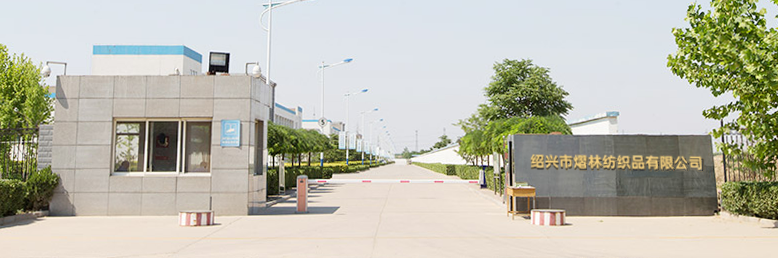
Shaoxing Yilin Textile supports custom rayon print fabric development, including base-fabric selection, digital and rotary printing, strike-off sampling, bulk quality control and market-specific roll packaging. Buyers can provide the intended garment, target GSM, order quantity and pattern artwork to receive a more accurate production proposal.

Leave a comment
This site is protected by hCaptcha and the hCaptcha Privacy Policy and Terms of Service apply.